A color activity can use a book already on the couch, three reusable cards, a few crayons, or a brush and water. Each leaves a different set of things to put away. This list ranks four examples by the cleanup actions described here, from closing one book to emptying and drying a water container. The order is a practical estimate, not the result of a timed test: spills, accessibility needs, available storage, and the materials you already have can change it.
How the ranking works
We consider both the cleanup actions and the number of separate materials in each example, not a measured time. The picture-book activity needs one book closed and returned. The card activity requires collecting and storing three loose cards. Crayon drawing requires returning two crayons and deciding where the paper belongs. Water painting adds emptying a container and drying a brush and work area if wet.
The list assumes the book, cards, crayons, and brush are already available; gathering them is preparation, not cleanup. It also assumes a small, controlled water activity without a spill. These conditions are examples, not a guarantee. If your crayons are already stored in a tray or your book is difficult to return, the practical order may differ.
The comparison uses one child and one adult, one location, and the specified number of materials. It does not rank the activities by educational effectiveness, developmental difficulty, or how much a child will enjoy them. A family can choose a lower-ranked option because the desired activity is more important than minimizing cleanup.
If a child uses an adapted tool, include that tool in your own cleanup plan instead of assuming the examples cover every need. A larger grip, a card stand, or a protective mat may add something to put away while making the activity possible. The ranking is a planning aid, not a reason to remove useful support.
No stopwatch was used for this list. “Fewer items and actions” does not establish a measured time: returning one book to a distant shelf might take longer than putting three cards into an envelope on the table. Use the described actions to estimate what will be manageable in your own space.
1. Find a color in a picture book
Choose a picture book the child is willing to look at and open a page with a clearly visible object. Point to a red mitten in the illustration, for example, and say, “I see a red mitten. Can you find another red item on this page?” Only ask for another if the actual page has one; otherwise ask the child to point to the mitten or describe another feature.
Let the child respond by pointing, looking, speaking, or using an agreed communication method. If the child calls the mitten another color, compare it with a reference rather than treating the book’s reproduction as a perfect color standard. Lighting, printing, and individual color perception can affect what each person sees.
Cleanup in this version is closing the book and returning it to its usual place. No pieces are removed from the book. If the book is borrowed, follow its care rules; the activity does not require drawing in it, adding stickers, or turning pages faster than the child wants.
Before the child looks, check the actual page for the feature you plan to mention. A page with a single red mitten supports “Find the red mitten”; it does not support “Find two red mittens” unless two are visible. A clear prompt prevents the child from searching for something the picture does not contain.
If the picture includes a red apple and a red coat, invite the child to point to either one and name the object if desired. Then compare the two areas: “Both look red to me, although one may look darker.” The purpose is to notice a shared visible feature, not to claim the printed colors are numerically identical.
Let the child choose a page or close the book when finished. The adult can hold the book at a comfortable angle without requiring the child to touch it. When returning a library book, keep any personal notes on a separate sheet; the book remains a reusable shared object.
2. Match reusable color cards
Place a large red reference card on a table, with one red and one blue candidate beside it. Ask, “Which card looks most like this red one?” Keep the reference visible. Check that all three cards are distinguishable and easy to see under the actual light.
The child may place the matching card beside the reference, point to it, or tell a partner where it should go. A card can also include a word or symbol as an additional cue, but say when the cue is being used. A successful match based on a symbol does not by itself show that the child distinguished the colors.
Cleanup consists of gathering the cards and putting them in an envelope or designated place. Reusable cards do not need to be cut during the activity. If cards are lost or scattered, cleanup takes more work than this example assumes; a small tray can keep them together, although the tray itself then needs to be put away.
For this example prepare three cards: a red reference, a second red candidate, and a blue candidate. Present the two candidates side by side, with the reference above them. If the child selects blue, ask what feature guided the choice before demonstrating a comparison. The child may have been following a different rule or may perceive the colors differently.
After one match, exchange the positions of the candidates and ask again only if the child wants another turn. If the same location is chosen, do not infer a cause from one response. Point to the reference and compare the candidates under the same lighting. A participant may also ask to stop or choose a different pair.
Place the envelope near the workspace before starting if easy cleanup is the priority. When finished, count the three cards as they go in, or let the child direct an adult to collect them. Counting is optional and should not replace the color question unless both participants choose to add it.
3. Make a crayon color sample
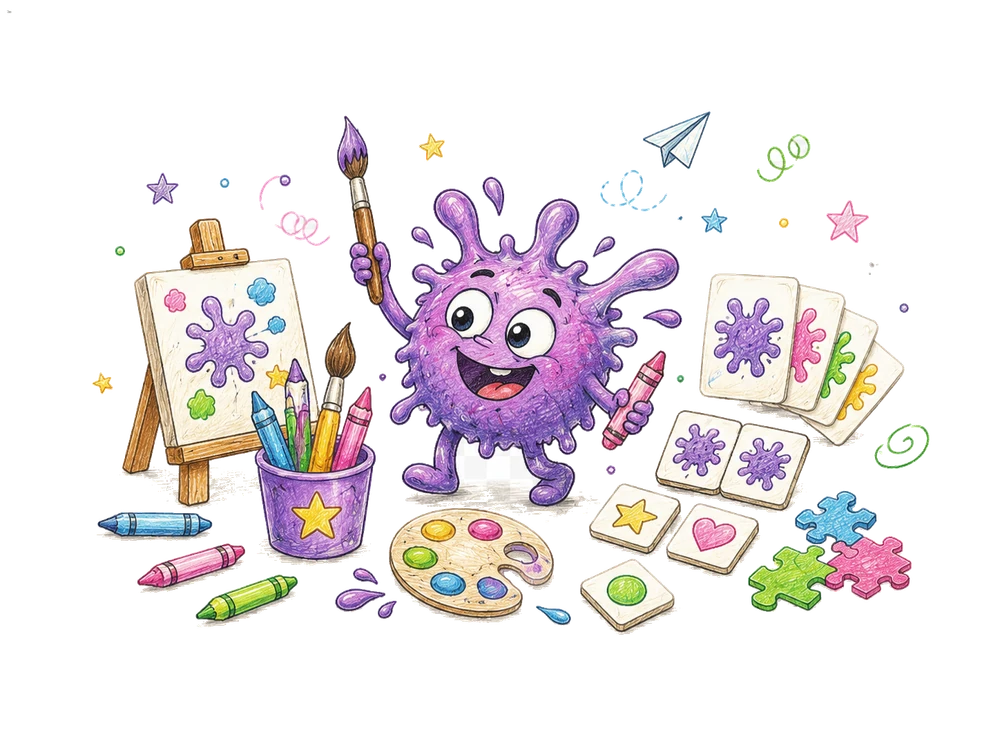
Offer a sheet of paper and two crayons, such as red and blue. The child can make one mark with each, choose a color for a simple shape, or direct an adult to draw. Ask a specific question: “Which mark did you make with the blue crayon?” Keep the crayon beside the mark if the child wants a visible reference.
A paper label can record the color name if that is useful. Crayons may vary in appearance on paper, so look at the actual mark instead of assuming the wrapper perfectly predicts it. A child who cannot comfortably grip a crayon can point to a color or use a different accessible tool appropriate for the surface.
At the end, return the two crayons and decide whether to save, recycle, or discard the paper according to the household’s usual practice. Check the work surface for stray marks or crayon pieces. Cleanup is usually more involved than collecting cards because there is a new paper artifact and a drawing tool, but the exact amount depends on what happened.
Draw two separate boxes on the paper before offering the crayons. The child can make a red mark in one and a blue mark in the other, or choose different colors. Keep the task focused on the actual choices: if the child selects green instead, label or describe the green mark rather than insisting it is blue.
If a crayon rolls away, a shallow tray can keep it within reach. The tray is an additional item to return, so include it when comparing cleanup with the card activity. Its usefulness may outweigh that extra action, especially when it allows the child to select a tool independently.
Compare a short line and a filled area made with the same crayon. The filled area may appear stronger because more of the paper is covered. Describe the visible difference without assuming the child used a different crayon. If the marks are too faint to compare, adjust the paper or tool with the child’s consent.
4. Paint with water on a suitable surface
Provide a broad brush, a small stable container with a little water, and a surface that the adult has checked is suitable for temporary water marks. Some surfaces darken when wet and lighten as they dry; this is not the addition of pigment. Try an inconspicuous area first and follow the surface maker’s care instructions.
Invite the child to brush a short line and observe how the wet area looks compared with the dry area. Ask, “What changed when the water touched this spot?” If the surface does not visibly change, record that observation and choose another activity; do not promise that every material will show the same effect.
An adult stays nearby, keeps water away from electrical equipment, and chooses a stable working area. When finished, empty the container safely, dry the brush and wet surface as appropriate, and return the materials. A spill adds cleanup, which is why this option is last under our assumptions.
Choose a water-tolerant surface that can be returned to its ordinary condition, such as a reusable board specifically intended for water drawing if one is available. Do not use books, untreated furniture, electronics, or a wall merely because they are nearby. The adult checks the actual surface and follows its instructions before inviting the child to try it.
Use only as much water as the brush needs to make a small mark. A stable container placed away from the edge reduces the chance of a spill but cannot eliminate it. If water spills, pause and dry the area before continuing. The predicted cleanup order does not count an unplanned spill as part of every session.
The brush can be used by an adult following the child’s direction. The child might point to a place for a line and then indicate where to make a second line. This preserves a meaningful choice without requiring the child to handle the water or the brush.
When the activity ends, check the surface before storing it: a damp board or brush may need time to dry. Emptying water, drying materials, and returning them are separate actions in this example. Depending on the surface, the adult may need to consult its care instructions rather than applying a general cleaning method.
Why water painting belongs in a color comparison
Water painting differs from using a red or blue material: the brush carries water, not colored paint. On some surfaces the wet area looks darker. This gives a child a chance to compare appearance before and after wetting, but the activity does not teach that water itself is a new paint color.
If the goal is naming a particular hue, the book or cards may answer that question more directly. If the goal is noticing a change in appearance on one surface, water painting offers a different observation. Choose the task to match the question rather than treating all four activities as interchangeable.
Ask the child to compare a wet patch with an adjacent dry patch on the same material. If the wet patch appears darker, record that observation as a change in appearance. Do not call it a new pigment or assume the same effect will occur on another surface.
Once a patch dries, the participants can look again. If it resembles the surrounding surface, note that result; if it does not, avoid promising that waiting longer will restore it. This is why a suitability check before the activity matters. The comparison is observational and does not establish an exact drying time.
A quick comparison before choosing
For the fewest separate items, use a book with a suitable page already available. For a movable match, choose reusable cards. For a mark the child can keep, use paper and crayons. For a temporary wet mark, use water only on a checked surface. These recommendations describe the examples here; individual preferences and access needs can change the choice.
For a shared table, check whether each participant can see or reach the selected material. A partner can hold a card or move a crayon according to the child’s instructions. If an activity requires a material that is not available or not suitable, choose another rather than improvising an unsafe substitute.
A child who wants to carry an example to another room might prefer a card, while a child who wants a picture to keep might choose crayons. A temporary water mark serves a different purpose. Ask what the child wants to make or investigate before choosing solely on the basis of cleanup.
Consider storage location as well as the list rank. If cards are already on a nearby tray and the book is on a high shelf, the card activity may be simpler to put away. Write down your own order after trying the activities if useful, but label it as your household’s experience rather than a measured universal ranking.
Possible responses and adult follow-ups
Child: “The mitten is orange.” Adult: “You see orange. Let’s compare it with these two reference cards under the same light.” Printed illustrations and screens can vary, and people do not always perceive color in the same way. The adult should not assume disagreement is carelessness or a problem that the activity can diagnose.
Child: “I want to point instead of drawing.” Adult: “You can point to the crayon you choose, and I can make a mark if you want.” The adult checks the choice before drawing. The child’s control over the selection is separate from whether the child holds the tool.
Child: “The wet line disappeared.” Adult: “Let’s look at it now. The surface looks dry again; we did not add colored paint.” If the mark remains, describe that result and follow the surface’s care instructions. Do not claim the mark must disappear on every material.
Child: “These two reds are not the same.” Adult: “What difference do you notice?” One card may appear darker, or the child may be attending to a border. Compare the actual cards without insisting that a broad shared color word means they must look identical.
Child: “The blue crayon made a pale mark.” Adult: “Let’s compare the mark with the crayon and the paper.” The paper color, amount of wax, and lighting can affect appearance. Describe what can be seen rather than asserting one cause without testing it.
Child: “I do not want the wet brush.” Adult: “We can choose the book or the cards.” The child does not need to tolerate an uncomfortable material to complete a color activity. If the adult uses the brush instead, the child can decide whether to observe or end the activity.
A common mix-up: color and object name
A child may identify the object correctly while using a different color word, or match two colors without naming either one. Ask one question at a time: “Where is the mitten?” is an object question; “Which card matches this red card?” is a comparison question. A color label is a further piece of information.
If the red card also has a star and the blue card has a circle, the child may use shape to choose. That can be a helpful access support, but the adult should not interpret the response as proof of color discrimination. To explore color matching specifically, use otherwise similar cards and still offer accessible alternatives.
A red apple and a green apple share an object name while their visible colors differ. Two red items can have different names. Use the actual pictures or objects available to demonstrate these separate categories, and avoid asking the child to infer a color from an object’s name alone.
An answer can depend on the question’s wording. “Show the red card” asks for a selection by a color label; “Show the card with the star” asks about a shape. If both features are present on one card, either cue might influence the response. State which question is being explored.
Make the activity easier to access
Use large materials, clear boundaries, and a comfortable viewing distance. Ask what the child can see rather than assuming that a particular pair of colors works for everyone. Patterns, labels, or different shapes can support participation when color alone is not a reliable cue; describe the feature actually used.
A child can observe, choose a card, or direct an adult without touching water or holding a crayon. If a material has an unpleasant texture or smell, replace it or select another activity. Participation and consent matter more than completing the fourth option on the list.
Before using a color-only prompt, ask whether the difference is visible to the participant and provide an alternative when needed. A participant can compare labeled cards, follow a high-contrast outline, or describe another feature. Do not use the activity to diagnose color vision or assume a particular diagnosis from an answer.
If the child uses a communication board, place it where it remains reachable alongside the book or cards. The adult should wait for the child to finish the selection and confirm an ambiguous signal. Cleanup includes returning the board to its usual accessible location, not taking it away before the child is done.
Add a next step
After matching red cards, introduce a third color only if the child wants another choice. Keep one reference card and ask for a match among two candidates. Check the answer against the visible reference, not against a hidden rule about which object should be selected.
For crayon work, compare the same crayon on two suitable papers, such as white and light gray. The mark may look different against each background. Record what the participants see and avoid claiming that the crayon itself has changed color based solely on a different-looking contrast.
For a water mark, make two separate lines on the same checked surface at different times. Observe which was made first and whether their appearances differ at that moment. This is a small comparison, not a measurement of drying time; results depend on the surface and conditions.
For a matching challenge, make two pairs of cards and mix their order. The child can pair the red cards and the blue cards while the adult asks how each choice was made. If labels or shapes differ, acknowledge that they offer additional cues. The activity remains useful even when color is not the only cue.
For a book challenge, compare two illustrations of the same object on different pages if the book actually contains them. Ask what appears similar and different, including color, size, or position. The answer depends on the images in hand; do not promise that a particular book has the necessary pages.
For the crayon sample, save the paper and look at it later in a different part of the room. Ask whether the marks look the same under the new lighting. This is a comparison of appearance in two settings, not a controlled measurement of the pigment or a test of the child’s vision.
Continue with BrainHunters
If an appropriate color or matching activity is available in BrainHunters, inspect its actual images and instructions before beginning. The child can show a choice or ask a partner to operate the control. Screen settings and viewing conditions may affect appearance, so the screen and a paper card need not look identical.
Afterward, return to the selected physical activity and ask what the child noticed: a matching card, a crayon mark, or a wet and dry area. The response can be spoken, indicated, or recorded with assistance. Put away the materials that were actually used rather than following cleanup steps for every option.
A digital matching task may display colors differently from physical cards. Before asking the child to compare across screen and paper, look at both and describe any visible difference. A screen setting, the room’s light, and the printed material can affect appearance; the exercise should not require an exact match unless the task supports one.
If a suitable digital task is unavailable or the child prefers a physical choice, the book, cards, or crayons can stand alone. Record a specific observation such as “chose the blue card when the red reference was visible” rather than a broad label about the child’s abilities. Include any labels or other cues that were provided.
Helpful answers
Is the first activity always the quickest to clean up?
No. The order assumes the specified materials and no spills. Your room, storage, and the assistance needed may change the cleanup.
Can a child participate without naming colors aloud?
Yes. A child can point, choose between clearly labeled options, use a communication device, or describe a visible feature in another way.
Does water painting leave a permanent colored picture?
No. On a suitable surface, water may temporarily darken the area and then dry. Try the surface first and follow its care instructions.
Turn a little idea into an adventure.
Try a short activity together, then bring the discovery back into your day.
Colors and pattern practice