A short sentence can give a common word a job to do. In ‘I see the cat,’ the word the tells the reader which cat the sentence refers to; changing cat to dog leaves the high-frequency word in place while the meaning changes. This activity focuses on noticing, reading, and writing one target word in a few small sentences. It combines attention to the word's letters and sounds with a meaningful context, rather than asking a child to guess solely from a picture or memorize an unexplained shape. Use the example sequence as written or adapt the target to a word the child is learning with a teacher.
Choose one word and a sentence that makes sense
The example target is the. Write ‘I see the cat.’ on a strip of paper. This sentence gives the child a small number of words to track and a clear place to find the target. Use a familiar picture of a cat only to establish meaning; the printed words remain the evidence for what the sentence says.
A high-frequency word is a word encountered often in print. Frequency does not mean that every letter is unpredictable or that the entire word must be learned as a visual outline. Examine how the target is pronounced in the sentence and which letters represent its sounds. Some common words contain sound-spelling relationships the child may not have studied yet.
The can have a reduced pronunciation before a consonant and a different vowel pronunciation in other contexts or speech varieties. In the example sentence, say the naturally as your family or teacher would pronounce it, then discuss the spelling without insisting on an artificial pronunciation. If the child is working on a different word, use the same procedure with accurate examples for that word.
Materials and a short preparation
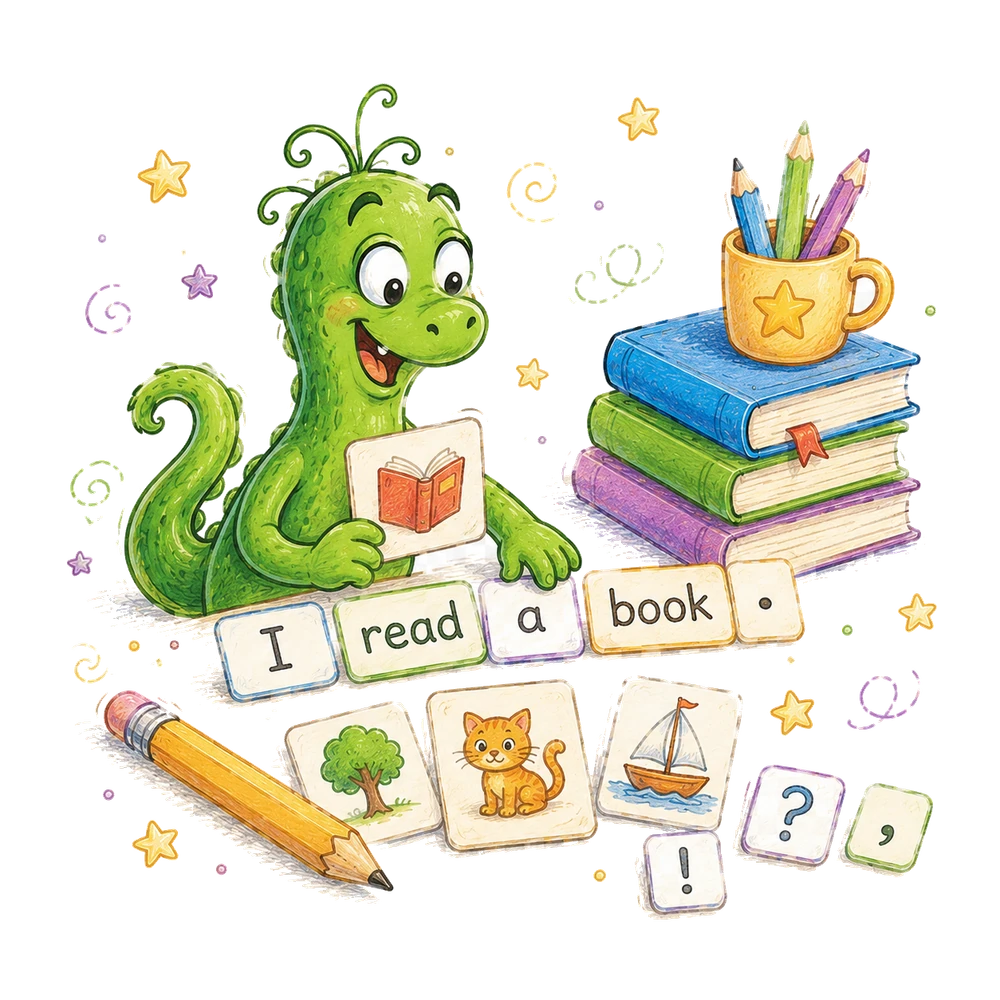
You need paper, a pencil, and a way to make three or four small word cards. Write one complete sentence strip: ‘I see the cat.’ Make separate cards for I, see, the, and cat. Add dog and a second the card if you want to change or repeat the sentence later. The punctuation can stay on the sentence strip instead of appearing on each movable card.
Choose print large enough to follow with a finger. Leave clear spaces between words so the child can distinguish one word from another. If the child benefits from pictures, draw a cat and a dog on separate cards and name them together before reading. A picture is an aid to meaning, not a substitute for checking the letters in the printed word.
If a teacher has provided a target word or spelling explanation, align the activity with that instruction. The adult can prepare and move the cards while the child points, speaks, or uses a communication device. No printer, purchased flashcards, or fixed number of repetitions is necessary.
A complete first sentence routine
Place the sentence strip in front of both readers. Read it aloud naturally once, pointing under each word as you say it. Tell the child the sentence describes seeing a particular cat; then return to the target word.
- Point to the word the and say it in the sentence. Ask the child to locate the same spelling on the separate word card.
- Name its letters in order: t, h, e. Notice that th works together to represent the first sound in this word; describe the vowel as it is pronounced in your sentence.
- Read the entire sentence again, moving a finger under one word at a time. Invite the child to say or indicate the when you reach it.
- Mix the cards I, see, the, and cat. Rebuild the sentence by comparing each card with the strip, including the spaces between words.
- Read the rebuilt sentence and check that the order matches the model. Point to the target once more and ask what word it is.
- If the child wants another round, replace cat with dog, read the new sentence, and notice that the remains the same word.
A model conversation about the
Adult: ‘Listen to this sentence: I see the cat. Which small word comes before cat?’ Child: ‘The.’ Adult: ‘Let's find it in the print. Here it is: t, h, e. In this word, t and h work together for the first sound.’ The adult points across the two letters and then to e while saying the naturally.
Child: ‘I thought that was see.’ Adult: ‘Let's compare the cards. See starts with s and has two e letters; the starts with t and h. We can check the letters and then read the sentence again.’ The adult places both cards where the child can see them, reads each, and invites another choice.
If the child points to the correctly but does not say it aloud, the adult can read the word and ask the child to locate its match. A spoken answer is one way to participate, not the only one. The exchange provides specific information about what the child recognized and which support was present.
Look closely at sounds and spelling
Say the target in the sentence, then say it on its own as naturally as possible. In common pronunciations of the, the first sound is the voiced th sound heard at the beginning of this. The letters t and h represent that sound together. The final e is part of the written word; its vowel sound can vary with pronunciation and context.
The child can trace or point under t-h together while the adult says the beginning sound once. Then point to e and discuss the vowel heard in the sentence. Do not require the child to divide the printed word into three separate spoken sounds merely because it has three letters. Letters and sounds are related, but their counts need not match.
For a different target, analyze its own spelling instead of copying this explanation. For example, in can, the three letters commonly correspond to three sounds; in said, the written vowel sequence needs a word-specific explanation. If unsure about a pronunciation or spelling relationship, check a reliable dictionary or the child's instructional materials before teaching it.
Keep the word order visible
Arrange the cards to match ‘I see the cat.’ Point under each card from left to right as you read. The gaps help show that the sentence contains four written words. The target the is one word, even though it has three letters. The period marks the end of the written sentence and is not another word to count.
If the child moves the cards into ‘I the see cat,’ read that order as written and ask whether it matches the model or sounds like the intended sentence. Compare one position at a time. The child can move the card that differs and then reread from the beginning.
Use the model for as long as it is useful. Removing it turns the task into a memory challenge and may prevent you from seeing whether the child can match the target spelling. When the child is ready, cover the model briefly, rebuild, and uncover it for a check; report that support when describing the result.
Change one word while keeping the target
Replace cat with dog to make ‘I see the dog.’ Read both sentences and ask what changed. The child can point to the last word and then to the unchanged target. This variation gives the a role in another meaningful sentence without pretending that the picture determines the printed word.
Try ‘I see the sun’ only if sun is a familiar word and the child can participate in reading or the adult supplies the needed words. For each sentence, check the actual print. An adult might ask, ‘Does this card start with c like cat or d like dog?’ when the child guesses from a picture without looking.
Keep the sentences grammatical and natural. A short sentence does not need to sound like a list of unrelated words. If the child suggests a different noun, write it clearly and read the resulting sentence together. The target is still the same word, while the noun supplies new meaning.
Find the target among similar-looking words
Place the, see, and cat cards on the table. Ask the child to find the. If necessary, read each card once, then compare its first letters and length. The begins with t-h; see begins with s; cat begins with c. Invite the child to check the whole spelling rather than choosing solely by the first letter.
For a more challenging comparison, add then. Both begin with the letters t-h-e, but then has a final n and is a different word. Read both cards and point out the added letter. Ask the child to find the exact sequence t-h-e with no extra letter at the end.
If visual similarity makes the task unnecessarily difficult, return to two distinct cards and keep the sentence strip visible. The aim is accurate recognition with useful evidence, not a trick question. Add then only when the child can benefit from attending to the full spelling.
Read the word in a new short sentence
Write ‘The dog can run.’ Read it aloud and point to The at the beginning. Compare its spelling with the lowercase the card. The initial capital T is used because it begins this sentence; the word is still the. The other letters remain h and e.
Ask the child to locate the target and compare the two forms. If uppercase and lowercase t are not yet familiar, provide both forms side by side and name them. Do not assume that recognizing a lowercase word automatically means the capitalized form will be recognized in a new position.
Read the whole sentence again. If dog, can, or run is unfamiliar, the adult can read that word so the target remains the focus. The child can still follow along and identify The. As the child learns more words, responsibility for reading the surrounding sentence can gradually change.
Respond when the child guesses from a picture
Show a cat picture and the sentence ‘I see the dog.’ A reader might say cat because of the picture. Explain that the picture and sentence do not match in this deliberately mixed example. Point to dog and compare its letters with the cat card; then choose either a matching picture or a matching sentence.
The example shows why pictures are useful for understanding but cannot determine every printed word. An adult can say, ‘Let's check what the letters tell us.’ For the target the, compare its exact spelling with the target card. For the noun, use the child's current decoding knowledge or provide the word.
Avoid withholding help until the child guesses correctly. Reading should remain meaningful, and a mismatch can be resolved together. Once the picture and sentence match, reread the sentence and ask what the word the refers to in that sentence.
Write the target with a model
Place the the card where the child can see it. Say the word, name the letters t-h-e, and invite the child to write or arrange letter tiles in that order. Compare the result with the card. If the letters are all present but out of order, point to the first difference and move one tile or revise one letter.
For example, if the child writes teh, acknowledge the three letters and compare their sequence with the model: t-h-e. The child can point to h and e in the model and decide which positions need to change. This feedback identifies the specific issue without requiring the whole word to be erased.
A child who cannot or does not want to write by hand can dictate the letters, choose tiles, type, or direct an adult. The instructional question is whether the sequence represents the target word. Handwriting practice can be a separate task with its own supports.
Move from copying to recall with a check
After writing the with the model visible, invite the child to look at the card, say or indicate the word, and then cover it briefly. Ask the child to write or arrange the letters from memory. Immediately uncover the model for comparison. This is a different task from copying, so a change in accuracy is useful information.
If a letter is missing, compare the attempt with the card from left to right. For example, an attempt of th has the first two letters but omits e. Add the missing letter and read the word again in the sentence. The child can keep the model visible in the next round if recall without it is not yet helpful.
Avoid an arbitrary target such as writing the word a fixed number of times without checking it. A few accurate attempts with a clear comparison provide more information than a page of copies made while attention has moved elsewhere. Stop or change the activity when the child asks.
Use the word to communicate a real message
Write ‘I see the moon’ after looking at a picture or seeing the moon outside, if that sentence fits the moment. Alternatively, write ‘The cup is red’ when a red cup is present. Read the message together and ask the child to find the target. The sentence should describe something both participants can identify.
Invite the child to choose the object or dictate a different sentence. The adult can write the unfamiliar words while leaving the target for the child to place or write. Read the complete message back and ask whether it expresses the child's idea. If not, revise the sentence together.
A message with a purpose gives the common word repeated use in context, but it should still be checked in print. A child can select the correct target card from two choices and place it in the sentence. Keep the rest of the task accessible so the child can focus on the intended word.
Compare two sentences with different meanings
Write ‘I see the cat’ and ‘I see a cat.’ Read both aloud. The words the and a are different, even though both sentences mention a cat. In an ordinary conversation, the often points to a cat the speaker expects the listener to identify, while a can introduce one cat without identifying a specific one. Meaning depends on the context of the conversation.
Use two toy cats to set up an example: choose one together, then say ‘I see the cat’ while pointing to the one both people have been discussing. In another scenario, a person spots a cat for the first time and says ‘I see a cat.’ The purpose is to notice that changing a small word can change how a sentence refers to something.
Do not require a young child to state a grammatical rule. They can choose the sentence that fits a simple scene and point to the different word. If the distinction is not useful for the current lesson, keep the original sentence and return to meaning later.
Try a two-person reading turn
The adult reads ‘I see’ and pauses at the target, inviting the child to say the, point to it, or select the matching card. The adult finishes with cat. On the next turn, swap roles if the child wants to: the child can direct when the adult pauses or choose which noun card goes at the end.
If the child supplies a different word, point to the printed target and compare it with the model card. Reread the sentence after the comparison. The pause should create an opportunity to use evidence, not pressure to respond within a fixed time.
Another partner can arrange the sentence incorrectly for the child to inspect, such as leaving out the. Read what is actually present and compare with the model. The child may place the missing card and explain how the completed sentence differs. This makes checking word order an explicit part of the task.
Simplify without losing the target
Start with the target card and one short sentence, both visible. Read the whole sentence to the child and ask for a point to the matching word. If identifying the small print is difficult, enlarge it or place a frame around the word while preserving its letters. The adult can move the frame according to the child's directions.
Use just two choice cards when a larger set is distracting. Make their spellings distinct at first, such as the and cat. Once the child can compare them with support, add a similar-looking card if it serves the lesson. Keep the model available rather than assuming that less support automatically means better learning.
A child can participate through speech, pointing, eye gaze, a switch, or a communication device. The adult should describe the actual response and assistance. For instance, selecting the from two visible cards after hearing the word differs from spelling it independently from memory; both are meaningful observations.
Add challenge through transfer and explanation
Give the child two short sentences with the target in different positions: ‘The dog can run’ and ‘I see the dog.’ Ask them to find the word in each, explain why its first letter differs in case, and read the surrounding sentence with the support they need. The target appears in two contexts but keeps the same letter sequence apart from capitalization.
For a writing challenge, let the child dictate an original sentence containing the. Write the other words as needed, then invite the child to add the target and check the message against the card. Ask what the sentence means and whether the word fits the intended message.
A further comparison can use the and then. Ask which card has an extra final letter and how that changes the word. The task remains grounded in print and meaning, rather than a timed recall test or an assumption that every common word follows the same spelling pattern.
Notice a specific response, not a permanent label
A useful note might say: ‘Matched the to a card in a four-word sentence with the model visible’ or ‘Wrote t-h-e after looking at the card, then checked each letter.’ Include whether the adult read the sentence, supplied a picture, or prompted the first letter. These conditions matter when comparing a later attempt.
One accurate reading does not establish that the child will recognize the word in every font, sentence, or capitalization. One mistake does not establish a reading difficulty. If questions persist, share specific examples and the supports used with the child's teacher or an appropriate professional.
At another time, place the same word in a fresh sentence and observe what the child notices. Keep the sentence short enough to follow but meaningful enough to discuss. There is no need to increase the number of words or remove every support automatically.
Continue with sounds and sentence building
To explore how letters can work together to represent one sound, see Digraph Detective: Two Letters, One Sound. To arrange meaningful sentence parts and discuss the result, try Sentence Building with Who, Does, and What Cards. The activities address related but distinct skills: a word's spelling and a sentence's structure.
Letters and reading offers an optional digital continuation. A paper sentence is sufficient for the practice described here. Save the strip for a later reading, use it for another message, or finish after one carefully checked sentence.
Helpful answers
Does high frequency mean the word must be memorized as a shape?
No. The child can examine its letters, sounds, and meaning. Some common words include spelling relationships that require specific instruction.
Why use a sentence instead of a word card alone?
A sentence shows the word in a meaningful context and provides a reason to read it. The card still helps compare its exact spelling.
What if the child guesses from the picture?
Compare the printed word with a known card and read the sentence. Pictures can support meaning but do not determine what the print says.
Should the child write the word from memory immediately?
No. Begin with a visible model if helpful, and add a brief recall attempt only when useful. Check the result against the model.
Is The a different word from the?
No. The capital T can mark the beginning of a sentence. Both forms spell the same word.

Turn a little idea into an adventure.
Try a short activity together, then bring the discovery back into your day.
Letters and early reading practice