A familiar book can become a letter activity without making anything new. A set of matching cards takes more preparation, but you can use it again. This guide ranks four options by the materials you have to make before you begin, assuming a suitable book, paper, and a marker are already within reach. The first two are tied: neither requires a homemade material. Choose a clear letter such as M, then decide whether your child would rather find it, trace its shape, look for it in a name, or match its uppercase and lowercase forms. The order describes setup, not which activity is best for every learner.
The ranking at a glance
Joint first: find a letter on a familiar book cover. Use a cover that already has a large, clear example of your chosen letter. You make no additional material. The main action is looking for the same printed shape, with the cover in view. If the book does not have a suitable letter, finding another source becomes part of your preparation.
Joint first: look at that letter and trace its shape in the air. This also requires no homemade material when the book is already open to a clear example. Showing the movement is part of the activity, not a separate item to prepare. A child can watch, point, direct your hand, or choose a different way to represent the shape instead of tracing in the air.
Third: make one name card. Write a familiar name on a piece of paper, then look for a chosen letter in it. The extra preparation is producing one readable card; cutting it out is optional. This option links a letter to a meaningful name, but it requires a name containing the letter you choose and a card large enough to see comfortably.
Fourth: make a small set of matching cards. Write M, m, N, and n on four separate pieces of paper. The child can find the uppercase and lowercase forms of each letter. Preparing and separating four cards is more work than writing one name card, and you will need somewhere to keep them if you plan to reuse them.
This ordering counts the homemade materials described here: none, none, one written card, and four written cards. It does not report measured setup times or rank learning outcomes. Finding a book on a high shelf, preparing large-print materials, locating a marker, or adapting a card can change the effort for your family. A set you made last week may be the quickest choice today.
Before choosing a letter
Select a letter that appears clearly in the material you intend to use. In the examples below, the target is uppercase M. Before you ask a child to find another M on a cover, check whether a second uppercase M is actually there. If there is only one, compare it with a handwritten M or change the invitation to finding the single example you can see. Do not ask the child to search indefinitely for a letter the source does not contain.
A letter name and a speech sound are related but are not the same thing. You can say, “This letter is called M,” when the goal is recognizing its printed form. If you also explore its common sound, use a familiar word such as “moon” and listen to the beginning. English spelling is not perfectly one-to-one, so avoid promising that every occurrence of a letter will sound the same in every word.
Keep the target visible while the child looks, at least for the first attempt. A child who cannot remember the model after it is covered may still be able to recognize a matching shape with the model in front of them. Deciding whether a mark matches M is a different demand from holding an image of M in memory. You can explore memory another time if that is the intended activity.
Consider the size, contrast, and position of the print. A decorative cover may stretch letters, place words over a picture, or use a font in which an unfamiliar letter is hard to distinguish. A plain handwritten M on a large card can be a better starting point even though writing the card adds preparation. Accessibility and interest are reasons to choose a lower-ranked option in this particular setup ranking.
Joint first: find a letter on a book cover
Place a familiar book where both of you can see it. Point beneath a clear uppercase M and say, “This is the letter M.” If the cover has another clear uppercase M, invite your child to find it. They can point, look toward it, use a communication device, or tell you where to point. Keep the first M visible so there is a model to compare with the second.
Suppose a child points to N. Rather than simply saying “wrong,” put your finger under the M and then under the N. In a plain printed uppercase form, M has two outer strokes and a dip between them; N has two outer strokes joined by a diagonal. Fonts vary, so compare the actual shapes on the page rather than treating one description as a universal recipe for every typeface.
If the child points to lowercase m, acknowledge what they noticed: it is another form of the letter M, although it does not look identical to the uppercase model. If the question was “find another uppercase M,” explain that you were looking for the same uppercase form and then decide together whether to include lowercase m in the search. The child’s response may reveal a useful connection rather than a failure to look closely.
A cover with only one M still works. You might say, “Let’s find this M together,” and stop after the child locates or watches you locate it. If you want a comparison, write an M on a separate slip and place it next to the cover. That creates a new prepared item, so the setup is no longer the zero-made-material version of the ranking, but it may be the most useful adjustment.
Keep the activity distinct from reading the whole title. You can tell the child what the title says, but identifying one letter does not require decoding every word on the cover. If a title has several repeated M shapes, point to each one separately and count them only if counting is interesting. Letter recognition remains the focus; a long search is not needed to demonstrate it.
A child may know the cover image and point to the correct area without yet attending to the letter. Move a plain M card beside the cover and ask which mark looks like the card, or choose another page with a clear M in a different position. This is a way to gather a more specific observation, not a reason to dismiss familiarity with the book as a useful entry point.
Joint first: trace the visible letter in the air
Use the same clear M as a visual reference. With your own finger, demonstrate a large M in the air while saying, “I’m making a shape like this letter.” Then invite the child to choose whether to imitate the movement, point to the parts of the printed M, or watch you make it again. You do not need a special tray, craft supply, or worksheet for this version.
For a plain uppercase M, you can describe the outer strokes and the middle dip as you move. There is more than one reasonable way to form a printed letter, and a child’s school may teach a particular handwriting sequence. If your goal is simply to notice the shape, accept a recognizable path without insisting on one sequence. If handwriting instruction is the goal, follow the child’s classroom guidance where available.
Stand or sit beside the child and orient the printed example so both of you can see it. Mirroring a movement face to face can be confusing: your right side may appear opposite theirs. A shared view lets you point to the same part of the M before moving. If the movement still feels awkward, lay the book flat and trace beside it on the table with a finger.
Air tracing is an option, not a test of letter knowledge or arm control. A child may recognize M while finding a large movement tiring, painful, or inaccessible. They could direct an adult to move, trace a large card with a preferred tool, follow a raised outline, or select the matching letter from two options. Ask which mode is comfortable instead of assuming that a bigger movement is easier.
If the child draws a shape resembling N, compare it with the visible M. Ask, “Where does this part dip down in the middle?” The child can indicate the dip on the printed model without repeating the movement. If the letter is printed in a decorative font where that feature is unclear, use a plainer model before attributing the difficulty to the child.
For a brief follow-up, put the model beside a blank sheet and invite the child to make an M with a finger on the table. The surface gives a stable reference without requiring a pencil. If they would rather write, add paper and a marker; that is a different material setup, not a requirement for completing the air-tracing option.
Third: write one familiar name card
Choose a name the child recognizes and is comfortable using. For this example, write “Maya” clearly on a piece of paper, with an uppercase M followed by lowercase a, y, and a. Point to the complete name and read it aloud. Then point to the first letter: “Maya starts with uppercase M.” The chosen name is an example; use the child’s own name, a relative’s name, or another familiar name only if it contains the letter you want to investigate.
Place the card next to a clear uppercase M on the book cover and ask whether the first letter of Maya looks like the model. The child can point to both, describe a feature, or place a finger under each one. In this example, the two marks represent the same uppercase letter even if their fonts or handwriting differ. Comparing two real examples provides more information than asking the child to recite the alphabet.
If the chosen name does not contain M, change the target to a letter actually present or choose a different name. Do not alter the spelling of a real person’s name just to fit the activity. Names can have varied spelling, accents, and letter forms; use the spelling preferred by the person whose name it is. A family nickname or a familiar character’s name is another possibility when a child does not want to use their own.
A name may contain the same letter more than once. If you write “Emma,” uppercase E begins the name and the two lowercase m letters appear together inside it. A child looking for M can notice both lowercase forms, while an uppercase-only search has a different answer. Be explicit about which form you are seeking, and avoid counting the two m letters as a single letter simply because they are adjacent.
If your child circles all the letters in Maya when asked to find M, cover the remaining letters briefly with a separate sheet, then reveal them one at a time while keeping the model visible. You might ask, “Which one looks like the M on the cover?” If covering creates uncertainty, place a separate M card next to the name instead. The point is to make the comparison clearer, not to hide information as a penalty.
For a child who uses tactile materials, you might prepare a large raised M or use a familiar accessible alphabet resource. Preparing that version may take more effort than writing with a marker, but it can make the task possible. The child can explore the name through the format they ordinarily use; a visual name card is not the only valid way to participate.
Fourth: prepare two uppercase–lowercase matches
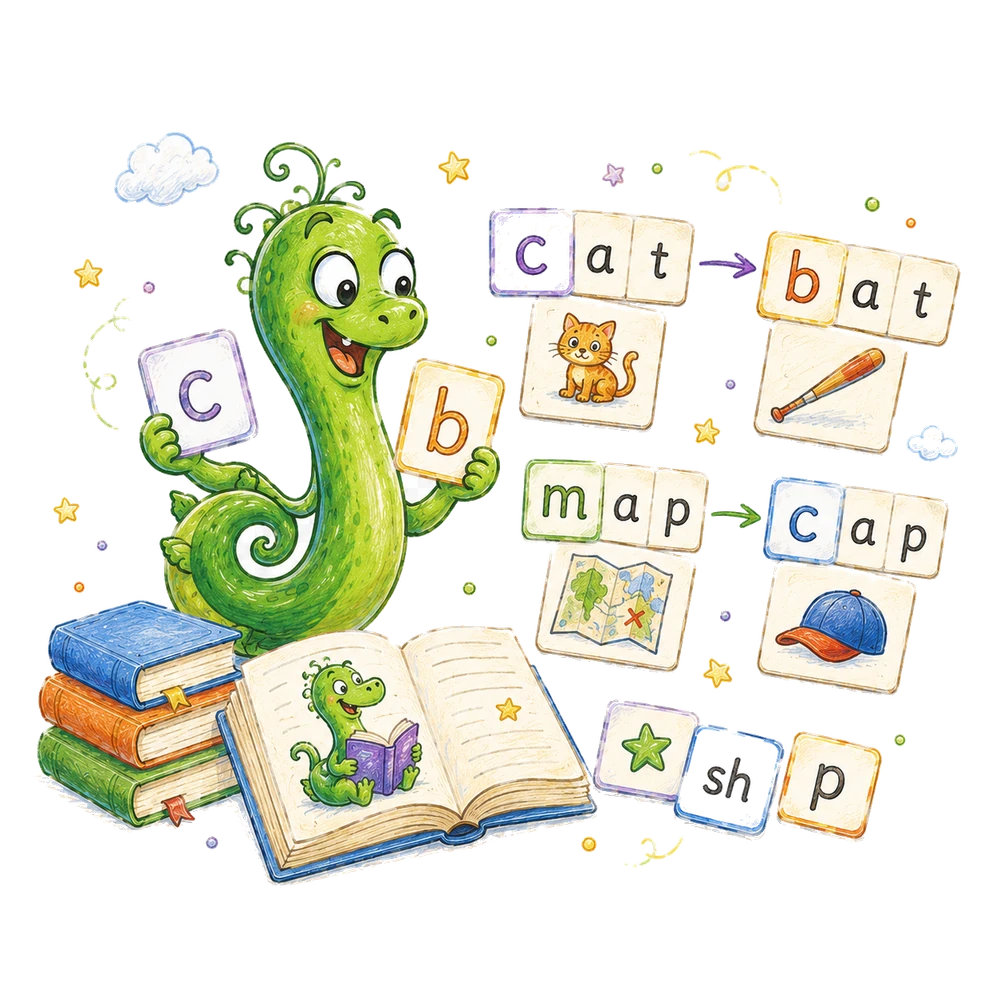
Cut or tear paper into four pieces large enough to handle. Write one letter on each: M, m, N, and n. Place the uppercase cards in one row and the lowercase cards in another. Before asking for a match, name the forms: “This is uppercase M and this is lowercase m.” The goal is to connect two written forms of the same letter, not to find two identical shapes.
Mix only the two lowercase cards and leave the uppercase M and N visible. Ask the child to place m under M. Then match n with N. At the end, check that each pair contains an uppercase and a lowercase form of the same letter. If this choice is too demanding, show just M and m first; introduce N and n after the relationship has been demonstrated.
M and N are useful for discussing differences, but they can also be easy to confuse in some print styles. Write each form plainly and inspect the cards before using them. If two of your handwritten cards look ambiguous, rewrite them rather than asking the child to resolve unclear marks. You can choose another pair of familiar letters, provided the uppercase and lowercase forms are labeled correctly.
If the child places n under M, compare both lowercase choices with the named examples: “This one is lowercase n; it goes with uppercase N. Let’s look for lowercase m.” Return the cards to the starting rows and let the child move the match if they wish. A direct explanation is more helpful than asking them to guess repeatedly without information.
Once the two matches are clear, switch roles. The child can place an uppercase card, and the adult finds its lowercase partner. The child may check the answer against a written alphabet or the original paired layout. This is not a race, and an adult’s mistake need not be staged to create a lesson. The role change gives the child a chance to direct where the cards go and decide how to check.
Store the four cards in an envelope or secure them together if that is useful for your household. Before a later use, check that all four are present: a missing lowercase n changes what can be matched. You can add letters gradually, but keep the initial choice small when the purpose is to compare two specific pairs. More cards increase search demands and make the setup different from the four-card activity ranked above.
How to choose among the four
Choose the cover search when a clear book is already nearby and the child wants to look. It requires no new object and can end after one found letter. It may be a poor fit if the cover’s lettering is tiny, crowded, obscured, or uncomfortable to view. In that case the effort of making a clear card may be justified by the improvement in access.
Choose the air-tracing invitation when the child enjoys making or observing movements and a visible model is available. A large motion is not automatically easier than pointing, especially for a child with motor or visual access needs. Agree on a comfortable alternative before treating the movement as part of the task. The ranking does not include any claim that tracing produces better learning than looking.
Choose the name card when a familiar name is meaningful to the child and contains a suitable target. It takes one piece of writing but can support several later conversations: the first letter, another occurrence of a letter, or a comparison with a book cover. Keep the activity centered on the child’s choice; some children may prefer a pet’s name or a fictional character to their own.
Choose the four matching cards when the child is ready to compare letter forms or wants to move pieces. The initial preparation is greater, but reuse changes the calculation on subsequent days. You can reduce the choice to a single pair and add the second when useful. Storing a finished set is a practical part of the plan if the benefit of reuse matters to you.
You can also stop before choosing any activity. If the child is hungry, uncomfortable, or interested in a different task, a letter search need not be inserted into that moment. An available book does not create an obligation to use it for instruction. The activities are options, not a schedule that has to be completed.
Make the ranking fit your actual materials
Imagine the book is already on the table and the paper and marker are in a drawer. The cover search and air tracing require no newly made item. The name card requires finding the supplies and writing one name. The matching activity adds four pieces to write and separate. Under these assumptions the published order is useful, but we have not timed any of the steps.
Now imagine the book has tiny lettering, while a large-print name card was made yesterday. Finding an accessible cover could take more effort than bringing out the existing card. The name card becomes the more practical choice for that child and moment. This does not contradict the ranking; it changes the starting conditions on which the ranking depends.
If scissors are unavailable, tear paper into four large pieces or fold a sheet and use the four areas as separate spaces. A folded sheet with letters in fixed positions is not exactly the same as movable cards, so decide whether moving pieces is important for the child. You can instead point to a pair or place a large marker beside each chosen letter. Keep small or loose materials appropriate to the child’s needs.
If you have no book with the selected letter, a clean food package or a large printed sign might offer a model, provided the print is readable and the object is safe to handle. Check the letter before inviting a search and be mindful that packaging can have crowded decorative text. A source that happens to be present is not necessarily a clear source.
If your child uses a screen reader, switch access, magnification, or tactile print, start with the tools that already work for them. Preparation may include opening an accessible file or positioning an input device. Count that effort for your own comparison rather than assuming a visual book cover is universally the least-preparation option. The aim is a usable choice under real conditions, not preserving a fixed ranking.
What to notice in a child’s response
Notice what the child actually did and what information was available. “With the uppercase M visible, Maya pointed to the same uppercase form on the cover” is more specific than “Maya knows letters.” It records the target and the support. It does not establish whether she recognizes M in every font, remembers it later, or can write it without a model.
If the child finds M in the name Maya but not on a patterned cover, compare the two displays. The issue may be visual crowding, the scale of the print, a different letter form, or the search demand. Try placing a plain card beside the cover and reducing the area to inspect. A difference between two tasks is a reason to examine the tasks, not a diagnosis.
If the child calls uppercase M “N,” repeat the name and compare the visible forms. If the child names M correctly but pairs it with lowercase n, show both learned pairs again. Naming a letter, recognizing its shape, and matching uppercase with lowercase are related but distinct actions. One short exchange cannot determine which part needs more experience.
A child may correctly match M with m and still not know the sound commonly associated with M. They may also hear the first sound of “moon” without identifying the written M. Keep your question aligned with the intended focus: “Which card is lowercase m?” asks about written forms, while “What sound do you hear first?” asks about speech. Either can be explored separately.
Record supports as well as answers. A note such as “Matched M and m after the adult named both cards” captures what happened. On a later day the cards may be arranged differently or the adult may provide a different prompt; compare those observations with the changed conditions in mind. Avoid interpreting one response as a broad measure of a child’s ability.
A small sequence across different days
On one occasion, use a clear M on a book cover and let the child find it while the model is visible. If the child wants to continue, look for a second matching uppercase M that you have already confirmed is present. Stop after a successful comparison or when interest fades. There is no required number of repetitions.
On another occasion, write a familiar name containing M, such as Maya. Read the entire name, then compare its initial M with a plain model. If that name is not meaningful for the child, select another appropriate name. Keep the book available only if it helps; the activity is still useful as a conversation about the letters in the name card.
Later, offer the two matching pairs M/m and N/n. Introduce each pair before mixing the lowercase cards. If the child prefers to revisit the name card instead, use that choice. These examples are possible invitations, not a required progression: someone may enjoy matching cards before a cover hunt, or may use a tactile letter instead of either.
Revisit a previous result by changing one feature at a time. For example, move from a plain uppercase M on a card to the same uppercase M on a clear cover while keeping the model visible. Changing the letter, size, font, and response method all at once would make it harder to understand which change affected the task. Record the concrete comparison rather than inferring a general improvement from a single try.
Continue with a relevant BrainHunters activity
For another name-based example, read letter hunts with a familiar name. Compare its suggested materials with the one-card approach here and choose the setup that fits your child. The value of the name comes from its familiarity and accurate spelling, not from completing every suggested variation.
If the child wants a digital activity, visit letters and early reading on BrainHunters and inspect the available choices together. A task that names a letter, identifies a sound, or matches a printed form may ask for a different skill from a book-cover search. Read the actual instruction first, then use a paper model if that support is helpful. You do not need to use all four offline activities before visiting the site.
Helpful answers
Which activity needs the least preparation?
The book-cover search and air tracing are tied when a clear letter is already visible on an available book. Neither requires making an additional material under those conditions.
Is the least-preparation option best for every child?
No. A large-print name card or accessible matching set may work better if a book cover is difficult to see or handle.
What if the chosen name has no M?
Choose a letter that actually appears in the name or use another familiar name containing M. Keep the person’s name spelled as they use it.

Turn a little idea into an adventure.
Try a short activity together, then bring the discovery back into your day.
Letters and early reading practice