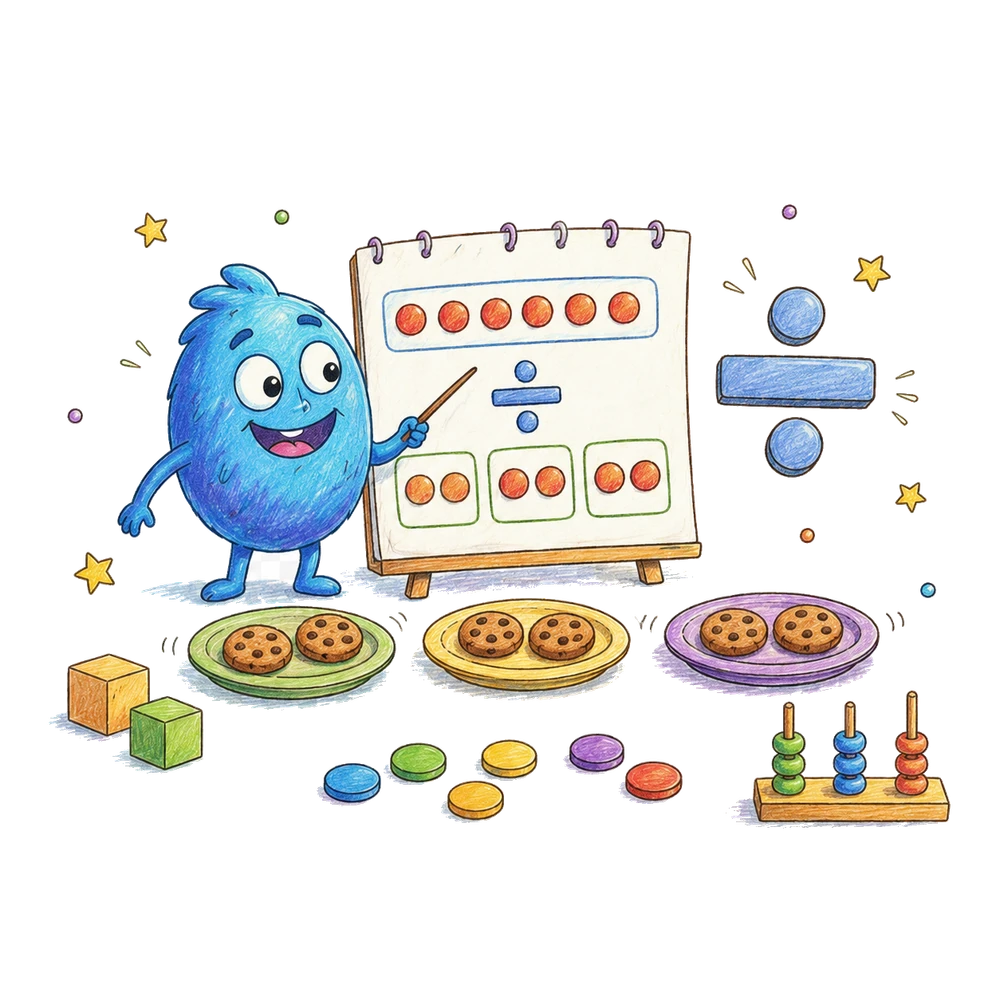
Six objects can be arranged as three pairs with nothing left over. Seven objects make three pairs and one extra. Pairing gives a concrete way to explore even and odd whole numbers: an even count can be divided into groups of two with no remainder, while an odd count leaves one object after all possible pairs are made. This guide shows the activity step by step, distinguishes the number of pairs from the number of objects, and checks what changes when one object is added. Paper shapes or suitable toys can serve as partners; no person has to be left out of a game.
The skill: test a count by making pairs
An even whole number of objects can be partitioned into pairs, with every object in exactly one pair and none left over. An odd whole number leaves one object after all possible pairs are formed. Six is even because three pairs use all six; seven is odd because three pairs use six and one remains.
The test concerns the number of individual objects, not the number of pairs. Three pairs contain six objects. Saying that the pair count is three does not make the six-object collection odd.
The child can move objects, indicate partners, or direct an adult. A drawn line between two objects can also show a pair. The physical arrangement is a check for the stated definition, not merely a visual pattern to memorize.
Prepare objects and a clear space
Gather seven suitable objects such as large paper circles or blocks. Use a mat or sheet to mark the collection being tested. Start with six and keep the seventh clearly outside the mat until it is needed.
Leave enough room to place paired objects together and separate them from any unpaired object. A pencil and paper can record the counts. Choose materials appropriate for the child; an adult can move pieces under the child's direction.
Explain that a pair contains exactly two objects and that each object can belong to only one pair in this round. The objects need not be identical in color or size if the question is only about their count.
Test six and then seven
Place six objects on the mat and count them once. Say, ‘Let's see whether every object can have one partner.’
- Put two objects together as the first pair.
- Form a second pair from two unused objects, then a third pair from the remaining two.
- Check that every one of the six objects is in exactly one pair and that none is left over. Six is even.
- Add the seventh object to the same collection. The three existing pairs remain, and one object has no partner.
- Say that seven is odd in this pairing test. Count all seven objects if the child wants to verify the new total.
- Remove the seventh object and check that the original six can again form three complete pairs.

A conversation about the leftover
Adult: ‘We have seven blocks. Can every block have one partner?’ Child forms three pairs and points to one block alone. Adult: ‘You made three complete pairs, and one block is left without a partner. Seven is an odd number of blocks.’
Child: ‘Can the extra block join that pair?’ Adult: ‘It can move beside them, but then that group has three blocks, not a pair. For this test, each group must contain exactly two.’
The child can add an eighth block if the story allows the collection to change. The two previously unpaired blocks can form a fourth pair, making eight even. State that an object was added before naming the new count.
Count pairs and objects separately
With six objects, count the groups: one pair, two pairs, three pairs. Then count the individual objects: one through six. Both counts are correct answers to different questions.
If a child says six is odd because there are three pairs, point to the unit being tested. The question concerns six objects. Every object has one partner, so the object count is even even though the number of pairs is three.
A table can record ‘3 pairs’ and ‘6 objects.’ The labels prevent the number of groups from being mistaken for the number of items. An adult can write while the child points to each quantity.
Check that each pair contains exactly two
A group of three objects is not a pair. If the child places three together and another three together, count the members of each group. Rearrange them into groups of two before using the pairing test.
An object should not serve as the partner for two different objects at the same time. If a drawing has two lines from the same circle to two others, revise the lines so each circle belongs to at most one pair.
The objects can differ in appearance. A red circle and a blue square still form a group of two if the rule is about number. A separate game may require matching colors, but that additional rule should be stated rather than assumed.
Add one object to change the result
Start with six objects in three complete pairs. Add one object. It has no partner among the original six if the existing pairs remain complete; regrouping cannot use seven objects in pairs without one left over. The new count is seven, an odd number.
Add one more object to the seven. The two previously unpaired objects form a pair, giving four pairs and eight objects. Eight is even. Count all objects or pairs to verify the new total.
Each addition changes the collection by one. Do not say the original six became odd without mentioning the seventh object. The parity result applies to the current count, not to the appearance of a particular arrangement.
Remove one object and check again
Begin with six objects in three pairs. Remove one object from the collection. Its former partner is left without a partner, and the remaining count is five. Five is odd.
Remove the unpaired object as well. Four objects remain in two complete pairs, so four is even. The removed pieces may stay on the table outside the mat, but they are not included in the count being tested.
State the boundary before pairing. If all six objects on the table are counted, the answer remains even; if only the four on the mat are counted, four is also even for a different collection. The location and question determine the set.
Zero in the pairing definition
An empty collection has zero objects. There are no unpaired objects, and zero can be written as two times zero. Zero is an even whole number.
A child might say there are no pairs. That is correct: zero pairs contain zero objects. ‘No pairs’ does not mean there is one leftover. A leftover would require an object to be present without a partner.
Compare the empty mat with a mat holding one object. Zero is even; one is odd because the single object cannot form a pair with another object in that collection. Use visible boundaries to keep the examples distinct.
Draw pairs to record a test
Draw six circles and connect them in three nonoverlapping pairs. Count the circles and check that each has exactly one line to its partner. Write ‘6 is even’ beside the drawing if the child is ready for the terms.
For seven, draw seven circles, connect three pairs, and leave one circle unconnected. Write or dictate ‘one left over.’ The unconnected circle is part of the seven-object collection, not an extra object added after the count.
If lines cross, the pairs may still be valid, but a clearer arrangement can help the child see which two circles belong together. Redraw or separate the groups as needed. The definition depends on membership in pairs, not on whether connecting lines cross.
Compare two arrangements of the same count
Place six objects in a row, pair adjacent objects, and observe no leftover. Rearrange the same six objects into a cluster and make pairs again. The total and even classification remain the same if no object is added or removed.
A scattered arrangement can make tracking harder. Move completed pairs to a separate area or use a marker for each paired object. The difficulty of seeing pairs does not change whether the count is even.
If a different result appears, check whether an object was missed or used twice. Count the collection and inspect each pair. The answer should follow from the same six objects, not from the visual length of the layout.
Use a small number list
Test counts from zero through six using objects or drawings. The even counts are zero, two, four, and six; the odd counts are one, three, and five. Record the results after checking each collection.
Notice that adding one alternates the result in this sequence: an even count becomes odd and an odd count becomes even. The pairing model explains the observation for these examples: one object either creates a leftover or supplies a partner for the previous leftover.
A list can serve as a reference, but do not require a child to memorize it before understanding the pairing test. The child can return to objects to check a number in the displayed range.
Connect an even count with equal groups
Six objects can be split into two equal groups of three. Arrange the objects as three cross-group pairs, one member in each group. Each group has the same count and all six objects are used.
Seven whole objects cannot be split into two equal whole-number groups while using all seven: three and three leaves one, while three and four are unequal. This is another view of the one-object remainder in the pairing test.
Keep the units and rule clear. If objects can be divided into equal parts, a different kind of sharing problem can be posed. The parity test here concerns a whole-number count of indivisible objects grouped in twos.
Make the first test easier
Start with two large objects. Put them together and show that both have a partner. Add one object and show the single leftover. The adult can move the pieces while the child points or indicates a choice.
Use clear space between the pair and the leftover. Ask one question at a time: ‘Does each object have a partner?’ Then provide the terms even and odd if useful. A child can understand the pairing before recalling the labels independently.
A speech response is not required. The child may point to the leftover, select a picture, use eye gaze, or communicate with a device. Keep the objects visible during the check.
Add challenge with a larger collection
Prepare ten or eleven suitable objects. Count the collection, then form pairs using each object once. Ten forms five pairs with no leftover; eleven forms five pairs and one leftover.
A child can predict the result before pairing, then check the prediction. If the spoken sequence suggests an answer but the objects give a different result, recount the collection and inspect the groups. Both the initial count and the pairing must be accurate.
For a larger group, move completed pairs away from the unpaired area. This reduces tracking demands while preserving the same rule. More objects should not require speed or removing needed supports.
Play with a partner without excluding anyone
Use paper shapes as the objects seeking partners. One person prepares the collection; the other forms pairs and identifies whether one shape remains. Swap roles and repeat with a different count.
If real people participate, avoid making an unpaired child the object of a public demonstration. The group can instead pair cards or toys together. The mathematical idea does not require a person to be left out.
Both partners can check that each shape belongs to one pair and that any leftover remains inside the counted collection. If the preparer adds an object, state the change and recount before naming the new result.
Observe the reasoning
A useful note might say: ‘Paired six paper circles without a leftover and counted three pairs’ or ‘Added one circle to six and identified the single unpaired object.’ Include the count, materials, and assistance used.
A child may form pairs correctly before recalling the words even and odd. Another may recite a number list but need help pairing objects. These are different observations. One response does not establish understanding of every number.
If questions continue, concrete examples and supports can be discussed with a teacher or appropriate professional. A permanent record is optional; the objects can be reused for another count.
Predict, pair, and revise
Place five circles on the mat and ask the child to predict whether all can be paired. The child may predict a leftover, predict none, or say they are unsure. Keep the prediction separate from the physical check.
Make two pairs and observe the fifth circle. One remains without a partner, so the count is odd. If the child predicted no leftover, invite a revision after showing the actual groups. The earlier idea can be compared with the evidence without treating revision as failure.
Reset with four circles and repeat. Two pairs use the entire collection, so four is even. A small change in the number of objects creates a different result; the classification does not depend on the color or placement of the circles.
Check a partner's proposed pairing
A partner places seven blocks in two groups of three and one single block, then says that there are three pairs. Ask the child to inspect the groups. Each group of three contains too many objects to be a pair.
Rearrange the seven blocks into three groups of two and one leftover. Count the blocks in each group. The conclusion that seven is odd now follows from the stated pairing rule, even though the partner's initial grouping did not demonstrate it.
For another example, a partner connects one circle to two others in a drawing. The shared circle has been used twice. Erase one line and form nonoverlapping pairs before deciding whether a leftover exists.
Compare five and six objects
Place five objects on the mat. Form two pairs and identify one leftover. Add a sixth object and pair it with the leftover. There are now three pairs and no unpaired object.
Ask what changed between the two tests. One object was added; the total changed from five to six and the previous leftover gained a partner. The first count is odd and the second is even.
Remove the added object to return to five. The remaining partner is unpaired again. These reversible actions let the child see the relationship rather than relying only on an alternating list of words.
Use a ten-frame without guessing from shape
Place six counters in a ten-frame, one per box. Pair the counters, for example by connecting neighboring occupied boxes with temporary markers. Three pairs use all six, so the count is even.
Add one counter in an empty box. Pair the seven occupied positions again; one counter remains. The number of empty boxes is a separate count and is not the criterion for whether the occupied count is odd.
If two counters occupy one box, count actual counters and arrange them into pairs. The frame can help organize positions, but it does not replace the need to identify the objects being tested. Keep one counter per box when using occupied positions as a direct representation of the count.
Investigate a change of two
Start with five objects: two pairs and one leftover. Add two more objects and pair the two newcomers with each other. There are now seven objects, still with one leftover. Both five and seven are odd.
Start instead with four objects in two pairs. Add two and make a third pair. Six objects are present with no leftover; both four and six are even. In these examples adding a complete pair preserves the pairing status.
The child can count the resulting collections from one as a check. State that two objects were added; a change of one would produce a different result. The physical pairs show why the existing remainder remains unchanged when a complete pair joins.
Explain the result to a listener
Ask the child to show a partner why six is even. They can point to three complete pairs and indicate that no object remains alone. A listener can count each pair's members and verify that every original object appears once.
Then show seven and ask the partner to find the unpaired object. If the listener counts only the three pairs, remind them that the leftover is part of the seven-object collection. The complete count includes both paired and unpaired objects.
A child may communicate by pointing, moving shapes, or directing an adult. The explanation should make the pairing evidence available to the listener; it need not use a memorized sentence.
Test a prediction about adding one
Show four objects in two complete pairs. Ask what may happen if one object is added. Add it and form pairs again: one object remains, so the new count of five is odd.
Now begin with five and add one. The leftover gains a partner, producing six objects in three complete pairs. The child can predict first and use the objects to check. In these examples adding one changes the parity of the count.
Keep the added object visible and count the new collection. If the child says the original four were odd, return to those four and verify their two pairs. A prediction about a new collection should not alter the classification of the starting collection.
Return to the original six
Place the original six objects on the mat and invite the child to form pairs in a different order. Count the three pairs and then the six individual objects. Each object has one partner and none remains alone.
If a partner checks the result, both can point to the same six pieces and confirm that no item is used in two pairs. The count is even regardless of which particular objects were paired together.
Continue with equal groups
For counting objects in groups of two, see Skip Counting by Twos with Paired Socks. For dividing a collection equally between recipients, try Equal Sharing with Crayons. The pairing test and equal sharing answer related but distinct questions.
Numbers and counting offers an optional digital continuation. Suitable objects and a clear space are enough to check a small count.
Helpful answers
Why is six even?
Six objects can form three pairs with no object left over.
Why is seven odd?
Seven objects form three complete pairs with one object left over.
Is zero even?
Yes. Zero objects leave no unpaired object, and zero equals two times zero.
Does the number of pairs determine whether the object count is odd?
No. Three pairs contain six objects, and six is even.
Do paired objects have to match in color?
No for a count-based parity test. Each pair needs two objects; a color-matching rule would be an additional condition.

Turn a little idea into an adventure.
Try a short activity together, then bring the discovery back into your day.
Numbers and counting practice