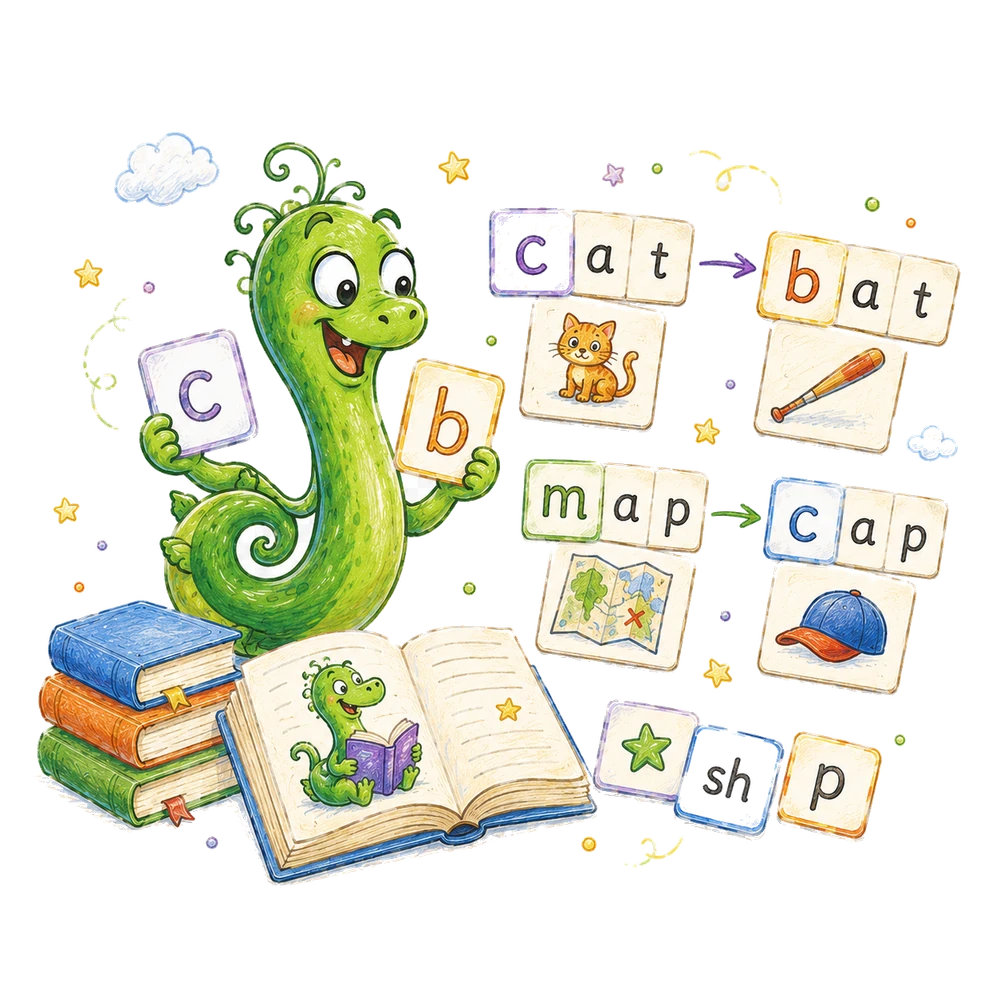
A cat and a hat are different objects, but their names rhyme in common English pronunciation: ‘cat’ and ‘hat’ share the ending /æt/. A basket of familiar pictures can make that sound relationship visible while the adult and child listen to the words. This guide starts with a complete three-picture game, explains what to say when a child groups by meaning instead of sound, and offers variations for listening, memory, pretend stories, and children who communicate in different ways. The child does not need to read the words or produce a perfect spoken rhyme to take part.
What the game asks the child to hear
The first question is whether two spoken words have matching endings. In the examples ‘cat’ and ‘hat,’ the stressed vowel and the sounds after it match in common English pronunciation. ‘Sun’ does not share that ending. Say the whole words and listen to how they finish; the pictures and objects are prompts for the names, not proof of a rhyme by themselves.
Rhyming is different from matching the first sound. Cat and hat begin with different sounds, /k/ and /h/, while their endings match. Cat and cup begin with /k/ in common pronunciations, but they do not rhyme. If the child has just played a beginning-sound game, explain that the new round asks about the end of the words instead.
The activity can be appropriate for a child in kindergarten, but the title's age is a guide, not a requirement or a deadline. A child can point, speak, sign, use a communication device, or direct an adult to move a picture. Hearing access, pronunciation, home language, and familiarity with the words all affect the task. One informal choice cannot diagnose a hearing or reading difficulty.
Prepare a small basket and agree on the names
Use a small basket or tray and three large pictures: a cat, a hat, and the sun. Draw them on paper, find them in a book, or use suitable household items if those make the names clear. A toy cat and an actual hat may work, while a drawing can represent the sun. Choose materials safe for the child and avoid loose pieces that are unsuitable for their age or situation.
Before asking about rhymes, point to each picture and agree on the word you will say: cat, hat, sun. If the child calls the animal ‘kitten,’ listen to that word rather than pretending they said cat. You can agree to use the shorter label ‘cat’ for this round if the child accepts it, or choose another example. The answer depends on the spoken label.
Keep the three choices visible and leave space between them. A child who cannot comfortably handle the cards can point or use their usual communication method while an adult moves them. The basket holds the chosen pair; it does not need to be a special teaching product. A bowl or a clearly marked place on the table can serve the same purpose.
A complete first round with cat, hat, and sun
Use the cat as the reference and offer hat and sun as choices. Say the words naturally before emphasizing their endings, and allow the child to hear them again. The following steps separate listening, choosing, and checking.
- Show the cat and say, ‘Cat. Listen to the end of that word.’
- Show the hat and sun. Say ‘hat’ and ‘sun,’ then ask, ‘Which word rhymes with cat?’
- If the child chooses hat, place cat and hat in the basket and repeat, ‘Cat, hat.’ Listen to the shared ending.
- Say ‘sun’ and compare its ending with ‘cat.’ Keep sun outside the basket for this sound rule.
- Ask whether the child wants to try another pair, make a different sort, or finish. Do not require an immediate spoken explanation.
An example conversation after a different answer
Adult: ‘Which rhymes with cat: hat or sun?’ Child: points to sun. Adult: ‘You chose sun. What did you notice?’ Child: ‘The cat is in the sun.’ Adult: ‘That could happen in a story. Let's listen to the word endings: cat, hat; cat, sun. Would you like to hear them again?’
The child has described a relationship in meaning, not necessarily attempted the sound rule. Both can be useful. If they want the story, follow it; if they want to return to the rhyme question, compare the spoken endings. Avoid repeatedly asking the same question without adding a useful cue, because the child may still be using a different rule or name for the picture.
If the child indicates hat but says a different word, check which response they intended. They may use ‘cap’ for that picture; cap does not rhyme with cat because its final sound differs. Choose an unambiguous hat picture or agree on the label for the round. The adult should not silently replace the child's vocabulary and then treat the resulting mismatch as an error.
Listen to the whole word and the ending
Say ‘cat’ and ‘hat’ at a comfortable pace. You can repeat the shared ending as a listening cue, then say the whole words again: ‘cat, hat.’ Avoid changing a word's pronunciation so dramatically that it no longer sounds familiar. If a child wants a visual cue, point to each picture in the order the words are spoken.
For contrast, say ‘cat, sun.’ Ask whether the endings sound alike or different. If the child cannot tell, offer to repeat both words, reduce background noise if practical, or use their usual listening support. The child need not imitate either word. Do not increase volume abruptly or assume that a child who declines the question did not hear it.
Pronunciation and rhyme judgments can vary by speaker, dialect, and language. Use examples that actually rhyme as your family says them, and change the words when an example is ambiguous. The cat/hat pair is intended for common English pronunciations; it is not a rule that every word with similar spelling will rhyme.
Rhyme is not the same as matching first sounds
Place a cat picture, a cup, and a hat on the table. Say the agreed names. Cat and cup start with /k/ in the example, but their endings differ. Cat and hat start differently but rhyme. Ask one question at a time: ‘Which starts like cat?’ or ‘Which rhymes with cat?’ The answer changes because the listening rule changes.
A child who chooses cup for the rhyme question may be attending to the shared beginning. Say, ‘You heard /k/ at the start of cat and cup. This time let's compare the ends.’ Then say cat and hat together. Recognizing a beginning sound is a useful observation even though it does not answer the rhyme question.
Do not demand that the child alternate between both rules if that is confusing. Use just cat and hat to introduce rhyming, then return to an initial-sound game on another day if the child wants it. If the child sorts by another feature, ask what rule they used before changing the arrangement.
Make the first choice easier
Begin by showing only cat and hat. Say both words and model that their endings sound alike. The child can listen, point to a picture, or put one card in the basket with assistance. Adding sun as a contrast is a separate step; introduce it when the child wants another choice.
Use a clear drawing and a familiar label. If the child needs more time, repeat the two words in the same order. If selecting a card is difficult, they can look toward an option using an established choice signal or instruct an adult to move it. A gesture or communication device can represent a choice without requiring the child to say the target word aloud.
If hearing spoken sounds is not the child's accessible route to this activity, consult their usual communication and learning supports. Do not assume that louder speech or a standard picture card is automatically helpful. A child can choose another activity, and the family can discuss appropriate adaptations with the professionals who know their needs.
Add another rhyming choice
If the child wants a larger set, add a picture of a bat as the animal or a sports bat, using a clear label. In common English pronunciation, cat, hat, and bat share the same rhyming ending. Say each word and let the child decide which pictures go in the sound group.
A word can have more than one meaning. If ‘bat’ in the picture looks like a club and the child names it ‘club,’ the relevant spoken ending changes. Agree on the intended label or select another picture. Do not assume the child will infer a specific word from an ambiguous drawing.
Keep a nonrhyming contrast such as sun separate. If the child includes sun because the animals are outdoors, acknowledge the story and restate the sound question if they want to continue. Three rhyming examples can show a pattern, but a single round is not enough to conclude that the child can recognize every rhyme.
Use real objects when their names are clear
A hat and a picture of a cat can be enough for the first pair. A mat and a hat can also rhyme in common English pronunciation, provided the family calls the object a mat. Ask before moving a personal item and choose objects that are clean and suitable for the child. A picture is preferable if a real object is too large, unavailable, or unsafe.
Say the names of the objects before putting them in the basket. If the child calls the mat a ‘rug,’ rug has a different ending and the comparison changes. That is not an incorrect name for the object. You can say, ‘We call this a rug. Shall we use a picture labeled mat for this rhyme, or choose a different pair?’
Avoid hunting around a room for a large collection. One pair and one contrast are sufficient to make the listening question concrete. If the child wants to bring an object into a pretend story, ask whether the story or the rhyme sort is the current goal; either choice can be valid.
Make a pretend story with a reason to listen
Use a toy figure as a character packing a basket. Tell the child, ‘The character wants two pictures whose names rhyme with cat.’ Offer hat and sun. Pause before the character picks one so the child can decide whether to help. When the child selects hat, say both words and place the pictures together.
If the child puts sun in the basket because the character is going outside, that is a reasonable story choice. You can follow the story or ask whether they also want to check the sound rule. The sun can remain in the story while not belonging to the cat/hat rhyme group. Do not treat imaginative play as wrong merely because it uses a different criterion.
For a simpler story, show only cat and hat and have the adult model the rhyme. For a more demanding one, offer cat, hat, and bat plus one contrasting word, naming all the pictures first. The child may signal an answer without speaking and can end the story after a single choice.
Add a memory step without confusing the goal
After cat and hat are selected, cover the hat picture and ask, ‘Do you remember which picture we put with cat?’ Let the child name it, point to its location, or ask to uncover it. Reveal the same card without changing it, then say cat and hat again to check the rhyme.
A child who remembers the hidden location may not remember the spoken name, and a child who forgets the picture may still recognize the rhyme when hearing both words. Those are different tasks. If the answer changes during the pause, show the picture and ask whether the child wants to listen again; avoid calling the result a measure of memory or reading ability.
Do not replace the hidden card with another object during this version. If you want to play a separate ‘what changed?’ game, explain that a card will be exchanged and define a new question. Keeping the first memory round predictable makes the check meaningful and lets the child decide whether that additional demand is welcome.
Take turns giving and checking a clue
One partner can say ‘cat’ and offer hat and sun; the other selects the rhyming word. On the next turn, the child can point to an image or use a device to choose the reference word while the adult listens. Both partners should have time to make a choice before someone moves the cards.
The adult can model a check: ‘I chose hat. Cat, hat: the endings sound alike. Is that the pair you wanted?’ If the child indicates a different label for a picture, use that label and check the sounds again. A child who directs the adult to move a card still controls the choice.
For two children, agree on short turns and use materials that both have agreed to share. A personal toy should not be taken without its owner's permission. If one child does not want to give a spoken clue, they can select a picture or pass. A partner role is an option, not a requirement to perform in front of someone else.
Distinguish rhymes from words that merely look alike
A picture of a cat and a picture of a dog are both animals, but ‘cat’ and ‘dog’ do not rhyme in the intended example. A hat and a mat may look very different while their names rhyme. To check the listening rule, say the words rather than comparing the pictures' shape, category, or color.
Written spelling can also be misleading. Some words that end with the same letters are pronounced differently, and some spoken rhymes use different spellings. A beginning game does not need a list of exceptions; it needs examples that the adult and child have actually said and heard. If print is introduced, keep the spoken comparison clear.
If the child sorts by pictures instead of sounds, invite them to show the rule. They may have made a coherent animal group. You can keep that group, then offer a separate sound round with the same cards. A different rule is not a reason to erase or dismantle the child's work without asking.
Use a book without interrupting every page
If a familiar book contains a cat, pause where it fits the child's interest and say, ‘Cat, hat: those words rhyme.’ The child can point to the cat, say another word, or simply listen. If they want to continue the story, resume reading rather than turning every page into a question.
An adult might invite a choice: ‘Does hat or sun rhyme with cat?’ Use pictures if they are available, or say the words aloud. Check that the child knows the labels. If the book uses a different word for the animal, such as ‘kitten,’ explain that you are choosing to call it cat for this example only if the child agrees.
For a further challenge, the child can invent a sentence containing the pair: ‘The cat has a hat.’ A complete sentence adds a meaning and language task beyond recognizing the rhyme. Let the child choose whether to create it, dictate it, use a communication device, or return to the story.
Compare a singular word with a plural label
A picture may contain one hat or several hats. If the child names a group ‘hats,’ listen to the word they actually said: the final /s/ changes the spoken ending compared with singular ‘cat.’ The pictures might share the idea of a hat, but ‘cat’ and ‘hats’ are not the same rhyming pair as ‘cat’ and ‘hat’ in this example.
You can point to one hat and ask whether the child wants to use the singular word ‘hat’ for this round. If they prefer to describe several hats, accept that description and choose a different rhyme question. Do not remove the plural ending from the child's speech without explaining that the words being compared have changed.
For a separate comparison, say ‘cats’ and ‘hats’ as plural words and listen to their shared ending in common pronunciation. Keep the two images clearly labeled by number and let the child choose whether to explore the new pair. The purpose is to hear the actual words, not to enforce singular labels for every picture.
Choose a next step based on the child's response
If the child comfortably selects hat for cat with two options and wants more, add bat as another matching word or introduce a different pair such as dog and log. Say the actual words in the family's pronunciation and verify the ending. Use one new pair at a time so the child knows which reference is being used.
If the child selects by appearance, explicitly name the sound rule and reduce the choices. If they ask for repetition, provide it. If a picture is ambiguous, change the picture or agree on a label. These are specific adjustments to the task, not assumptions about the child's motivation or ability.
If the child prefers to sort animals, make a story, or stop, follow that preference for an optional home activity. Repeating the same rhyme on another day is also acceptable. A longer list is not automatically a better experience, and a child does not need to meet a fixed number of matches to end the game.
Keep a useful observation without turning it into a score
A family might write, ‘Chose hat after hearing cat and hat a second time,’ or ‘Used a picture instead of handling the toy.’ Include the actual word and support used. A different picture label or pronunciation can change the comparison, so record that context if it matters. It is also fine to keep no note.
Do not claim that one match proves a child can read or that one different choice diagnoses a hearing or learning problem. If a concern persists or affects daily communication, share specific observations with the child's teacher or an appropriate professional. They can consider the child's full context and established supports.
Avoid recording or publishing a child's name, voice, or image without an appropriate reason and agreement. The game can use fictional pictures and can remain entirely offline. The child's preference about keeping their drawing or card should be respected within the family's practical arrangements.
Continue on BrainHunters
For a different listening task, explore beginning sound games with objects you already have. Explain that the new question concerns the beginning of a word rather than a rhyming ending. Letters and early reading practice offers an optional digital activity if the child wants it.
Choose the activity and level actually available, and keep any support the child needs. The basket game itself needs no account or paid material. Repeat cat and hat, try a new clear pair, or put the basket away according to the child's interest.
Helpful answers
Does a child need to read the words to find a rhyme?
No. An adult can say the words while the child listens and indicates a picture or object.
Why do cat and hat rhyme even though they start differently?
In common English pronunciation they share the ending after their different initial sounds. Rhyming concerns the spoken ending in this example.
What if the child calls the picture a kitten?
Listen to the word they actually use. Agree on ‘cat’ for that round if they want, or select another example with a clear label.
Must the child say the rhyming word aloud?
No. They can point, sign, use a communication device, or direct a partner to move a card.
Does one incorrect choice establish a hearing or reading difficulty?
No. The label, listening rule, access, and support can affect an informal choice. Discuss persistent concerns with an appropriate professional.
Turn a little idea into an adventure.
Try a short activity together, then bring the discovery back into your day.
Letters and early reading practice