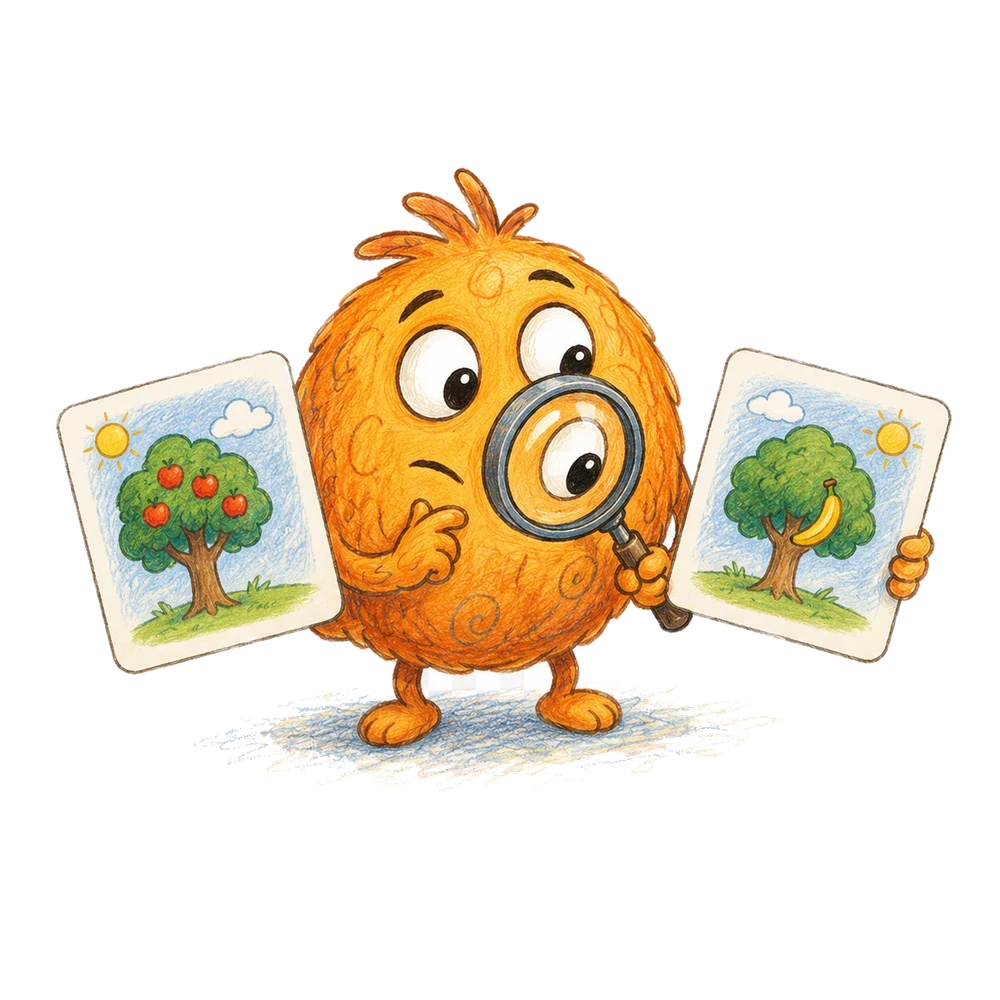
A familiar tree, garden, or window view can become a record of change over time. Choose one safe, accessible place and one feature to observe, then compare dated descriptions or pictures. Local seasonal patterns differ, so a tree that keeps its leaves or a winter without snow can be an accurate observation. This guide separates weather, predictions, and source information from what the child actually noticed.
The question: what changes in one place over time?
Choose a familiar, safe place that can be observed more than once: a tree visible from a window, a garden bed, or a park scene viewed from an accessible path. At each visit, invite the child to notice one feature and record the date. A drawing, spoken description, symbol, or photograph can preserve the view.
The central skill is comparing observations while identifying what stayed the same and what changed. A child may notice leaves, flowers, daylight, water, or another visible feature. A single observation does not establish a season or explain why a change occurred.
Seasonal patterns vary by location and year. Some places have wet and dry periods rather than the familiar four-season picture. NOAA’s [changing seasons resource](https://www.noaa.gov/education/resource-collections/climate/changing-seasons) describes the variety of seasonal patterns. Use the child’s local experience and accurate labels.
Choose a place and a safe view
An adult selects an accessible position and remains responsible for safety. A window, a public path, or an adult-prepared photograph sequence can work. Follow local rules and do not approach wildlife, pick plants, or enter unsafe areas for a better view.
Choose a fixed reference such as a tree trunk or a building edge. Record where the observer stood or which window was used. A later view should use the same reference when practical, while acknowledging that the place itself can change.
Never ask a child to look directly at the Sun. During severe weather, follow local safety guidance and postpone the observation. A drawing or labeled image can be used at another time.
Prepare a simple page
Make spaces for date, place, “what I notice,” and “question.” The child can draw, dictate, select symbols, use a device, or direct a helper. A written record is optional and need not include a precise home address.
Choose one feature to watch across visits, such as the visible leaves on a particular tree. Describe the view: “from the kitchen window” or “from the path near the bench.” A helper confirms which feature the child chose before writing.
If the child prefers a fictional or public place, use accurately labeled pictures of the same scene at different times. Explain that the pictures are records, not live observations.
A first visit in steps
A first entry can be made at any time of year. The child does not need to know a season name before describing the view.
- Have an adult choose a safe accessible place or a labeled image sequence.
- Let the child choose one feature to observe.
- Record the date, view, and actual description if desired.
- Keep any prediction or question separate from the observation.
- At a later visit, compare the same feature and note changes in the view or setup.
- Review what the entries support and leave missing information uncertain.
An example conversation
Adult: “What would you like to watch in this place?” Child: “The tree by the bench.” Adult: “What do you notice today?” Child: “Many green leaves.” The adult writes the date and the child’s words if the child agrees.
At a later visit, the child notices fewer visible leaves. Adult: “We recorded many leaves in the first view. Today you see fewer from this position. What might we need to check before comparing?” The group can consider whether the tree and view are the same.
Do not replace the actual observations with a textbook sequence. If the tree looks similar, record that. If the child cannot see all branches, note the limitation.
Compare the same feature
If the first entry describes visible leaves, ask about visible leaves at the next visit. A later entry about rainfall can be useful, but it answers a different question. The child may choose to track more than one feature in separate spaces.
A change in angle, distance, lighting, or obstruction can affect what is visible. Record a different view and avoid claiming an exact change in the whole tree when only one side was observed.
The child can point to a branch or indicate a drawing. A helper confirms the chosen feature before adding a note.
A tree that keeps its leaves
Not every tree loses all its leaves in the same season. An evergreen tree may retain foliage while individual leaves or needles still change over time. Record what happens to the selected tree rather than expecting every local tree to match a deciduous-tree illustration.
If leaves remain visible at both visits, that is a useful comparison. The child can look for another feature, such as a visible cone or branch position, without disturbing the plant.
A source may identify the kind of tree, but an unclear picture alone may not support a species name. Use “tree by the bench” when identity is uncertain.
A plant may be managed by people
A garden bed can change because a person plants, trims, waters, or removes plants. If the adult knows about an action, record it as context. Do not attribute every difference to the season alone.
A child might notice that flowers appeared after planting. The record can say what was observed and what was reported about the planting. Without more evidence it should not claim that one condition caused every change.
If the cause is unknown, leave it as a question. The child can still compare the visible scene without entering the bed or touching plants.
Weather at one visit is not the whole season
A rainy day, a cold morning, or an unusually warm afternoon is a weather observation at a particular time. It does not by itself describe the climate of a place or guarantee the conditions of an entire season.
Record “rain visible during our 10 a.m. check” rather than “it rained all season” based on one visit. The child can compare several dated entries while acknowledging that unobserved times are missing.
NOAA distinguishes short-term weather from longer-term climate in its [weather and climate explainer](https://www.noaa.gov/explainers/what-s-difference-between-climate-and-weather). The family record is a small set of observations, not a climate study.
A photograph as a record
An adult may take a photograph from the chosen safe position when appropriate. Label the date, approximate time, and view. A similar framing at a later visit can help comparison, but the camera and lighting may still differ.
A photograph shows one frame. It may hide a branch behind another object or make a color look different. Avoid inferring an exact leaf count or condition when the image does not show it clearly.
Respect privacy: a tree or public scene can be recorded without including a child’s face, an address, or other people. Follow the family’s or setting’s rules before keeping or sharing images.
A drawing as a record
The child can draw the tree, a branch, or a single leaf they noticed. A helper may draw according to the child’s directions. Label the date and the selected feature; a drawing does not need to show every detail.
Two drawings may differ in size because of the paper or the child’s choices. Do not use them as exact measurements unless a consistent scale and method were intended. They can still show a chosen feature, such as leaves visible or not visible.
If a child adds an imagined animal, label it as part of the story rather than a direct observation. Both the observation and the creative addition can be valued.
A prediction and a later check
After the first entry, ask whether the child wants to predict what they may see later. They might say, “The tree may have fewer leaves.” Write the prediction separately with its date.
At the next check, record the actual view. If it matches the prediction, the two entries agree for the observed feature. If it differs, preserve both and consider whether the tree, view, and timing were the same.
A prediction is optional and should not be treated as a promise. The record does not show what happened during every unobserved day between visits.
When the place cannot be revisited
A route may be closed, a family may move, or a tree may no longer be visible. Record that the planned comparison could not be made. A missing entry should not be filled from a guess or an unrelated picture.
The child can choose a new place and begin a new series. Label the change so the two locations are not treated as identical. An existing photograph can still support a discussion of the earlier view.
An accessible image sequence from a reliable source is another option. It represents the source’s place and times, not a live observation of the original location.
Two places may have different seasonal patterns
A child may have seen snowy winter images but live in a place where winter has little or no snow. Another place may have pronounced wet and dry periods. Both experiences can be discussed without treating one as the universal model.
Label the place and time for each picture. Ask what the child can see and what the caption or source adds. A picture of snow does not prove that every location has snow during the same month.
The child can use local names for seasonal patterns. An adult can consult reliable local information when a more specific explanation is needed.
The hemispheres are not in the same season at once
Astronomical summer in the Northern Hemisphere corresponds to astronomical winter in the Southern Hemisphere, and vice versa. NOAA explains this contrast in its [seasonal overview](https://www.noaa.gov/jetstream/global).
This broad relationship does not mean every place has the same daily weather or that all communities use the same seasonal categories. A photograph from one hemisphere cannot describe conditions everywhere in that hemisphere.
For a young child, the immediate activity can remain focused on one local place. Introduce the hemisphere comparison only if it helps answer the child’s question.
A safe daylight comparison
At two dates, a child might note whether it is light outside at a chosen clock time. Record the date, time, location, and actual view. Weather, buildings, and curtains can affect what the child sees.
Do not ask the child to watch or look directly at the Sun. A local sunrise and sunset table can provide additional information, but it is a source report separate from the child’s observation.
Daylight duration changes through the year differently by location. A few checks at one time do not measure the exact length of the day.
If the child notices an animal
A bird or insect may appear in one view and not another. Record the observation and time without claiming that the animal has migrated or disappeared permanently. It may simply be outside the frame.
Observe wildlife from a safe distance and do not feed, catch, or follow it. An adult chooses the location and follows local guidance. A labeled educational photograph can replace a live encounter.
If the child asks about seasonal behavior, consult information about the named species. A single appearance is not enough to determine a general pattern.
Count only what is visible
If the child wants to count flowers in one part of a garden, define the area and count each visible flower once. At a later visit, use the same area and view when possible.
A flower hidden behind a leaf or outside the frame should not be guessed. Record “three visible from this side” rather than claiming there are exactly three in the whole garden.
Gardening, growth, and visibility can all change between visits. The count is a specific observation, not a complete explanation of why the number differs.
A simpler first activity
Show one clear picture of a familiar place and ask the child to point to a tree, plant, or other visible feature. An adult can read the date or describe the view. One observation is enough for the first page.
At a later time, show a second labeled picture of the same place and ask whether the selected feature looks the same or different. “I cannot tell” is a valid answer if the image is unclear.
No season name, measurement, or prediction is required. The child can choose a response through gaze, gesture, speech, or a device.
A more detailed comparison
Select one tree and take or draw three dated views from a consistent safe position. At each visit, describe the same branch or visible area. Label any change in viewpoint, obstruction, or known human action.
The child can arrange the entries by date and describe a sequence: “leaves visible in the first and second views; fewer visible in the third.” Do not infer the exact date of a change between observations.
If the group measures a feature, use a suitable consistent reference and units. A casual drawing’s size is not a direct measurement of the tree.
Accessible ways to notice change
Provide a large image, spoken description, high-contrast labels, or a suitable tactile representation according to the child’s needs. A model of a leaf or tree represents a feature but may not reproduce the real place.
A child can choose a feature and direct a helper to describe or record it. If an adult supplies a visual report, identify it as the adult’s report. The child’s selection and question can still be recorded as their own contributions.
Ask before offering touch and respect a request to stop. A safe seated or indoor view can be as useful as a walk.
Avoid a predetermined seasonal checklist
A page that requires snow in winter, flowers in spring, and falling leaves in autumn may not fit the chosen place or year. Replace mandatory symbols with options for “other,” “not visible,” and the child’s own description.
If a symbol is used, explain what it represents and record the actual observation. A snow symbol should not be selected merely because the calendar says winter.
A flexible record respects local variation and produces more reliable comparisons. The calendar can provide context without dictating what must be seen.
What the record can support
A dated series can support statements about what was visible at those checks: “The selected branch had leaves in the first picture and fewer visible leaves in the second.” Include any changes in view or known maintenance.
It cannot establish the exact date of every change, a long-term climate trend, or a single cause without further information. A child’s explanation can be kept as a hypothesis or question.
The group can choose to continue observing or finish. An honest incomplete series is more useful than invented entries.
Mark the boundary of the view
A window frame or a drawing of a bench can mark the part of the scene being compared. At the first visit, show the child which branch or garden area falls within that view. Record the reference in words or a sketch.
At a later visit, check whether the same reference is visible. If a new building or curtain blocks it, write that the view changed. Do not infer that a hidden feature disappeared from the place.
A helper can describe the boundary or place a large symbol on a page after the child confirms it. The participant need not operate a camera.
A plant that flowers at a different time
A familiar plant may flower at a time that differs from a generic seasonal calendar. Record the date and visible flower rather than moving the observation to a season where a worksheet expects it.
If the child asks why the timing differs, consider the plant’s identity, local conditions, and source information. A single observation does not establish which factor caused the timing. An adult can consult a suitable local resource.
The plant can be observed without picking a flower. A drawing or image preserves the feature while leaving it in place.
Compare a morning and an evening view
Two observations on the same date can differ because of time of day as well as weather. If the child notices light on a wall in the morning and shade later, label the times before considering the result.
That daily comparison is not by itself a seasonal comparison. To discuss a seasonal pattern, additional dated observations and consistent conditions may be needed. Do not look directly at the Sun.
A child can choose whether to record the wall, tree, or another safe feature. A helper’s description is labeled as a report when the participant did not directly observe it.
A place after maintenance
A tree may be pruned or a garden bed cleared between visits. If the adult knows that maintenance occurred, add a dated note about the action. The child can still compare the visible scene.
Do not attribute the missing branch or plant solely to a seasonal cycle when a known human action changed the place. If the cause is unknown, keep it as a question.
The observation should be made from the approved safe position. The group does not need to enter a work area or handle removed material.
A record with a missing date
Suppose a family intended to observe monthly but missed one visit. Leave the missing date blank or mark “not observed.” Use the actual date for the next entry.
The two surrounding entries may show a difference, but they do not reveal exactly when it happened. A child can place the dated cards in order while acknowledging the gap.
A flexible schedule can still support a useful comparison. Completing every planned box is not the purpose of the activity.
A question chosen by the child
After the first visit, the child may ask whether the same branch will have flowers later. Write the question separately and keep the selected branch identifiable in the safe view.
At the next visit, describe what is visible. If the branch is hidden, “cannot see it today” is more accurate than answering yes or no. A reliable source can provide general information but cannot replace an unmade observation.
The child may choose another feature or end the series. The adult maintains safety and respects the place throughout.
Review and continue
Read or show the entries back to the child and confirm that the words or symbols reflect their intended observations. Correct a mislabeled date or image transparently. Keep predictions and source information distinct from direct observations.
Keeping a simple plant observation journal provides another way to compare dated features. Weather watching without predicting the forecast focuses on conditions at a particular time.
Choose a follow-up that fits the child’s interests and local conditions. One familiar place and two carefully labeled views can support a meaningful comparison.
Helpful answers
Must every season look like the pictures in a book?
No. Seasonal patterns differ by place and year; record the local view rather than a required symbol.
Does one rainy day describe the climate?
No. It is a short-term weather observation at a particular time and place.
What if the tree looks the same at two visits?
Record that no visible change was noticed in the chosen feature from the stated views.
Can we use photographs instead of visiting?
Yes. Use accurately labeled images of the same place and identify them as source records.
Does the child need to touch plants?
No. Pointing, descriptions, pictures, or a helper can support the comparison.
Sources & further reading

Turn a little idea into an adventure.
Try a short activity together, then bring the discovery back into your day.
Shapes and object practice