Three paper tiles can make a short English word that a child can inspect and change. In a common pronunciation, c-a-t represents the three sounds in ‘cat’; changing the first tile to m makes ‘mat.’ This guide explains what CVC means, gives a complete first round, shows how to respond to a different arrangement, and separates spoken sounds from written letters. It also includes accessible ways to choose and move tiles, word-change examples, and realistic limits on what one home activity can demonstrate.
What CVC means for these examples
CVC describes a consonant-vowel-consonant sound pattern. In a common English pronunciation, ‘cat’ has the sounds /k/, /æ/, and /t/: a consonant, a vowel, and a consonant. The written example c-a-t uses three letters to represent those sounds. ‘Mat’ and ‘map’ can be described similarly in the pronunciations used here.
A letter and a sound are not the same thing. English spelling does not always use one letter for each sound, and a three-letter written word is not automatically a three-sound CVC word. This activity uses a small set of clear examples; it does not claim to cover every English spelling pattern. Say the words as the family actually pronounces them and choose alternatives if a contrast is unclear.
The child's goal can be to choose a tile, identify a sound, arrange a word with a reference, or hear the adult blend the sequence. Those are related but distinct tasks. A child can point, speak, sign, use a communication device, or direct an adult to move a tile. The activity is optional and is not a diagnostic assessment.
Prepare five readable paper tiles
Use paper or card, a dark marker, and a stable surface. An adult can cut five large pieces and write lowercase c, m, a, t, and p, one per tile. The exact size should fit the child's vision and handling needs; leave a generous margin around each letter. A non-slip mat or a partner holding the paper can help if the tiles move unexpectedly.
Prepare a small reference strip reading ‘cat’ in the same clear typeface as the tiles. Add a familiar cat picture if it helps identify the word. Agree that the picture is called ‘cat’ for the example; if the child calls it a kitten, acknowledge that label and clarify which spoken word the tiles will represent. A picture and a word are related but not identical.
You do not need a full alphabet set. Keep c, a, and t visible for the first word and place m and p nearby for later changes. If cutting or manipulating individual pieces is not accessible, write the letters on a single sheet and let the child point or direct an adult. The child remains able to choose without personally moving every tile.
Build cat with a visible model
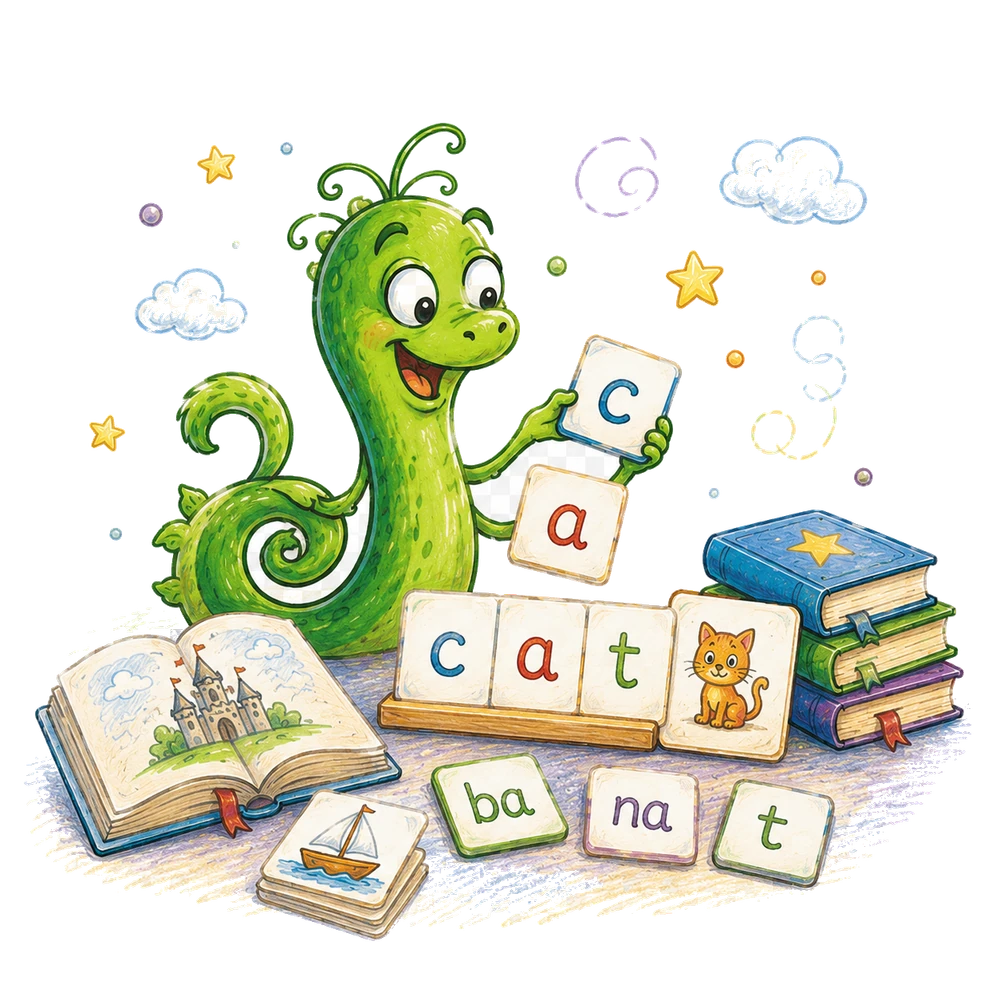
Place the ‘cat’ reference above three empty positions. Read the whole word aloud and explain that the child can match each tile to the printed form. Give help when requested rather than removing the reference after one success.
- Point to c on the reference and offer the c tile. The child can place it below the matching letter or indicate where an adult should put it.
- Repeat with a and t, keeping the tiles in the same order as the reference.
- Say the sounds /k/, /æ/, /t/ in the intended pronunciation, pointing to the corresponding tiles.
- Blend the sounds smoothly and say the whole word ‘cat’ naturally. Let the child point to the cat picture if they want.
- Ask whether the child wants to check the row, change one tile, hear the word again, or finish.
An example conversation when a tile is misplaced
Adult: ‘The reference says cat. Which tile goes under this first letter?’ Child: points to t. Adult: ‘You chose t. Let's compare it with the c on the strip. Would you like a hint or another look?’ Child: points to c, asks for help, or chooses a different arrangement.
The child may have touched the wrong card, chosen the card nearest to them, or intended a new word. Ask what they meant before assuming a difficulty with letter identification. If the child wants to make a different arrangement, you can explore it separately; the reference question is whether the row matches c-a-t.
Do not rearrange every tile for the child without asking. Offer a specific action: ‘Would you like me to hold the strip while you point?’ If the child directs the adult to move c, that is still a meaningful choice. A supported match should be described as supported rather than presented as independent spelling from memory.
Say the sounds and then the whole word
For the intended example, point to c and model /k/, to a and model /æ/, and to t and model /t/. Then say the sounds closer together and say ‘cat’ naturally. Avoid adding a long extra vowel to the consonants, which can make the sequence sound like additional syllables. The child can listen rather than imitate.
If separating every sound makes the word hard to recognize, start with the whole word, show the three tiles, and then model the sequence. Some children benefit from a smoother blend instead of long pauses. Ask whether they want to hear it again and use their established hearing and communication supports.
Pronunciation varies. If a phonetic symbol is unfamiliar, say ‘the vowel we hear in cat as we say it’ and use the family's actual pronunciation. The symbol is explanatory for the adult; a child does not need to learn phonetic notation to make a selection.
Change cat to mat
Keep a and t in their positions. Replace c with m and read the new row: m-a-t, ‘mat,’ in a common English pronunciation. Ask, ‘What changed?’ The child might point to the first tile or say that c became m. Ask what stayed the same; a and t are still in the middle and at the end.
If the child calls the picture a rug rather than a mat, acknowledge the familiar label. For the word-building example, agree that the written sequence m-a-t is ‘mat’ in the intended pronunciation, or choose another clear picture. The word on the tiles and the child's preferred label for an object need not always be the same.
A reference strip for ‘mat’ can help the child compare the row. Keeping the model visible is a support, not a failure. If the child wants to try without it, they can then return to the strip to check. Do not change a second tile while asking what changed between cat and mat.
Change mat to map
Place m-a-t on the table and offer p as an alternative to t. Change only the last tile to make m-a-p. Say ‘mat, map’ and listen to the last sounds /t/ and /p/ in the intended pronunciations. The initial m and middle a remain in place.
If the child selects p but says that the first sound changed, point to the unchanged m and compare the final positions. Ask whether they want the adult to say each word again. A child may be describing a change in the picture or the physical position rather than the sound; confirm the intended meaning.
For a smaller task, show both completed words on reference strips and point to their final letters. For a more demanding one, give the child the p tile and let them decide where it belongs. The same tile movement can be carried out by a partner under the child's direction.
Keep the word, picture, and action distinct
A cat picture can help identify the word ‘cat,’ but selecting it from sight does not by itself demonstrate that the child blended /k/ /æ/ /t/. If you want to observe an oral blending choice, say the sounds and offer two clearly named pictures, while keeping all access supports the child needs.
A map picture may be called a chart, drawing, or plan. Check the label before using it as the answer to m-a-p. If the name differs, the child has not necessarily made a sound error. Agree on the word or select another example.
Do not hide pictures or remove visual supports solely to create a harder test. Instead, describe what happened: ‘The child selected the cat picture after the adult read the word and the reference remained visible.’ That is a useful, accurate observation of the supported activity.
An easier version with fewer choices
Offer the c tile and the reference c first. The child can point to a match or watch an adult place it. Add a only if they want to continue. A single match can be the entire activity; the child does not need to complete c-a-t in one sitting.
Another option is to place two tiles correctly and offer the final t alongside a contrasting p. Ask which tile matches the reference ‘cat.’ The child can use the visible strip and does not have to recall the spelling. If both options look crowded, present them one at a time.
If the child communicates with a device or through gestures, make those supports available before asking. An adult can read, point, hold the strip, or move the tile by agreement. Do not treat a motor action or spoken answer as the only valid evidence of a choice.
Add a challenge by changing only one position
After cat and mat, invite the child to choose between returning to cat and making map. Keep the reference strips available. Ask which position needs a different tile and let the child indicate it. The child can compare the rows before making a physical change.
For another example, add a lowercase b tile and make ‘bat’ from ‘cat’ by changing the initial letter. In common pronunciation the final /æ/ and /t/ remain while /k/ changes to /b/. Say the words as the family uses them and make sure the child understands the intended meaning of bat.
Do not add several unfamiliar tiles at once merely to increase difficulty. The point of the extension is to connect one controlled change with a different word. If a child wants a more open arrangement, label that as creative play and discuss the result without promising every sequence is an English word.
Compare a letter name with the sound in a word
The English letter C is named ‘see,’ but it represents /k/ at the beginning of cat in the intended example. The letter A is named ‘ay,’ while the vowel in cat is /æ/ for many speakers. A child may know the letter names and still be exploring the sounds used in a specific word.
If the child says ‘see’ when asked for the sound of c in cat, acknowledge the letter name. Model the word and the relevant sound separately: ‘C is the letter name; in cat, it represents /k/.’ A child can point to the tile without having to produce either term aloud.
Do not infer that a letter always has one sound. For example, C represents a different initial sound in ‘city’ for common English pronunciations. The activity is a concrete example of cat, not a complete explanation of English phonics.
A pretend post office for map and mat
Set a small box on the table as a pretend post office. The character needs a ‘map’ or a ‘mat.’ Place the written reference strips and familiar pictures nearby. The child can build the requested word with tiles or choose a picture while an adult reads it.
If the child gives the character a rug and calls it a rug, follow the story. For the word-building question, explain that the tiles m-a-t are being read as ‘mat’ in this example. A fictional story can continue with the child's preferred word; the spelling task should be explicit rather than imposed on the story.
To add a final-sound comparison, switch mat to map by replacing t with p. Ask which tile changed and read both words. If the child wants to move the toy rather than work with letters, accept that as a different play goal. No real mailing or purchase is required.
Take turns building and checking
One participant can choose a reference word and the other arranges the tiles. An adult can build cat while the child checks the row against the reference, then the child can choose mat for the adult. The child may indicate a card or use a communication device instead of reading the word aloud.
If the adult places a tile incorrectly, ask the child whether they want to compare it with the reference. Do not make deliberate mistakes a requirement or assume the child enjoys correcting them. A genuine question such as ‘Did I put the p where you wanted it?’ gives the child control over the result.
For two children, agree on short turns and use paper or other materials both accept as shared. An adult can help keep the tiles accessible and ensure that one participant does not make all the decisions. Either child may pass or stop.
When the tiles make a surprising sequence
A child may arrange c-t-a or select only two cards. Ask what they intended before describing it as a failed word. They could be making a pattern, exploring the shapes, or matching a different reference. If they want to build cat, compare the row with c-a-t and identify one position to change.
Some letter sequences may represent unfamiliar or invented words. You can try saying the sequence using the agreed sounds and ask whether the child intended a pretend name. Avoid claiming that every arrangement is a standard English word, and avoid rejecting imaginative play merely because it does not match the current reference.
If the child chooses a different activity, they can keep their arrangement or put it away. The adult should not erase a drawing or change a row without asking. A clear choice about whether to continue supports a useful interaction more than repeatedly forcing the target order.
Use a reference to check one position at a time
With the finished c-a-t row below the ‘cat’ strip, compare each position. Point to c above and c below, then a, then t. Ask the child which position they want to check first. A matching reference shows the intended written order, though it does not by itself show that the child blended the sounds.
If one tile differs, point to that location and offer a choice between comparing the two forms, hearing the word, or changing the tile. A child may need a larger font or more spacing. Keep the task focused rather than replacing the whole row after one mismatch.
A child who wants to remove the strip can try the row from memory and restore the model to check. That is a separate recall task. If they prefer the model to remain visible, it can stay for every turn. The adult should accurately describe the support rather than treating it as an obstacle to learning.
Let the child choose the next word from two models
Place the completed word cat below its reference and show two additional strips: mat and map. Ask which word the child wants to build next. If they choose mat, replace only c with m. If they choose map, compare all three positions: c changes to m and t changes to p, while a remains in the middle. The latter path involves two changes, so it should not be described as a one-tile change.
If the child would rather make one change at a time, build mat first and then change t to p for map. Say each whole word after the row changes. The child can point to a reference strip or tell the adult which tile to move; the adult checks that the selection matches the intended word.
If the child chooses neither reference, they may rearrange the tiles for another activity or stop. Keep the chosen examples and their labels explicit so that a playful arrangement is not mistaken for a supported spelling attempt.
Know the limits of the CVC label
The label describes the sound pattern being used, but English writing can be more complex than three independent letters. For example, a sequence of written letters can include combinations that represent one sound, and pronunciations can vary. The selected cat, mat, and map examples are intended to keep the first exercise straightforward.
Do not require the child to classify every word as CVC during the game. The immediate task is to arrange, hear, and compare a few familiar examples with appropriate support. If the child asks about another word, say it together and check the actual sounds before assigning a pattern.
The game also does not establish that a child can read unfamiliar words or needs a particular intervention. A family can repeat a known example, choose a different activity, or discuss a persistent concern with the child's teacher or an appropriate professional.
Record what happened, if it helps
A private note might say, ‘Matched c-a-t with a visible strip and asked the adult to hold the tiles,’ or ‘Changed t to p after hearing mat and map.’ Include the model and assistance used. A score without that context can make two different situations look identical.
For example, matching cat after seeing the written strip and building cat after hearing only the spoken word are different tasks. The first uses a visual spelling model; the second asks the child to choose written symbols from the spoken sequence. If the child tries both, note which support was available in each round. Do not present the supported match as proof that the unsupported version was also completed.
Ask the child which part they want to keep or change. They may prefer a larger letter, a different picture, or no repeat. Do not publish a child's name, voice, image, or communication-device screen without an appropriate reason and agreement.
An informal note is not a reading assessment. For a persistent concern, share specific examples with the child's teacher or another qualified professional. The child can also choose not to save the cards or any record.
Continue on BrainHunters
For an oral activity before or alongside print, try blending three sounds with a toy train. Explain that the train spaces model sounds while the tiles in this guide are written letters. Letters and early reading practice offers an optional digital activity when the child wants one. Before moving to a new activity, ask the child whether to save the word row or put the tiles in an envelope. Their choice can mark a clear end to this turn.
Choose a level actually available and keep the child's normal supports. The paper-tile activity needs no special purchase or subscription. The child can return to the same word later, choose a new word, or finish after one tile.
Helpful answers
Does CVC mean any written word with three letters?
No. CVC describes a consonant-vowel-consonant sound pattern. English spelling does not always map one letter to one sound.
Must the child know the letter names before starting?
No. An adult can read the reference and model the sounds while the child indicates a tile or listens.
Why keep a reference strip visible?
It lets the child compare the intended written order. Matching with a model and spelling from memory are different tasks.
What if the child calls a mat a rug?
Acknowledge the familiar label and agree on the word being built, or choose a different clear example.
Does one tile choice diagnose a reading difficulty?
No. The response can depend on the task, material, pronunciation, and support. Discuss persistent concerns with an appropriate professional.

Turn a little idea into an adventure.
Try a short activity together, then bring the discovery back into your day.
Letters and early reading practice