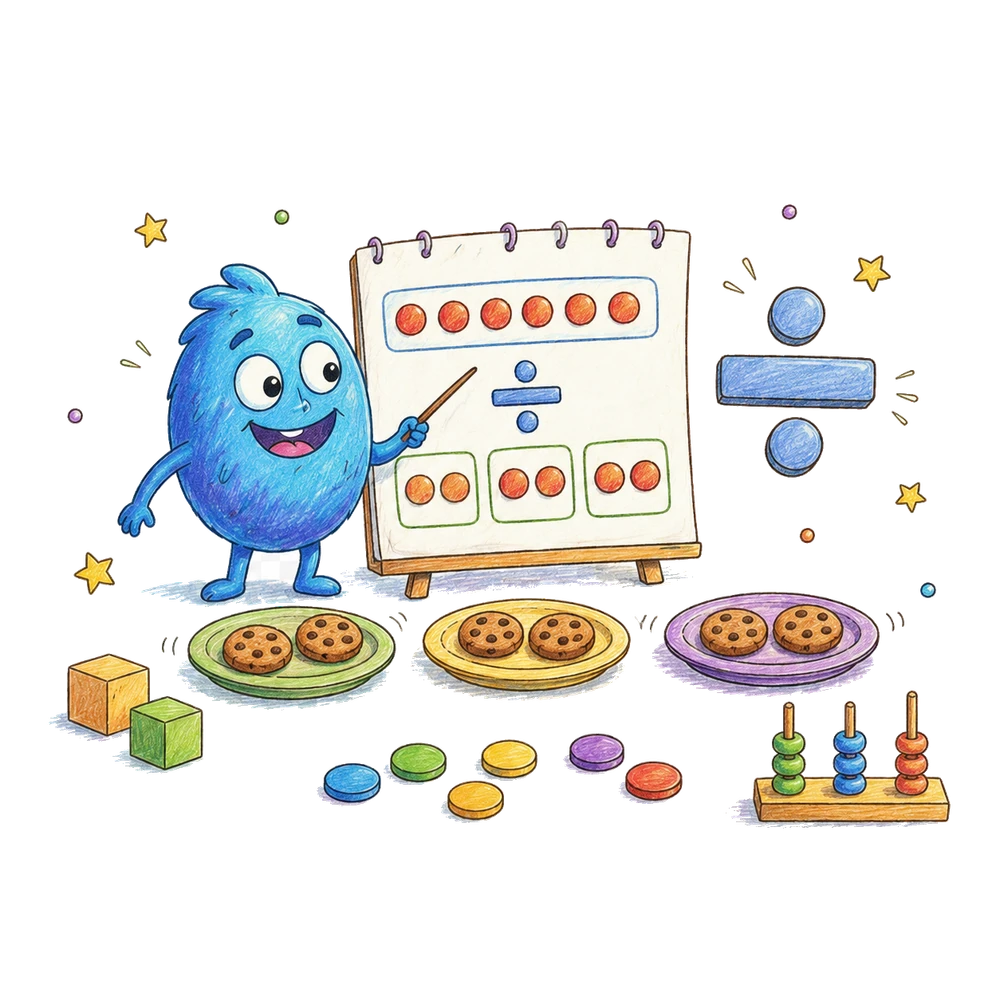
A child can solve an addition problem with a chosen support and then review one step using a second representation. Try 28 + 17 and check how the total was formed.
Practice independently, then review one decision
Independent practice can include asking for help, using a reference, and checking a result. In this example, a child works on 28 + 17 and then reviews the calculation with a second representation. The child decides how much support to use and whether to continue after the review.
The goal is to connect a proposed answer with a visible check, not to complete a fixed number of problems alone. Paper, a pencil, and an optional set of tens-and-ones drawings are enough. A partner can write or point under the child’s direction.
Prepare a clear work area
Write “28 + 17” on a sheet with space beneath it for the child’s method and a separate area for a check. Provide a pencil and an eraser if useful. A child who prefers a communication device or to dictate can direct an adult to record each step.
Agree on what help is available before starting. A number line, place-value drawing, or adult reader can be used without making the practice less independent. Independence concerns the child’s decisions and access, not a requirement to work without support.
Choose a way to begin
The child may add tens and ones, use a written vertical method, draw groups, or choose another approach. Ask, “How would you like to start?” Do not require the method shown below if the child has a different valid plan.
If the child wants a starting suggestion, show 28 as 20 + 8 and 17 as 10 + 7. Keep the written expression visible. The child can point to the tens and ones or ask an adult to make the drawing.

One possible calculation
Combine the tens: 20 + 10 = 30. Combine the ones: 8 + 7 = 15. Then combine the parts: 30 + 15 = 45. Write the steps separately so the child can see where each number came from.
Another valid route is to add 10 to 28 to make 38, then add 7 to reach 45. The two methods organize the same addition differently. The child can choose either or explain a different correct method.
A sample conversation
Adult: “Would you like to solve this first, or would you like a starting idea?” Child: “I will add the tens and ones.” The child writes 30 for the tens and 15 for the ones. Adult: “What will you do with those parts?”
Child: “Put them together: 45.” Adult: “Would you like to check with a drawing or a number line?” The child chooses. The adult follows the choice and does not immediately replace the child’s work with another method.
Review with tens and ones
Draw two tens and eight ones for 28, then one ten and seven ones for 17. Together the drawing has three tens and fifteen ones. Exchange ten ones for one ten in the representation, leaving four tens and five ones: 45.
The exchange changes the grouping, not the total. If drawing individual ones is cumbersome, use labeled groups that the child understands. Check that the drawing represents both starting numbers accurately before using it to review the answer.
Review with a number line
Start at 28. Move forward 10 to 38, then forward 7 to 45. The two moves add 17 altogether because 10 + 7 = 17. Label the start, intermediate point, and endpoint.
A number line need not show every unit if the larger moves are labeled clearly. If the child prefers, split the seven into two and five: 38 to 40, then 40 to 45. Check that the total movement remains 17.
Compare the answer and the check
If the calculation and the check both produce 45, ask whether each representation actually included 28 and 17. Agreement is encouraging, but two methods can share the same error if both omit a part.
Point to the 20 and 8 in the first number, and the 10 and 7 in the second. On the number line, show the starting 28 and moves totaling 17. This review checks the meaning of the work, not only the final numeral.
A different answer in the check
Suppose the written calculation gives 45 but the number line ends at 44. Ask the child to show the starting position and the two moves. Perhaps the second move was only 6; inspect the marks rather than assuming.
If the line shows 28 to 38 and then 38 to 44, the second move is 6, so the line represents adding 16 rather than 17. Add the missing unit or redraw the check with the child’s agreement. The written calculation can remain visible.
If the original calculation is wrong
Suppose the child combines the ones as 8 + 7 = 14 and obtains 44. Use a drawing or a familiar counting strategy to examine the ones. Eight and seven make fifteen, so the parts are 30 and 15, giving 45.
Ask whether the child wants to correct the original step, write a new version, or explain the change orally. Do not erase their work before they have a chance to show the reasoning. The incorrect step can help identify what needs review.
Check with subtraction
A related check is 45 − 17 = 28. Subtract 10 from 45 to get 35, then subtract 7 to get 28. This supports the proposed total because removing one addend returns the other.
This is useful only if the child understands or can follow the subtraction. It is one possible check, not a requirement. If subtraction introduces a separate difficulty, use the tens-and-ones drawing or number line instead.
Use an estimate as a reasonableness check
A rough estimate can show whether an answer is in a plausible range. For example, 28 is near 30 and 17 is near 20, so their rounded sum is about 50. An exact answer of 45 is reasonably close to that estimate.
Rounding changes the numbers, so the estimate does not prove that 45 is correct. A result close to 50 could still be wrong. Use an exact representation to check the arithmetic when an exact answer is required.
Choose a shorter problem
If 28 + 17 requires too many steps, try 12 + 5. Show one ten and two ones, add five ones, and count 17. A number line from 12 forward five intervals reaches the same result.
The child can stop after one method or compare both if interested. The smaller example keeps the review step while reducing the amount of regrouping. It is not a punishment for finding the first problem difficult.
Offer a further challenge
If the child wants another example, try 36 + 18. One route is 36 + 10 = 46, then 46 + 8 = 54. A tens-and-ones drawing can also show three tens plus one ten and six ones plus eight ones.
The fourteen ones can be regrouped as one ten and four ones, giving five tens and four ones. Check that both models represent the same addends. Keep the new problem separate from the previous one.
Make the review a choice
After solving, offer specific check options: a drawing, a number line, or explaining the steps to a partner. The child may choose one or ask for a different support. A review can focus on a single uncertain step rather than repeating the whole solution.
If the child is tired or finished, pause and return later only if they want to. The review is meant to make the result understandable, not to extend the activity indefinitely.
A partner listens without taking over
The child can explain a step while the adult asks a focused question: “Where did the 15 come from?” The child points to 8 and 7 or shows the ones in a drawing. The adult waits before supplying an explanation.
If the child requests help, offer the specific support requested, such as reading a number or drawing the groups. A partner can correct their own misunderstanding when the child clarifies. The child’s method remains visible.
Accessible ways to record the work
Use large print and space between steps. The child can dictate, point to choices, use a communication device, or ask an adult to move a marker. A number line or place-value drawing can be made at a size the child can see comfortably.
Confirm an unclear selection before writing it. A child need not independently hold a pencil to make mathematical decisions. Familiar accessibility tools remain available during both the calculation and the check.
A common error: checking only the final answer
Seeing 45 in two places does not ensure that both models correctly represent 28 + 17. Inspect the starting amounts and operations. A copied answer in the check area is not an independent representation.
Ask the child to show how the check was made: which group represents 28, which represents 17, or how far the marker moved. A correct answer and a correct explanation support each other but are separate things to inspect.
A common error: removing all support
An adult may assume independent practice means no alphabet, number line, calculator, or human assistance can be used. In this activity, the child can choose an appropriate reference or ask for a specific accommodation.
If the goal is to practice a particular written method, explain that goal and agree on useful supports. Do not silently change the task into a test of working without tools. The child’s understanding can be expressed in more than one way.
Notice what the review revealed
Afterward, consider whether the child identified the addends, showed the regrouping, or found a missing step on the number line. The check may confirm a correct process or reveal a specific point to revisit.
Do not use one example as a developmental assessment or compare speed with another child. The child can choose to save the page, revise it, or put it away. One reviewed calculation may be a complete session.
Set a goal for the review
Before solving, ask which part the child wants to check afterward: the addition of the ones, the regrouping, or the total. The goal may change as the child works. Write a short reminder only if the child wants one.
For 28 + 17, the child might be unsure whether 8 + 7 is 14 or 15. A focused review can draw those fifteen ones and count them. It need not repeat every step if the remaining parts are already clear to the child.
If a broader check reveals another issue, discuss it without treating the initial focus as a mistake. A review is a way to gather information about the work, not a fixed ritual.
Read the expression before calculating
Point to 28, the plus sign, and 17. Read “twenty-eight plus seventeen” or let the child indicate the numbers with a communication tool. Ask what operation the plus sign requests.
If the child wants a story, imagine 28 paper marks and 17 more being added. No physical collection of 45 objects is required. The story should describe combining amounts, not removing one group.
Keep the written expression available during the review. A second representation must refer to these same two quantities; changing one addend produces a different problem.
Represent twenty-eight in place-value parts
Write 28 = 20 + 8. Draw two labeled tens and eight individual marks. Ask the child to show which part represents twenty and which represents eight. The drawing need not use small physical counters.
If the child points to the digit 2 as two individual ones, connect its position to the two groups of ten. The 2 in 28 represents twenty, while the 8 represents eight ones.
A child can direct an adult to add or move marks. Confirm the arrangement before proceeding to the second addend, so an error in the starting representation can be corrected early.
Represent seventeen in place-value parts
Write 17 = 10 + 7. Draw one ten and seven ones separately from the representation of 28. The child can point to the written digits and the matching groups.
Keep the two addends visually distinct until the child chooses how to combine them. Labels or separate spaces can help. If a drawing has six ones instead of seven, add the missing mark before using it as a check.
The decomposition is one method, not a demand that the child always draw every unit. It is useful here because the review can inspect where the tens and ones came from.
Combine the tens in the drawing
Two tens from 28 and one ten from 17 make three tens, or 30. Move the drawn groups together or enclose them with a line if the child wants to show the combination.
Do not count the digit 2 and the digit 1 as three individual ones. They describe groups of ten in these positions. The physical or drawn grouping makes that value visible.
The three tens are only part of the final answer. The eight and seven ones still need to be included. Ask the child where those marks are before moving to the next step.
Combine and regroup the ones
Count eight ones and seven ones. One strategy is to pair two of the seven with eight to make ten, leaving five. The fifteen ones can be represented as one additional ten and five ones.
Add that additional ten to the three tens already present. Four tens and five ones represent 45. Point out that regrouping does not create or remove units; it changes how the same fifteen ones are organized.
If the child prefers to count all fifteen marks, that is also valid. Use the strategy that helps them understand the check rather than requiring a particular mental shortcut.
A vertical written method as another representation
A child may write 28 above 17 with ones aligned under ones and tens aligned under tens. In the ones column, 8 + 7 = 15: five ones remain in that column and one ten is regrouped with the tens. The tens then total 2 + 1 + 1 = 4.
The result is 45. The written regrouping should be connected to the drawing of fifteen ones becoming one ten and five ones. If the child’s notation differs, ask them to explain how it represents the same value.
A vertical method is optional. If column alignment is difficult to see or write, a place-value drawing or number line can support the calculation instead.
Check the number-line moves
On a line with a clear starting mark at 28, draw an arc labeled +10 ending at 38. From 38 draw another arc labeled +7 ending at 45. Read the labels together: the added parts total 17.
The endpoint labels are positions, while the arc labels describe the size of the moves. A child may check the second arc by counting seven unit steps if the line has appropriate marks.
If the drawn arc ends at 44, compare the labels and positions. A move from 38 to 44 has size 6, so it does not match the +7 label. Revise the drawing with the child’s agreement.
A specific error in the tens
Suppose a written method says 20 + 10 = 40. Ask the child to show two tens and one ten. Count the groups: three tens make 30. The visible groups isolate the part that needs attention.
The ones calculation may already be correct. Preserve it while revising the tens step, then recombine the parts. Avoid asking the child to redo every part when the specific mismatch is known.
After revision, the child can choose whether to check the full result on a number line. A focused correction can be enough if it answers the child’s review question.
A specific error in the ones
If the child writes 8 + 7 = 14, draw eight marks and seven separate marks. Count all fifteen or make ten by moving two from the seven to the eight. Show the remaining five.
Ask the child whether they want to update the written step or make a new copy. The original mark can remain visible for discussion. Correcting one part does not require erasing the child’s work without permission.
After using 15 for the ones and 30 for the tens, combine them to obtain 45. Check that both parts came from the original addends.
A specific error in regrouping
A child may correctly find fifteen ones but write the final result as 35 by leaving the extra ten out of the tens total. Show three tens and fifteen ones, then group ten of those ones as another ten.
Count four tens and five remaining ones. The total is 45. The moved group is not an extra amount added from outside; it is a new grouping of ten existing ones.
The child can use a drawing, physical pieces, or a verbal explanation. Ask which version makes the exchange understandable and leave the reference available.
Record a question for a teacher or caregiver
If the child remains uncertain, they can write or dictate a specific question: “Why does ten ones become one ten?” Keep the drawing beside the question if that helps explain the confusion.
The child decides whether and when to show the work to a teacher or caregiver. An adult can help prepare the question without sending it to anyone on the child’s behalf unless that communication is agreed.
A precise question can be more useful than a general statement that the answer is wrong. It identifies the step the child wants help understanding.
Finish with the child’s chosen next step
After reviewing the calculation, ask whether the child wants to keep the page, make a correction, ask a question, or stop. If the child chooses to save it, the original work and the check can remain together so the reasoning is visible later.
A second problem is optional. The child can return to 28 + 17 another day or choose a different activity. Finishing one review does not require a timed set of additional calculations.
Continue on BrainHunters
If the child wants a separate screen activity, explore numbers on BrainHunters together and read the instruction shown. A site activity may use a different operation or representation.
The paper calculation is not automatically recorded on the site. A screen is optional; a visible review of one arithmetic step can stand on its own.
Helpful answers
Does independent practice mean no help?
No. A child can choose references, accessibility tools, or a partner’s specific assistance while directing the work.
Does a similar estimate prove the exact answer?
No. An estimate can flag an implausible result but does not establish exact arithmetic.
What if the check gives a different result?
Inspect the starting quantities and each step in both representations, then revise the part that does not match the intended calculation.
Turn a little idea into an adventure.
Try a short activity together, then bring the discovery back into your day.
Letters and early reading practice