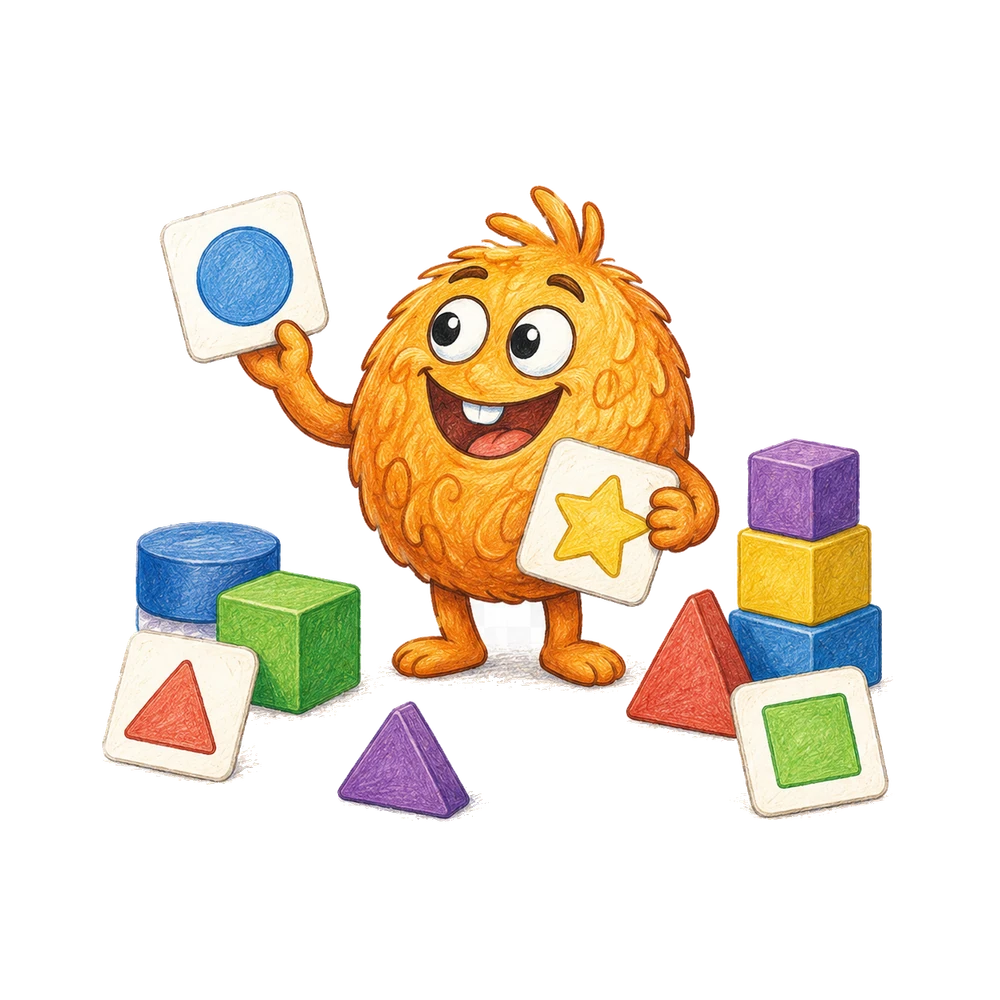
Naming a shape is a starting point. By tracing sides, finding corners, and comparing examples in different positions, a five-year-old can explain what they notice and give another person a useful clue.
From a name to a useful description
A child may quickly name a triangle or rectangle and still be working out which features make that name useful. Describing the straight sides, corners, and curves of a shape gives the child a way to compare examples, explain a choice, and recognize a familiar shape when its size or orientation changes.
This activity focuses on noticing and describing visible features of flat shapes. The child does not need to memorize a formal definition or count perfectly to participate. Pointing to a side, tracing a corner in the air, or directing an adult to a shape can communicate an observation alongside spoken words.
Gather a small set of shapes
Cut or draw large shapes on paper: two triangles of different sizes or orientations, a rectangle, a square, and a circle. Use sturdy paper if it makes the pieces easier to handle. An adult can prepare the pieces; the child does not need to use scissors. Drawn outlines on a single page work if loose pieces are inconvenient.
Make the outlines clear and leave room between them. A thick dark line on a plain background can help a child see the edges. Choose shapes without tiny detachable parts and adapt the materials to the children present. Keep a blank sheet and a drawing tool nearby for a later experiment.
Start with what the child notices
Place a triangle and a circle in view. Say, “What do you notice about these?” The child might say “This one is pointy,” point around the circle, or name a color. Respond to the observation before adding a mathematical word: “You found a point where two sides meet. We can call that a corner.”
If the child names colors instead, acknowledge the response and make the shape feature visible: “The triangle is yellow. Let’s follow one of its sides with a finger.” Color is a real property of the object, but the activity investigates the boundary. A child can follow with a gaze or ask the adult to trace.
Trace a side and find its ends
Point to one straight edge of the triangle. Move a finger from one corner to the next and say, “This straight part is one side.” Stop at the corner rather than moving continuously around the whole outline. Invite the child to choose another side and show where it begins and ends.
For a paper piece, the side is the straight portion of its boundary; the filled interior is not an additional side. A thick drawn line has width, so follow its general path rather than demanding that the child touch one precise pixel. The goal is to distinguish one boundary segment from the whole shape.
Count sides without losing the starting place
Ask the child whether they want to count the triangle’s sides. Choose one side, touch it, and say “one.” Continue around the boundary, touching each new straight side once: “two, three.” A small removable marker beside the first side can help show where the count started. Remove it afterward if the child finds it distracting.
If the child says four, ask them to show the sides they counted. They may have counted a corner as a side or returned to the first side. Trace the path together and stop when it reaches the starting point. Avoid simply announcing the correct number; seeing where the count repeated is more informative.
A conversation about corners
Adult: “Where do two sides meet?” Child: “Here, at the point.” Adult: “Yes, that is one corner. Can you find another one?” The child points to a second corner. The adult can then ask whether the child wants to find the last corner or compare this shape with another.
If the child points to the middle of a side, show the nearest end: “This part is straight. The corner is where this side meets the next side.” Let the child trace both sides toward their meeting point. A rounded paper corner caused by cutting is still a practical approximation of the intended geometric corner.
Compare two triangles
Put a large triangle beside a smaller one. Turn the second so that one corner points sideways. Ask, “What is the same about their sides and corners?” The child may notice that each has three straight sides, even though the outlines are not the same size and do not point in the same direction.
If the child says the sideways shape is not a triangle, rotate it slowly while keeping it on the table. Ask the child to count its sides before and after the turn. Turning the paper changes its orientation but does not add or remove a side. A triangle need not rest on a horizontal edge to be a triangle.
Compare a triangle and a rectangle
Place a triangle next to a rectangle and invite the child to trace their boundaries. Count the straight sides of each if the child wants to: three on the triangle and four on the rectangle. Ask, “Which shape has one more side?” A child can also place one marker beside each side to compare the two sets.
If counting is tiring, compare one feature first: “Can you find a corner on each?” Then show the extra side as a separate observation. Both shapes have straight sides and corners; a description can include what they share as well as what makes them different.
Look closely at a square and a rectangle
Offer a square and a non-square rectangle. Both have four straight sides and four square corners. In the square, all four sides are the same length. In the non-square rectangle, the two long sides match each other and the two short sides match each other. Let the child compare edges by placing the pieces together when practical.
A square is also a rectangle: it has four right angles. Everyday picture books sometimes present “square” and “rectangle” as separate categories, but mathematically a square belongs to the rectangle family. The child can use either accurate name for a square; the more specific word tells a listener that all four sides match.
Make equal length visible
Choose two paper rectangles whose edges can be aligned. Place a corner of one at a corner of the other, then compare the ends of two sides. Ask, “Do these sides reach the same place?” The child can point to the endpoints or move one shape to make the comparison easier.
Do not judge equal length solely from the color or position of an edge. A long side that slants can look shorter than a horizontal side even when they match. Rotating a piece or using a strip of paper as an informal length marker can make the comparison clearer. Measurement with a ruler is optional.
Explore a circle without inventing corners
Trace around the circle and notice that its boundary is curved all the way around. Unlike the triangles and rectangles in this activity, it has no straight sides or corners where two straight sides meet. The child might describe the boundary as “round,” “curvy,” or “like a wheel.” Those observations can all start a discussion.
If a circle printed from pixels or cut with scissors looks slightly uneven, explain that it is a drawing or model of a circle. Focus on the intended curved boundary rather than counting small irregularities in the paper. Compare it with the straight edges of a rectangle drawn on the same sheet.
Use a description to find a shape
Spread the prepared shapes apart. The adult chooses one without pointing and gives a clue: “I am thinking of a shape with three straight sides.” The child can point to either triangle. If both triangles match, accept both and add another clue only if you intend to identify a particular piece: “It is the smaller one.”
Next let the child choose a shape and give a clue. The child may say “It has corners” or “It is blue.” Several pieces may fit. Instead of calling the clue wrong, show two possibilities and ask whether the child wants to add a detail. A useful description depends on what the listener needs to distinguish.
Respond when a clue has more than one answer
Suppose the child says “four sides,” and both a square and a rectangle are on the table. Point to both: “These each have four sides. Which one were you thinking of?” If the child chooses the square, ask whether they want to add “all the sides are the same length” or simply point to the intended piece.
This exchange demonstrates that a true clue can still leave more than one possibility. It does not mean the child failed. When playing again, the adult can deliberately offer a broad clue and let the child explain why two shapes qualify. That makes uncertainty part of the game rather than a mistake.
Try a shape that does not match a clue
The adult says, “Find a shape with three straight sides,” and the child chooses a rectangle. Ask the child to show the sides they noticed. Count each straight edge together while the child points or directs the adult. If four sides are found, place the rectangle nearby and ask whether another piece might match three.
A child may have chosen by color, heard a different number, or interpreted the task as choosing any shape. Clarify without assigning a reason: “I was asking about the number of straight sides. Let’s look at this edge together.” If the child does not want another attempt, end the game or return to free exploration.
Build an outline with larger materials
Use long strips of paper to make a triangle outline on a table. Place three strips so their ends meet. The child can move a strip while the adult holds another, or tell the adult where to place each one. Count the strips as sides and point to the places where neighboring strips meet.
Next arrange four strips as a rectangle. If the strips overlap at the corners, explain that they represent the sides of the outline; the overlapping ends are not extra sides. Choose materials suitable for the child and avoid narrow loose pieces when they are unsafe. Large drawn lines provide the same comparison.
Change one feature and describe the result
Draw a triangle and a separate four-sided figure. Ask the child to compare the number of sides. On a fresh sheet, show how adding another corner to a simple closed outline can result in a four-sided figure. The exact figure depends on where the new point is placed, so draw the complete new outline instead of adding an unrelated line inside the original.
The child may want to make the change on their own sheet. Ask, “How many straight sides does your new outline have?” Count the boundary together. An interior decoration or a line that does not form part of the boundary does not automatically become another side.
Compare shapes inside a drawing
Draw a simple playground scene or invite the child to make an imaginary one. A slide might contain a triangle; a sign might be a rectangle. Ask the child to choose one shape in the drawing and describe its outline. If lines overlap, trace the intended boundary so both people know which shape is being discussed.
A real playground object may be three-dimensional, while the drawn outline is flat. Say “the rectangular outline of the sign” rather than suggesting the whole physical sign is a flat rectangle. The child can also draw an invented shape and explain which parts are straight or curved.
Connect a flat shape with an everyday object
Look at the front face of a book or a rectangular sheet of paper. Trace its visible boundary and compare it with the paper rectangle. A book has thickness, while the face being considered can be described approximately as rectangular. Ask whether the child can find another flat face with four straight edges.
Perspective can make a rectangle look like a slanted quadrilateral from an angle. Move the book or look more directly at its face before comparing. Rounded corners or decorations can also make an everyday object an imperfect model. These details are worth acknowledging rather than forcing every object into an exact category.
Investigate a rotated square
Place a square with one side roughly horizontal, then rotate the same piece until a corner points upward. Ask what changed and what stayed the same. The child can observe that it looks like a diamond, then count the four sides or compare their lengths. The same square remains a square after it turns.
“Diamond” can describe how a shape looks in everyday speech, but it is less precise than naming its properties. Not every diamond-shaped quadrilateral is a square. In this particular example the piece is a square because it has four equal sides and four right angles, regardless of which corner points upward.
Let the child draw a clue
Ask the child to draw a closed outline for the adult to find or describe. The child may draw three lines that almost meet, a rounded shape, or a figure with several crossing lines. Ask which boundary the child intended before counting. Drawing precision is not the same skill as noticing shape properties.
If the child wants help closing a gap, offer to point to the two endpoints or draw on a separate sheet. Do not take the crayon and correct the picture without permission. Once the outline is clear enough to discuss, the child can decide whether to count its sides or invent a name for it.
Make the task more accessible
Start with two large outlines rather than a full set: a triangle and a circle, for example. Use contrasting colors against the background while making clear that color does not define the shape. A raised outline or a thick strip attached securely to a page may provide another way to follow the boundary if that suits the child.
The child can direct an adult to trace, indicate a corner with a gaze, or use a communication device to choose “straight” or “curved.” Allow time for the response and position materials where the child can see or reach them. Adaptations support participation; they do not require the child to use one particular gesture or word.
Offer a further challenge
Add a four-sided figure that has no right angles, such as a clearly drawn parallelogram, and compare it with a rectangle. Both have four straight sides, so side count alone cannot identify a rectangle. A child can notice that the corners look different without being required to measure angles.
Another challenge is to choose two different shapes that share a feature, then describe both the shared feature and a difference. A triangle and a square both have straight sides and corners, but their side counts differ. Let the child choose whether to explain with words, pointing, or an arrangement of pieces.
Play with another child
Give each participant a set of visible shapes or let both use one shared set. One child selects a shape and describes a feature; the other points to a match. Then invite a role change. If several pieces fit the clue, both children can look for another detail rather than treating the first choice as a failure.
Avoid comparing who names shapes faster. One child may trace the outline while another speaks; both actions can contribute to the description. If a child does not want to hand over a personal piece, use a different set or draw the shapes on a shared sheet.
Listen for the feature the child is using
After the activity, notice whether the child pointed to individual sides, recognized corners, compared a rotated example, or revised a clue after finding two matches. These observations can guide the next invitation. They are not a score and do not establish a developmental diagnosis.
If the child consistently uses color to find a shape, try two pieces of the same color with different outlines. If the child counts one side twice, mark the starting side. Each adjustment responds to a specific difficulty in this game. Stop when the child is finished rather than adding more items for the sake of a longer session.
Look for a right angle
Show the corner of a rectangular sheet of paper. Place it against a corner of the drawn rectangle, aligning one edge of the sheet with one edge of the rectangle. The second edge provides a practical way to compare the opening at the corner. Repeat at another corner if the child is interested.
A paper corner is an approximate model, especially if it is bent. The purpose is to notice a feature shared by the square and rectangle, not to demand an exact measurement. A slanted parallelogram can still have four straight sides while its corners do not match the paper corner. Let the child observe this difference before introducing the term “right angle.”
Distinguish an outline from a line inside it
Draw a rectangle and add a line from one side to another inside it. Ask the child to trace the outside boundary in one color. The outside still has four sides. The interior line may divide the drawing into smaller regions, but it does not give the original rectangle a fifth outside side.
Now invite the child to choose one of the smaller regions and trace its own boundary. That region can have its own sides and corners. Clarify which outline you are discussing before counting; a page can contain a large shape and several smaller ones at the same time.
A clue that combines two features
Place a circle, a triangle, a square, and a non-square rectangle on the table. Say, “I am thinking of a shape with four straight sides, and all four sides are the same length.” Give the child time to inspect the pieces or compare their edges. The square fits both parts of that clue.
If the child points to the non-square rectangle, first confirm the accurate part: “Yes, it has four straight sides.” Then compare a long side with a short side and ask whether they reach the same length. The child can change the answer or ask for another clue. Explain which two features you used without treating the first choice as a careless mistake.
Continue with a new set of examples
On another day, offer shapes with new sizes or orientations and ask the child to choose which ones to compare. Keep at least one familiar piece so the child can connect the new example with a known boundary. A shape’s color, size, and position can vary while its defining properties remain the same.
If the child wants a screen activity, explore shapes on BrainHunters together and read the prompt actually shown. The paper activity is separate and is not automatically recorded as an answer in the child’s account. A brief conversation about a single chosen shape can also be a complete activity.
Helpful answers
Is a square also a rectangle?
Yes. A square has four right angles, so it is a rectangle; it also has four sides of equal length.
Does turning a triangle change its shape?
No. Turning it changes its orientation. Its three straight sides and three corners remain.
What if my child calls a circle a wheel?
A wheel is a familiar comparison. Trace the curved outline together and compare it with a shape that has straight sides.
Turn a little idea into an adventure.
Try a short activity together, then bring the discovery back into your day.
Shapes and object practice