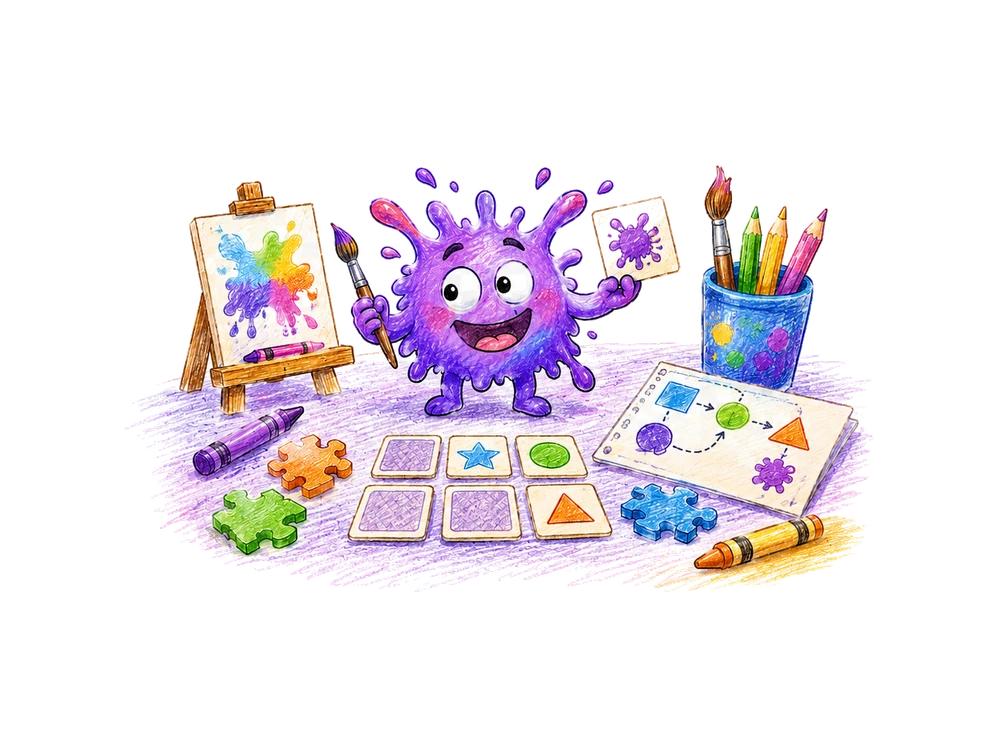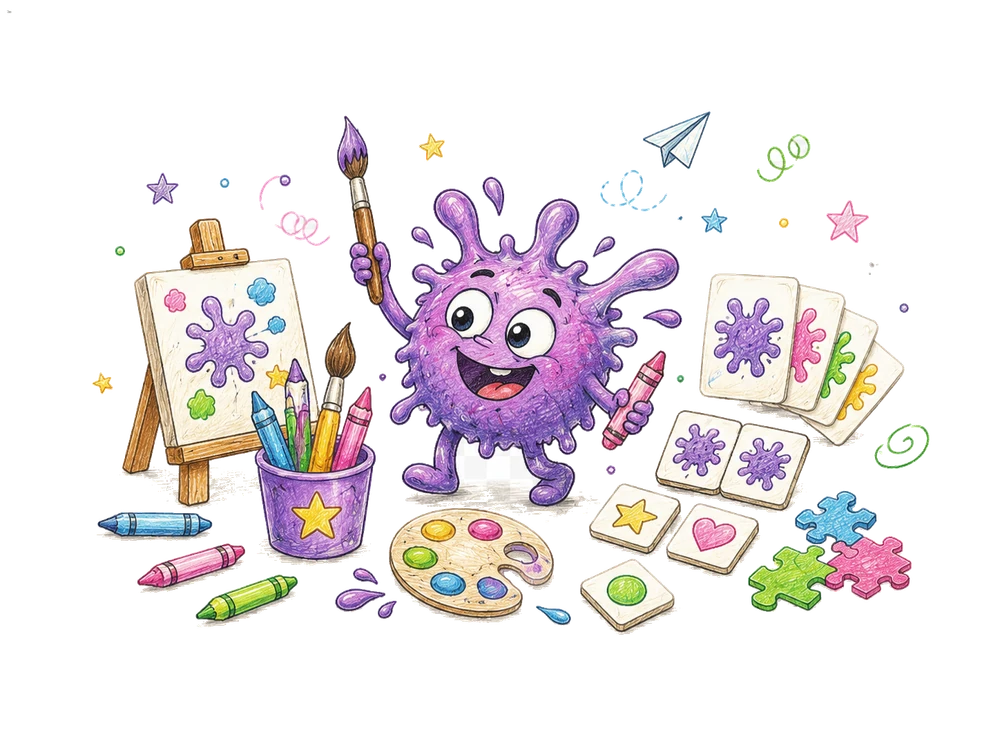
A drawing can give a four-year-old a way to share a story, make a plan, or show someone an idea. This activity offers paper and a comfortable tool, then follows the child’s explanation instead of testing whether an adult can recognize the picture.
Prepare a simple drawing space
Offer a sheet of paper and two or three drawing tools the child can use comfortably, such as chunky crayons or washable markers. A firm surface helps. Tape a corner of the paper if it slides, or let the child draw on a larger sheet placed on the floor. Keep caps and other small parts away from children who might put them in their mouths.
Choose an invitation the child can understand from experience: a trip to a park, a meal, an imaginary animal, or a route around a room. None is required. The child might instead choose a person, sound, feeling, or entirely invented subject. Have a second sheet nearby for the adult, so the adult can model a mark without drawing over the child's work.
Begin with a choice, not a test
Place the paper within reach and say, “Would you like to draw something real, make something up, or choose another idea?” If the choices feel too broad, offer two based on what the child has recently enjoyed: “A bus or a tree?” The child can decline both and start with a line, a color, or a blank page.
Avoid opening with “Can you draw a house?” unless the child has chosen that subject. That question can make the activity feel as if the adult already knows what a successful answer looks like. An invitation such as “What would you like to put on your page?” leaves room for a drawing that looks different from the adult's mental picture.
Watch the marks before naming them
Give the child time to work. Notice what you can actually see: “You made a long curved line,” or “There are three blue marks close together.” Those observations do not assume that the marks are waves, a road, or letters. If the child is concentrating, an attentive pause may be more useful than a running commentary.
When the child looks up or offers the page, ask, “Would you like to tell me about it?” If the answer is no, acknowledge the choice: “All right. I can look quietly.” A drawing can be personally meaningful even when its maker does not want an audience or a spoken explanation.
A sample conversation about a journey
Child: “This is where we went.” Adult: “Where would you like me to start looking?” The child points to a small mark. Adult: “Start here. What happens next?” The child moves a finger along a line and says, “We went to the playground.” The adult follows the route with a finger held above the page, without covering the drawing.
Child: “Then the bus came.” Adult: “Is the bus on the page, or are you telling me that part?” Either answer works. The question lets the child decide whether the line represents the vehicle, the road, movement, or something that has not been drawn. The adult can repeat the child's words accurately instead of supplying a different story.
When the adult cannot recognize the picture
Suppose the child draws a circle and several lines and announces, “This is my dog.” The adult may not see a dog. A useful response is “Tell me about your dog,” followed by a pause. The child might point to a line and name a tail, describe a favorite game, or say that the drawing is finished. The meaning belongs to the child.
Guessing repeatedly can turn the exchange into a puzzle for the adult. If the adult has guessed wrong, a short repair is enough: “I called that a sun, but you said it is the dog's ball. I understand now.” There is no need to erase the guess or ask the child to redraw the ball so others will recognize it.
Give an unfamiliar listener enough context
Invite the child to show the picture to a trusted person who did not see it being made, if the child wants to share. Ask the listener to start with an open request: “What should I know about your drawing?” The child can choose one detail to explain rather than narrate the whole page.
If the listener asks “Where is the bus?” the child might point, add a mark, or say that the bus is outside the picture. These are different ways to supply information. The listener can check understanding by saying, “The blue line is the road, and the bus is coming from here. Did I get that right?” The child can confirm or correct it.
Use drawing to make a practical request
A drawing can communicate an idea that matters beyond the activity. For example, the child might sketch a place to build with blocks and indicate where a bridge should go. The adult asks, “Do you want the bridge between these two towers?” and waits for a response before moving the blocks.
If the adult puts the bridge in a different place, the child can point to the picture and revise the plan together. This exchange practices making a request and repairing a misunderstanding. The drawing does not need to be a scale diagram, and the adult should not treat an unclear mark as permission to decide for the child.
Draw a sequence without requiring a perfect story
Offer a long piece of paper or fold one sheet into two spaces. The child can draw what happened first on one side and what happened later on the other. A familiar example might be putting on boots and then stepping into a puddle. Let the child select an event that is comfortable to recall; avoid asking for a distressing experience as an exercise.
The two spaces are a support, not a requirement that every story have two pictures. A child may use one large image or draw the ending first. Ask, “Which part happened first in your story?” If the child changes the order, follow the new explanation. An invented story does not have to match a real sequence.
Add words only with the child’s agreement
Ask, “Would you like me to write down what you said?” If the child agrees, write the child's exact words on a separate strip or in a space the child chooses. For “The bus is going home,” record that sentence rather than replacing it with a longer adult description. Read it back so the child can change or remove it.
Writing is optional. It may help someone else understand the drawing later, but the child does not have to copy the words or spell them. If the child adds letterlike marks, respond to their intended meaning: “You wrote a sign for the bus.” Do not silently correct the marks or suggest that the picture is incomplete without a label.
When a child says, “I can’t draw”
The child may be comparing a mark with a detailed image or worrying that someone will judge it. Put the tools down and ask whether the child wants help starting, wants you to take a turn, or wants to stop. A small starting point could be “Make any line you like; we can decide what it is afterward,” but offer this only if the child welcomes an idea.
Do not take over and finish the picture for the child. If the child asks for a model, make one on your own paper and explain that it is one possibility: “I made a circle for my wheel. Yours can be different.” The child's decision to use a different shape, or no shape at all, is part of the communication.
When the meaning changes
A line may begin as a road and later become a river. Ask whether the child wants to tell the story again using the new idea. It is fine if both explanations remain possible. Drawing often supports exploration while an idea is developing; a changing account is not by itself evidence of confusion.
A listener who needs to act on the drawing can clarify the current plan: “Is this the river now, or should I still put the toy car on it?” That question matters when people are building or playing together. It should not become a demand that the child maintain one fixed label for every mark.
Respect a private picture
The child may make marks about an experience and not want to show anyone. Ask where the page should go: in a folder, on a shelf, or into recycling. If an adult needs to keep a record for a specific reason, explain the reason in language the child can understand and discuss what can remain private.
Do not post a child's picture or story online simply because it is appealing. A name, a recognizable location, or a personal experience can reveal more than the child intends. For a family display, ask which side should face out and whether the written explanation should be included.
Make the task easier
Offer a choice between making one mark and placing a familiar object on paper for the adult to trace. The child can indicate a location with a finger, gaze, or a communication aid while the adult handles the crayon. The adult should describe the action and check that the result matches the child's intention.
A dark marker on a plain sheet may be easier to see than a pale crayon on patterned paper. A sloped surface or a larger grip may make the tool easier to hold. Use supports the child already finds comfortable; the activity does not diagnose vision, motor, or language differences.
Add a challenge when the child wants one
Ask whether the child wants to add one detail that helps a listener understand the idea: “What could show where the bus stops?” The child may draw a sign, point to an existing mark, or explain that the stop is not shown. An added detail should serve the child's message, not make the page look more realistic.
Another option is to tell the same story to two listeners. After the first conversation, ask, “Is there anything you want the next person to know at the start?” The child may add context or leave the story unchanged. Do not score the two versions against each other or require a longer explanation.
Offer a role for another child
Each child can have a separate sheet and choose whether to share. One child may explain a picture while the other listens, then they can switch if both want to. A listener can point to a detail and ask what the artist wants them to know about it. The artist can answer, change the topic, or keep that detail private.
If they want a shared page, agree on the space before either child draws. One might draw a path and the other add a place along it. Check before changing someone else's marks: “May I add a bridge here?” Shared drawing is a chance to negotiate a plan, not a contest for the most recognizable picture.
An adult mistake: giving the picture a label too soon
An adult may say, “What a lovely flower,” when the child intended a helicopter. Even a friendly label can redirect the child's explanation or leave the child feeling unheard. Replace the guess with an observation and a question: “I see a circle with lines around it. What would you like to tell me about it?”
If the child already heard the wrong label, correct yourself without asking the child to reassure you. “You said helicopter. Thank you for telling me.” Then follow the child's next cue. The child might show how it moves, point to a landing place, or prefer to keep drawing without further questions.
An adult mistake: asking too many questions
Several questions in a row can interrupt the work and make the child search for answers instead of developing an idea. Start with one invitation and wait. If the child answers briefly, treat that as a complete contribution. A smile, a point, or a request for another color can be a sign to continue the drawing rather than the conversation.
The adult can also share a concise observation without requesting a response: “That line goes all the way across the page.” Then leave space. If the child asks for a response, offer one related to the child's meaning: “I see where the bus is going now.” Stop discussing the picture when the child asks to stop.
Notice communication, not drawing level
After the activity, consider whether the child had a way to express the chosen idea and whether the listener responded to that idea. Did the child point to a location, choose between two possibilities, revise an explanation, or indicate that the drawing was private? These observations can guide the next invitation.
Do not use the number of colors, the realism of a person, or the length of an explanation as a score. A quiet child who chooses not to explain has also communicated a preference. A drawing activity on its own cannot determine whether development is typical or whether a child needs professional support.
A second example: designing a place for a toy
Put a toy on the table and ask whether the child would like to draw a place for it. The child might make a box and say, “This is the bed.” The adult can ask, “Where would you like the toy to go in?” If the child points to one side, place the toy there and ask whether that matches the plan.
The child may discover that the toy does not fit on the drawn bed. Offer a choice: make the bed larger, use a smaller toy, or pretend that it fits. Each choice changes the play in a different way. Avoid presenting the mismatch as a drawing error; the point is to communicate and adjust an idea together.
A third example: a picture for a family member
If the child wants to make a picture for someone, ask what the recipient should notice. The child might draw a plate and explain that it is a favorite meal shared together. Offer to write a short message in the child's words, but leave the picture uncaptioned if that is the child's preference.
Before giving the picture away, check that the child is ready: “Would you like to keep this, give it to Grandma, or decide later?” Families use many names for relatives and caregivers. Use the name the child actually uses, and choose a recipient who is present and appropriate for that family.
Include gestures and communication tools
A child who uses a communication board or device can select words, point to symbols, or combine a gesture with a drawn mark. Position the tool where the child can reach or see it, and allow enough time for a response. Ask the child's usual communication partners how they interpret a particular signal when necessary.
Do not require spoken naming before responding to the child's idea. For example, if the child points to a picture of “outside” and then to the drawn door, the adult can say, “You want the toy to go outside through this door. Is that right?” The child can confirm or correct the adult in an available way.
Return to an earlier drawing
If the child chooses to keep the page, look at it another day and ask, “Do you remember anything you want to tell me about this?” The child may remember a different detail, make up a new story, or say no. A changed story does not require correction. The page can support a new conversation without serving as a memory test.
If the child wants to add a mark, ask where it should go. If the adult recorded words earlier, read them only with the child's agreement and ask whether they still describe the picture. The child may want a new label on a separate strip so both versions can be kept without altering the original.
Connect marks with shapes when it serves the idea
A circle, square, or long line can help a child describe a feature of a drawing: “The wheel is round,” or “The door has straight sides.” Follow the child's purpose. If a wheel is drawn as a square in an imaginary vehicle, ask about the vehicle rather than insisting on a round wheel.
For a separate screen activity, explore shapes on BrainHunters together if the child wants to. Read the actual prompt and let the child respond in an accessible way. The drawing made at home is a separate activity and is not automatically recorded as a response on the site.
Use a drawing to solve a small play problem
Imagine that a child wants a toy animal to reach a pretend garden, but another toy blocks the way. Invite the child to draw or point out a possible path. The adult might say, “Show me where you want the animal to go.” Follow the indicated path with the toy and ask before moving the obstacle. The child can revise the route or decide that the animal should wait.
If the first idea does not work in play, describe what happened without assigning blame: “The bridge we made is too narrow for this truck.” Ask what the child wants to try. A wider bridge, a different vehicle, or a pretend journey are all possible responses. The picture supports a shared plan; the child's explanation tells the adult how to use it.
For a child who prefers not to draw, an adult can make a mark only after asking where it should go. The child remains the person deciding the route. When the game ends, put the paper where the child chooses rather than treating it as a worksheet that needs to be graded.
A short plan for another day
Set out paper and a comfortable drawing tool, then let the child choose an idea. Observe one visible mark without naming it for the child. When the child offers the page, ask one open question and allow time for a response. Repeat the child's meaning and check your understanding if you need to act on it.
Finish by asking what the child wants to do with the page. A future invitation can build on the same interest: a new route, another place for a toy, or a picture for a chosen person. The next drawing need not look more detailed or follow the same subject to be a useful opportunity for communication.
Helpful answers
Should I ask my child what every part of the picture means?
No. Invite the child to share if they want to, listen to the detail they choose, and respect a wish to draw or look quietly.
Does the drawing need to look realistic?
No. The child can use any marks and explain them with speech, gestures, or a communication tool. Follow the intended meaning rather than judging realism.
Can I write the child’s story on the page?
Ask first. If the child agrees, record their words in a place they choose and read them back so they can change or remove the text.

Turn a little idea into an adventure.
Try a short activity together, then bring the discovery back into your day.
Letters and early reading practice