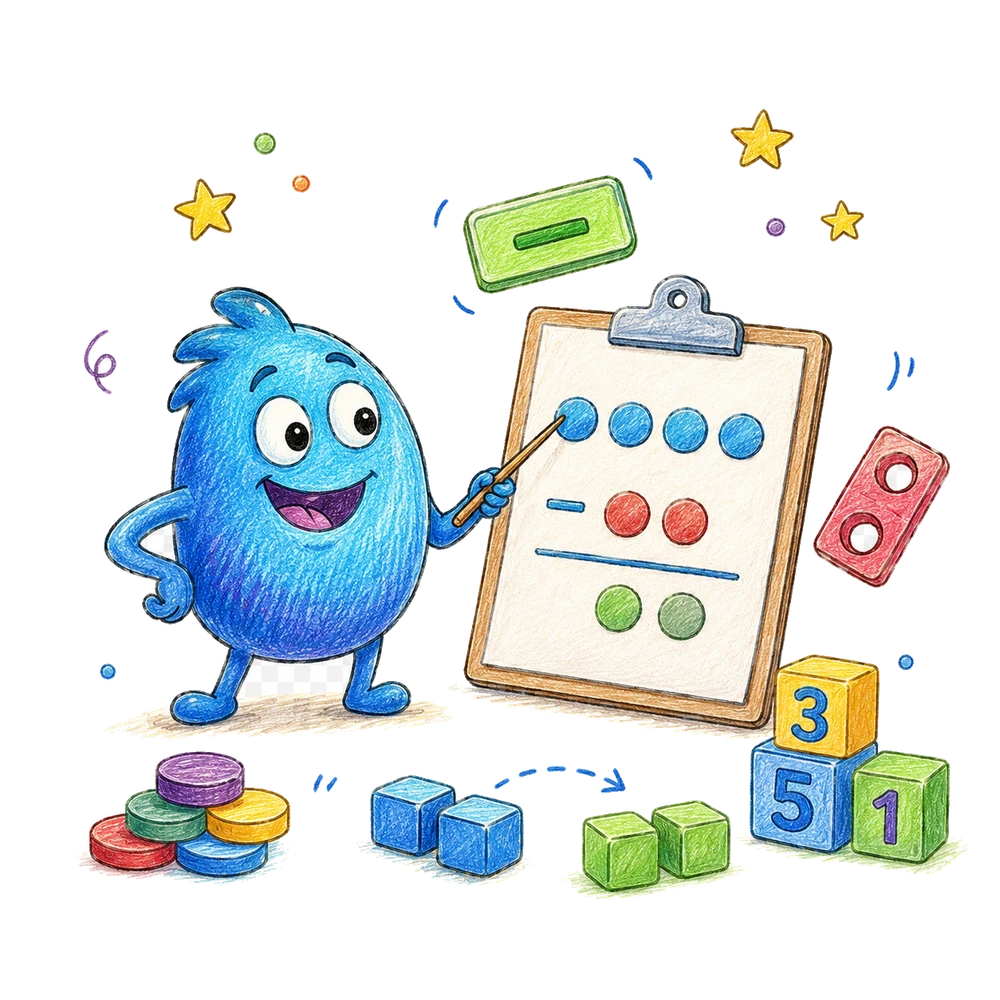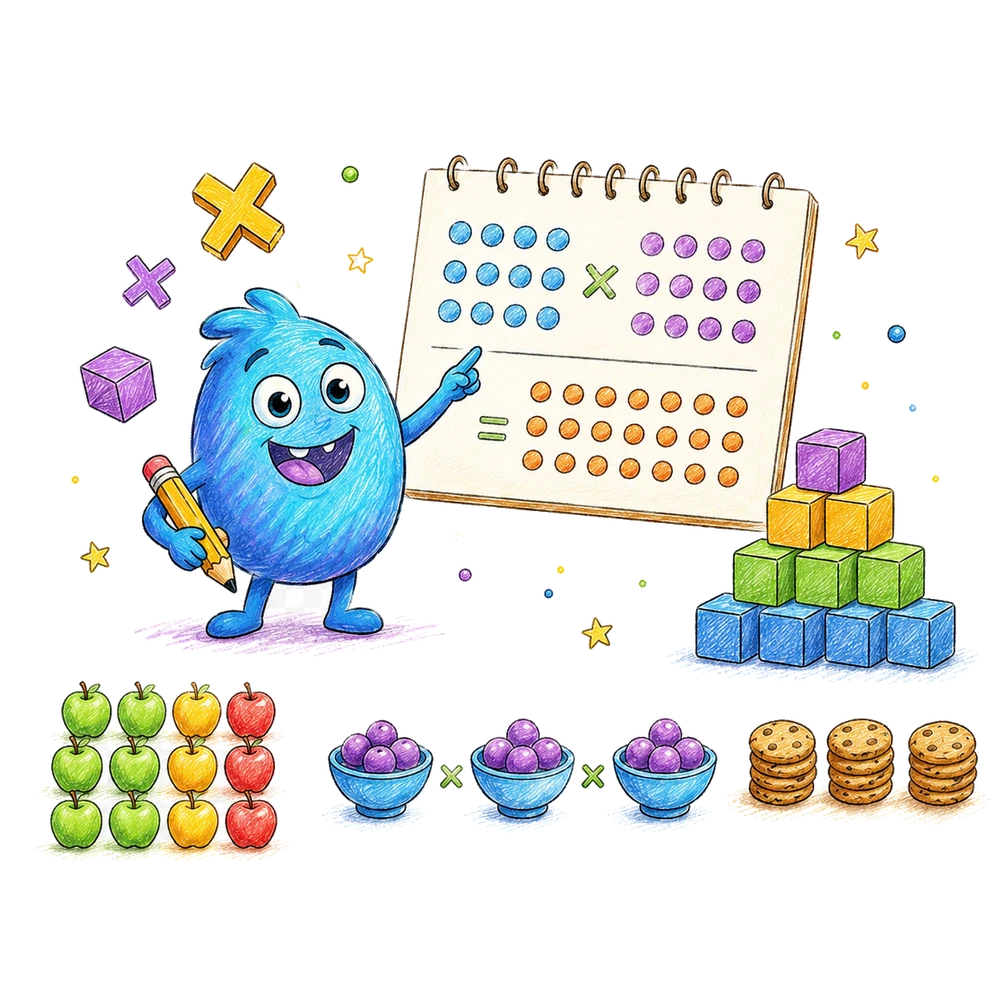
Compare a short sequence of number words with counting three selected objects, then choose the support and pace that fit the child.
Two different questions about numbers
A number song can give a child a familiar sequence of number words and a rhythm to enjoy. Counting objects asks the child to connect one number word with each selected object and use the final word to describe the group's total. A song may include objects, and a counting activity may include a rhythm; the two approaches can overlap.
This comparison uses a short spoken or sung sequence “one, two, three” and three large, safe toy blocks. The child can listen, point, speak, use a communication device or direct a helper. The aim is to see what each activity makes available, not to rank children by how quickly they respond.
The first question is “What number word comes next in this familiar sequence?” The second is “How many blocks are in this selected group?” A child can know the order of the words and still be learning how to coordinate them with objects. They can also select objects while another person supplies the words.
A song may provide a memorable setting, but its words and actions need to be checked. Some songs count forward, some count backward and some include a story that changes a group. Listen to the particular song before deciding what question it supports. The example here uses only a short original sequence.
What each approach offers
Preparation: a short sequence of number words needs no physical materials, though the child must be able to access the sound, visual representation or other chosen form. Counting three blocks needs suitable objects and a place to arrange them. Either activity can be paused or repeated by agreement.
Focus: the sequence highlights the order of words. A group of objects gives each word something specific to correspond to. Saying “one, two, three” in order does not by itself show which objects were counted or whether a group contains three; the objects and the question make that connection visible.
Feedback: a participant can repeat or compare the word sequence with a familiar model. With blocks, they can check whether each selected object was counted once. A helper may point, move objects or provide words when requested. Note what assistance was used when describing the attempt.
A spoken or sung sequence can be used while sitting together or during an ordinary transition, if everyone wants to participate. No object needs to be retrieved. Its pace can be adjusted when spoken by a partner. A fixed recording may not allow that adjustment unless it is paused.
Objects make the boundaries of a particular group visible or otherwise accessible. A child can select one block at a time and check whether any remain. The physical arrangement may need preparation, and a person who cannot comfortably manipulate the blocks may need a different response method.
Neither format requires a public performance, a worksheet or a score. A family may use a sequence for enjoyment and a separate object task to answer a counting question. An observation from one activity should not be described as if it automatically measured the other.
Prepare a short number sequence
Use the familiar words “one, two, three” in a comfortable rhythm. You can speak rather than sing, tap a hand with consent or use a visual sequence. No particular commercial song or recording is required. Ask the child whether they want to join, listen or stop.
Keep the purpose clear: the child is hearing or expressing an ordered sequence. If they say the words with the adult, that shows participation in this specific sequence. It does not by itself establish that they can count any group of objects.
One simple version is for the adult to say “one,” pause, then “two,” pause, then “three.” A child can listen or supply a word if they choose. If the rhythm is comfortable, the words can be spoken on three beats. There is no need to use a recorded song or reproduce a particular tune.
A visual sequence can use three large cards with the numerals 1, 2 and 3 if the child finds them useful. Explain that the cards represent written numbers and the spoken words are another form. Recognizing a numeral is a separate action from saying its name or counting blocks.
If a child uses a communication device, give them time to find the word or symbol. A partner should not race through the sequence while the child is still selecting. The sequence can be paused, shortened or ended according to the participant's preference.
Prepare three real objects
Choose three large blocks or other safe, distinguishable items suitable for the participants. Place them on a stable surface with enough space to see or select each one. Small pieces are unsuitable for children who may put them in their mouths. Follow the guidance for the actual materials.
Ask “How many blocks are in this group?” and indicate the three blocks. If other objects are nearby, explain that they are not included in this question. A child can identify each block by pointing, looking or directing a helper; handling is not mandatory.
Place the blocks so no block hides another. If one is at the edge of the table or outside a participant's reach, move it safely with their agreement. A clear arrangement can make it easier to determine which object is being selected. The blocks do not need to be identical unless the chosen task requires that property.
A tray, mat or large piece of paper can mark the group. Explain that the tray is not a fourth block. If the child wants to count another nearby object, decide whether it will be added to the group and state the new question. The boundary of the group should be clear before counting starts.
If the child cannot distinguish the blocks visually, use appropriate larger or tactile objects according to their preferences and needs. Ask before guiding a hand. An adult can move the chosen item after confirmation, but should not select it without the child's direction.
Count the selected group
Select one block and say “one,” select a different block and say “two,” then select the remaining block and say “three.” The final number word gives the total for this group when each block has been counted once. The child may do some or all of these actions, with help they request.
If the adult supplies the words while the child selects the blocks, describe both roles. For example: “The child pointed to each block; the adult said the number words.” A helper's voice or hand can support access while the child retains control of the choice.
One arrangement is to place the three blocks in a row. The child chooses an order, and each block receives one number word. It is not necessary to start at the left if all three are counted once. After the last selection, check whether any block in the agreed group has not been counted.
The adult can ask “How many blocks did we count?” after the group is complete. The child may say “three,” select a numeral card or show the whole group. If the response is ambiguous, ask what the child means instead of assuming the last block alone represents the total.
If the adult moved a block and said a word without the child's direction, that portion of the activity was modeled by the adult. The child can then decide whether to try another group or stop. A demonstration and a child's own selection are useful but distinct observations.
A conversation comparing the activities
Adult: “We said one, two, three together. Would you like to count these blocks now?” Child: points to one block. Adult: “You chose this one. Shall I say one?” After confirmation, they continue with the other two. Adult: “We counted three blocks in this group.”
If the child wants only the sequence, accept that choice. If they want to arrange blocks without counting, that is another valid activity. The comparison is useful when participants understand what question they are exploring and can decide whether to continue.
Child: “I know one, two, three.” Adult: “Would you like to say those words while we choose the blocks?” The child agrees and selects a block for each word. The adult then asks whether any selected block was missed. Together they inspect the group.
If the child says the three words but points to only two blocks, the adult can ask which objects were meant. Perhaps the third block was hard to see or the child was focusing on the rhythm. Offer a clearer arrangement or another attempt if desired. Do not infer a cause from the mismatch alone.
The child might say “three” before any block is selected because they remember the end of the sequence. Ask whether they are naming the next word or answering how many blocks are in the group. Then offer to inspect the blocks if they want. Both interpretations are possible until the question is clear.
If the child chooses only two of three blocks and wants to finish, the adult can describe what happened without supplying a diagnosis: “We selected two blocks in this attempt.” The remaining block can stay on the mat. A later attempt is optional.
What a rhythm can and cannot show
A rhythm can help some people anticipate the next word and enjoy repetition. A child may recite the sequence with a partner or listen to it without speaking. Their interest and preferred way of participating matter; a rhythm is not universally useful or accessible.
A correct recitation is evidence of that sequence in the conditions observed. It does not alone show that the child assigned each word to one object. To explore that question, introduce a group and agree on how its members will be selected.
A familiar sequence may be recalled without a group present. For example, the child can anticipate “three” after hearing “one, two.” This is an observation about the sequence. It does not answer how many blocks are in a box unless that group is separately identified and counted.
Some songs contain actions such as adding or removing an item. In that case, a song can also represent changing quantities. Check what the actual words and actions say before drawing a conclusion. A simple recitation and an object-based song are not identical formats.
What objects add to the question
With three blocks, the child can show the group, select each block and check whether one was skipped or selected twice. Moving counted blocks to a separate area is one possible support. The adult should explain the two areas and ensure that moving is safe and accessible.
Objects can also introduce handling demands unrelated to understanding the number words. If a block is out of reach or hidden behind another, change the arrangement or provide requested assistance. Do not conclude that a child cannot count simply because the materials were inaccessible.
Suppose the blocks are separated by large gaps. Their positions can change without adding or removing a block. A child can recount the same group to check that there are still three. This explores the group itself rather than merely the order of number words.
If a fourth block is added, the selected group has changed. Counting the new group can reveal four when every block is included once. A previous answer of three was appropriate for the earlier group. Keep the two moments separate when describing the result.
A common mistake: counting a block twice
If one block is selected for both “one” and “two,” pause and review the selection if the child wants to. A marker or separate counted area may help. Explain that the marker is not another block in the group. Then decide together whether to try the same group again.
A child may point to the same block twice for another reason, such as asking to move it. Ask what they mean before calling the action a counting error. The adult's interpretation should be confirmed when the signal is ambiguous.
A counted area can be a large mat divided into “not yet counted” and “counted” spaces. Move one selected block after each number word if the child wants this support. Before starting, explain that the mat is not an object to count and that moving a block does not create a new block.
Alternatively, leave the blocks in place and use a large marker to indicate the current selection. The marker advances only after the participant chooses a new block. If the marker causes confusion or is inaccessible, use another agreed method rather than insisting on it.
When the words and movements differ in speed
An adult who says all three words before the child selects three blocks may make the correspondence unclear. Wait for each chosen object before saying the next word if that is the agreed support. A child who speaks independently may need time to coordinate their own selection and words.
For a participant using a communication device, allow time to find and confirm the intended number or object. A slower response is not automatically incorrect. The activity can stop after one or two selections if the child wishes.
A recorded song may continue while the child is still selecting the first block. Pausing the recording or using an unrecorded sequence can create room for the next choice. The resulting pace may not sound like the original song, but it can support the selected counting task.
If a child points quickly while an adult is speaking slowly, ask whether they want the adult to change pace or simply observe. The child may have a different way to keep track. A helper should not move objects ahead of a selection just to align with a rhythm.
Make the comparison easier
Begin with one large object and the word “one.” The child can choose the object and decide whether the adult should say the word. Add a second object only if the child wants to continue. A one-object example gives a clear link without requiring a long sequence.
For the sequence alone, use two number words or a comfortable visual representation. If sound or music is unpleasant, do not insist on singing. The format should be accessible and enjoyable for the person involved.
With two large blocks, the child can select the first and second in any agreed order. The adult can say “one” and “two” at the child's request, then identify the total. If two objects are difficult to distinguish, adjust the spacing or use another safe set before interpreting the response.
For a word sequence, the adult can offer a pause after “one” and ask whether the child wants the next word. Listening is a valid role. If the child prefers a visual or tactile representation, use a familiar accessible form and explain what it represents.
Add a next step
After counting three blocks, add one block and ask a new question about the four-object group. Explain that the group changed. The earlier answer “three” still describes the previous group; it should not be treated as wrong for the earlier situation.
Another option is to let the child choose three objects from a larger collection. Confirm which items are included, then count that chosen group once. The child can direct a helper to move them into a separate space.
A child can count three objects and then put one outside the selected area. Ask “How many remain in this group?” after confirming that the removed object is no longer included. The earlier total and the new total refer to different groups.
To compare arrangements, place the same three blocks close together, count them, then spread them apart without adding or removing any. The child can recount or pair the blocks with marks. A longer-looking arrangement does not necessarily contain more objects.
Combine a rhythm and object counting
A participant can say one number word as each of three blocks is selected. The rhythm may slow or stop while the child chooses the next object. The goal is to maintain the agreed one-to-one connection, not to keep an inflexible musical tempo.
If a recording plays too quickly, the group can pause it or use an unrecorded sequence. A child may prefer the song and object activity on separate occasions. Combining them is an option, not a required progression.
A partner might tap once after each selected block while saying the corresponding number word. The tap is a cue, not an additional object. If tapping is distracting or uncomfortable, omit it. The child can control whether the cue continues and how much time is allowed between selections.
If a number song has a fixed beat, avoid forcing the child's hand to match it. The participants can speak the words at the pace of selection instead. This may change the musical experience, so ask whether the child prefers a separate song and a separate counting round.
A child may enjoy tapping three times without counting objects. That is a separate activity: the taps are the actions being counted or heard, depending on the question. If three blocks are introduced later, explain whether each tap corresponds to a selected block. Do not assume the connection has already been made.
A partner can ask “Would you like to choose the next block before I say the next word?” The child can accept, change the pace or stop. A repeated sequence should remain responsive to the participant rather than continuing after they withdraw from the activity.
Optional record and continuation
A note might say, “The child selected three blocks in turn; the adult supplied the number words at the child's request.” It records a specific group and support. Saving a note, photograph or score is not necessary.
If the child wants another number activity, explore the number activities on BrainHunters. Read the specific instruction and check its response method. The song or block activity can also end after one attempt.
A note can identify the question and the group: “We counted the three large blocks on the mat.” Add who selected the objects and who supplied number words if that distinction is useful. Do not turn one observation into a general judgment about the child's mathematical development.
If the child makes a drawing of the group, explain what each mark represents. Three marks can record three selected blocks, but their position on the page may not reproduce the original arrangement exactly. Saving the drawing or sending it to another person is optional.
Helpful answers
Does reciting a number sequence prove a child counted objects?
No. Object counting also involves identifying the selected objects and relating the words to them.
Can a parent say the numbers while the child selects objects?
Yes. The roles and the requested support can be described separately.
Must a child sing to participate?
No. Speaking, listening or another accessible representation may be suitable.

Turn a little idea into an adventure.
Try a short activity together, then bring the discovery back into your day.
Numbers and counting practice