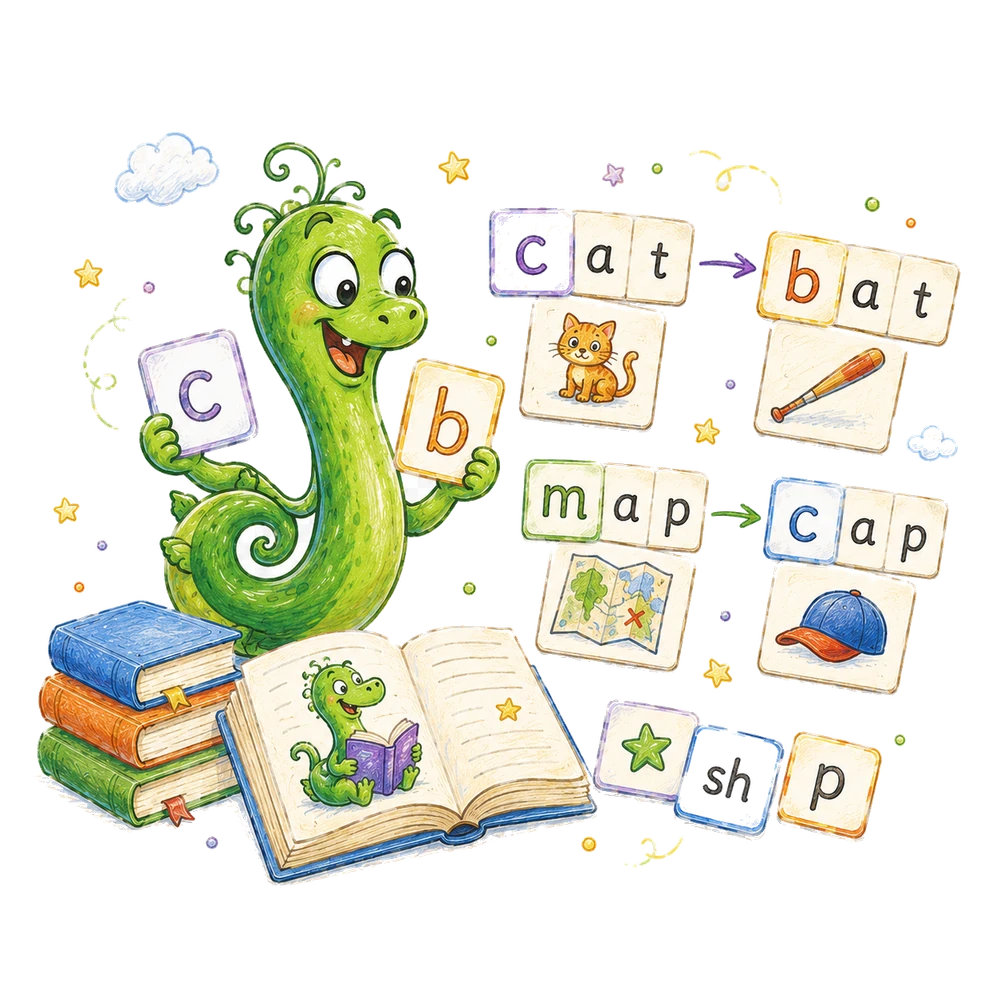
A flashcard isolates a written word; a sentence places it in context. Compare the two using “can” to express ability and to name a container, and choose the support that fits the child and the question.
What each format helps you see
A flashcard shows a word on its own. A sentence gives that word a context and shows how it works with other words. The two formats answer different questions: “Can the child identify this word here?” and “What does this word mean or do in this sentence?”
For example, a card reading “can” can be examined letter by letter or named with adult support. In “I can hop,” the same word contributes to a statement about an action. In “The can is on the shelf,” it names a container. The printed word is the same, but its role and meaning differ.
Neither format guarantees independent reading or understanding. A child may recognize a card by its color or memorize a sentence. Ask the child to explain or show meaning, and describe any help that was provided.
Comparison at a glance
Preparation: write one familiar word on a card, or write a short sentence that uses it. A card needs less surrounding text; a sentence requires the other words and the situation to be understandable enough for the intended question.
Practice focus: a card can isolate a written form for matching or discussion. A sentence can show meaning, word order, and surrounding information. A sentence may introduce additional reading demands beyond the target word.
Feedback: an adult can ask what the child notices on the card or what happens in the sentence. Reading a word aloud, pointing to it, or explaining a sentence is helpful support, but it changes what can be concluded about independent reading.
Prepare a small example
Write “can” clearly on a card. On separate strips, write “I can hop.” and “The can is on the shelf.” Use a large, legible print style and enough space between words.
The two sentences use the same spelling with different meanings. If a shelf or a container is unfamiliar in the child's context, show a suitable object or choose a different sentence the family understands.
A child can look at the cards, listen to an adult read, point, act out an idea, or use a communication device. Explain which activity you are offering and ask what support they prefer.
Try the isolated word card
Show “can” and ask what the child notices. They may name the word, point to a letter, ask for help, or say they do not know. An adult can read it aloud on request.
If the child says “can,” ask what the word might mean. There may be several answers: a container, or a word used to say someone is able to do something. A single isolated card does not specify which meaning is intended.
If the adult supplied the pronunciation, describe the response as word identification with adult reading support. The card alone does not prove how the child would read the word in another setting.
Read the action sentence
Show “I can hop.” Read it aloud if the child wants help. Ask, “What does the sentence say I can do?” The answer is hop. The child can point to a picture, move in a comfortable way, or answer without performing the action.
Point to “can” and discuss its role in this sentence: the speaker says they are able to hop. The child need not use grammatical terms to explain the idea.
If hopping is not comfortable or possible, do not ask the child to demonstrate physically. A drawing or a different familiar action can convey the sentence's meaning.
Read the container sentence
Show “The can is on the shelf.” Read it together or aloud. Ask, “What is on the shelf?” In this sentence, “can” refers to a container.
A clean, safe container or a drawing can make the meaning visible. Do not assume the child must touch or open a particular container. The words around “can” help explain which meaning is intended.
Place the isolated card next to the same word in the sentence. The spelling matches, but the surrounding words change the interpretation. A child may need help understanding “shelf” before answering the question.
A sample conversation
Adult: “This card says can. What could can mean?” Child: “A can of soup.” Adult: “Yes, it can name a container. Let's look at this sentence: ‘I can hop.’ Does it mean a container here?”
Child: “No, it means I can do it.” Adult: “Right, the sentence is about being able to hop. Now let's read: ‘The can is on the shelf.’ What does can mean here?”
The child can point to a container rather than explain verbally. If the adult reads the sentence, note that support. The conversation explores meaning even when the child is not reading every word alone.
Common mistake: assuming one word has one meaning
An isolated word card may have more than one meaning. Treating a child's “container” answer as wrong because the adult intended “able to” ignores a valid interpretation of “can.”
Add a sentence or picture to make the intended meaning clearer. Then ask whether the same word has a different role in the second example. The surrounding words are evidence for interpretation.
A sentence can still be ambiguous. If the child offers an interpretation that fits the words, listen before correcting it. Choose a clearer example when the activity requires a specific meaning.
Common mistake: confusing recognition with decoding
A child may recognize a familiar card because of its color, position, picture, or a remembered outline. That recognition can be useful, but it does not by itself show that the child decoded the letters.
To explore print more closely, use a plain card and ask the child what they notice. Offer help if requested. Do not remove every support merely to create a test; decide what question the activity is intended to answer.
Similarly, a child may remember a sentence after hearing it several times. Ask about its meaning or show the same word in a new, understandable sentence if that is useful and welcome.
Make the card activity easier
Use one card with a familiar word and read it aloud while pointing to it. Match it to a picture or object when the meaning is clear. The child can indicate a choice rather than say the word.
For “can,” a picture of a container can support that meaning. Explain that the card may have another meaning in a different sentence; do not require the child to learn both at once.
Choose large print and a plain background. If visual print is not accessible, use the child's established alternative and adjust the aim of the activity accordingly.
Make the sentence activity easier
Use a short, clear sentence with familiar words. An adult can read “I can hop” and ask what action it names. The child may answer with a picture or a word rather than reading independently.
Point to the target word only if the child wants that support. If a different action is more familiar or accessible, write a new sentence and confirm that it still uses “can” in the intended way.
A sentence with unfamiliar vocabulary may make it hard to interpret the target word. Explain or replace the surrounding words before concluding that the target itself is the difficulty.
Add a challenge
Offer two short sentences containing the same word and ask how its meaning changes. The child may match a container picture to “The can is on the shelf” and an action picture to “I can hop.”
For a child interested in writing, invite them to create a new sentence with one meaning of “can.” An adult can write the sentence as dictated, then read it back for confirmation.
Do not assume every word has two distinct meanings or require a new sentence to fit the adult's preferred example. Check that the child's sentence is understandable in its context.
A card can reduce visual clutter
A single word on a plain card gives the child fewer items to inspect than a full sentence. That can be useful when the immediate goal is locating a familiar word or comparing its written form.
Less text does not mean the task is automatically easy. The word may be unfamiliar, the typeface hard to see, or the meaning unclear without context. Ask what the child notices and adjust the material.
Keep the card large enough to read or access comfortably. A child can choose whether to compare it with a picture, listen to it, or put it aside.
A sentence can supply useful clues
In “The can is on the shelf,” the surrounding words suggest an object placed somewhere. In “I can hop,” the word appears before an action. These contexts help explain the intended meanings.
Context is useful, but a reader still needs a way to access the words around the target. An adult can read the sentence, provide a picture, or select an easier sentence.
Do not treat a correct answer after an adult's explanation as proof that the child independently read the sentence. Both meaning and reading can be explored with appropriate support.
When the sentence has an unfamiliar word
If “shelf” is unfamiliar, show or describe one before asking what is on it. Otherwise the child may understand “can” but not the location in the sentence.
You can write “The can is on the table” if that setting is clearer. Check that the new sentence preserves the container meaning and is appropriate for the child's experience.
Keep track of what changed between examples. A different sentence, adult explanation, or picture can affect the response, so the two attempts are not identical tests.
A word card with a picture
A card may contain both a picture and a printed word. This can help connect them, but a child may identify the item from the picture without reading the word. That is useful for meaning, not proof of independent print recognition.
To compare formats, keep picture and word on separate cards. The child can match them with adult help, then look at the word alone if interested.
If separating the cards removes a necessary access support, keep them together. The goal is participation and a clear understanding of what the activity demonstrates.
A sentence with a picture
A picture can show a person hopping or a container on a shelf. Ask the child what they see before reading the sentence. The picture may supply information that the child uses to interpret the written words.
After reading, compare the picture with the sentence. If the illustration shows a container on a table but the sentence says shelf, discuss the mismatch rather than expecting the child to ignore it.
An illustration is one support, not a replacement for checking the words. It may also have more than one reasonable interpretation.
A child writes the sentence
Invite the child to dictate or write a sentence with “can.” They might choose “I can draw.” An adult can write the words and read them back: “Is that what you wanted to say?”
If the child uses the container meaning, they might say “The can is red.” Ask whether the sentence expresses their idea before discussing the word's role.
Spelling and handwriting support can be offered as requested. A child who dictates the sentence is still contributing its meaning and structure.
Two people sort the meanings
Prepare two group labels: an action or ability example, and a container example. Read the two “can” sentences and ask each participant where they belong. A picture can support each group if both participants understand it.
If one child reads independently and another listens to an adult, both can discuss meaning. Avoid ranking them by speed or assuming they received the same support.
If a sentence does not clearly fit either group, set it aside and explain why. A sorting game should not force an ambiguous example into an unsupported answer.
Accessibility and participation
Use clear print, adequate contrast, and a layout the child can see or access. A child may respond by speech, gesture, eye gaze, symbol selection, or a communication device.
An adult can read a card or sentence aloud, provide a tactile or digital alternative, or move a card at the child's direction. Ask which support the child wants and confirm their choice.
If the support changes the task, that is acceptable. Be precise about the resulting observation: understanding a read-aloud sentence and independently reading print are related but distinct activities.
Using more than one language
A multilingual child may explain the English word's meaning in another language. Listen to the explanation and check the intended meaning in the sentence. The response language does not by itself show whether the child understood.
A direct translation may not carry both meanings of “can” in a single word. Discuss each English sentence separately instead of assuming a one-to-one translation.
Families can choose familiar examples from their own languages. If an adult is unsure about a translation or pronunciation, check it or keep the discussion to a language they can explain confidently.
What a useful note might say
A specific note could say: “An adult read ‘The can is on the shelf’; the child pointed to a container.” Another could say: “The child named the plain card ‘can’ without a spoken prompt.”
These observations describe different tasks and supports. Neither establishes that the child understands or reads every occurrence of the word in all settings.
A note is optional. The child can save a dictated sentence or discard the cards. Recording or publishing a child's voice is not needed.
Two cards that look alike
Write “can” on two plain cards using the same size and style. Place one beside each sentence. The child can compare the written forms and notice that the same letters occur in the same order.
Then ask which meaning fits each sentence. Identical spelling does not force identical meaning. The action sentence and the container sentence provide different context.
If the child cannot access print visually, read both sentences and discuss their meanings using an accessible alternative. That version explores spoken language, not the visual comparison of letter forms.
An unfamiliar sentence on a familiar card
A child may recognize “can” on a familiar card but need help when it appears in a new sentence. Try “The can is red” and read the other words as needed. Ask what the sentence describes.
If the child points to a red container after the adult reads the sentence, that shows a supported meaning choice. It does not establish that the new sentence was read independently.
If the child wants to try reading, give time and offer help on request. A new context can be interesting without becoming a timed test.
One meaning in several sentences
Use two sentences with the container meaning: “The can is red” and “The can is on the shelf.” An adult can read both, and the child can identify what the sentences say about the container.
The first gives a color; the second gives a location. The word “can” has the same intended meaning in both, while the rest of the information differs.
Choose a familiar object or picture and check that it matches the sentence being discussed. A blue container does not illustrate “The can is red” without an explanation that the sentence is hypothetical.
One sentence with a different target word
Change “I can hop” to “I can draw” if drawing is more familiar or accessible. The meaning of “can” still concerns an ability, while the named action changes.
Ask, “What action does the sentence name?” The child can point to a drawing or describe the action without performing it. The activity should not require a child to demonstrate an ability they do not want to demonstrate.
This comparison shows that a sentence has several meaningful parts. The target word's role and the action word can be discussed separately.
What the word card leaves unspecified
The isolated card “can” does not say whether a particular container is red, where it is, or who can perform an action. The sentence adds some of that information.
A child who offers an example is adding context of their own. Ask what they mean rather than treating the added idea as if it were printed on the card.
You can use the child's context to create a sentence, then read it back. The written sentence should represent the child's intended idea, not a substitute chosen by the adult.
What a sentence still leaves open
“The can is on the shelf” does not say what is inside the can or whose shelf it is. A child can imagine those details, but they are not established by the sentence.
Ask, “What does the sentence tell us?” and, separately, “What could we imagine?” Both questions can support discussion, but their answers have different status.
A picture may add details, such as a label or a color. State whether you are describing the picture, the sentence, or an invented story.
A careful check after adult help
If the adult reads the word card and the child places it next to a container picture, note both actions. The child associated the spoken word with a picture; the response does not isolate print reading.
If the child later identifies the same word without that prompt, that is another observation under different conditions. Compare what was available in each attempt rather than presenting the two as the same task.
A child may prefer adult support on one day and independent exploration on another. Offer the choice without using the difference as a fixed label.
Making a small reusable set
Write the word card and each sentence on separate pieces of paper. Store them together if the family expects to use them again. A reusable set does not require laminating, buying supplies, or keeping a record of the child's responses.
Check the wording before each use, especially if a child edits a sentence. If a sentence becomes unclear, ask its author what they meant and revise it together.
The child can also choose to discard the cards. The activity is complete without keeping a product.
Changing the adult’s question
With the same card, ask “What word is written here?” to focus on the printed form. Ask “What might this word mean?” to invite possible meanings. With a sentence, ask “What does the word mean here?” to focus on context.
These questions can produce different responses without contradiction. A child might name a container for the isolated word and describe ability in the action sentence.
Choose one question at a time. If the child asks for clarification, explain what you want to know and provide a suitable way to answer.
Continue on BrainHunters
If the child wants to look at letters or words in another setting, explore the letters activities together. Check the instructions and available supports in the activity you choose.
A digital activity may use a different word or ask a different question. The examples in this comparison do not guarantee that a particular sentence or audio feature is present on the site.
Helpful answers
Is a flashcard enough to show the meaning of every word?
No. Some words have multiple meanings, so a sentence or other context may be needed to identify the intended meaning.
Can an adult read a sentence aloud?
Yes. The child can discuss its meaning with reading support, though that is different from reading it independently.
Does a picture on a word card prove the child read the word?
No. The child may use the picture to identify the item; that can support meaning without demonstrating independent reading.

Turn a little idea into an adventure.
Try a short activity together, then bring the discovery back into your day.
Letters and early reading practice