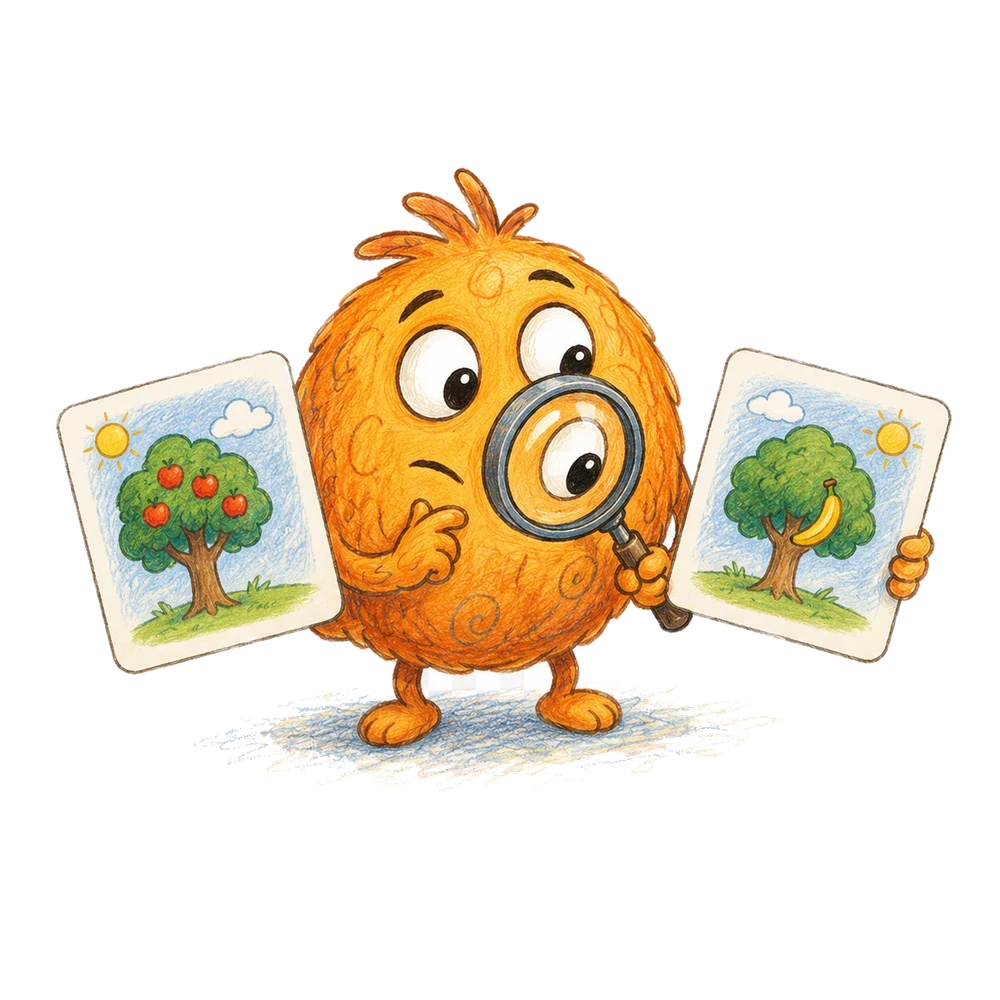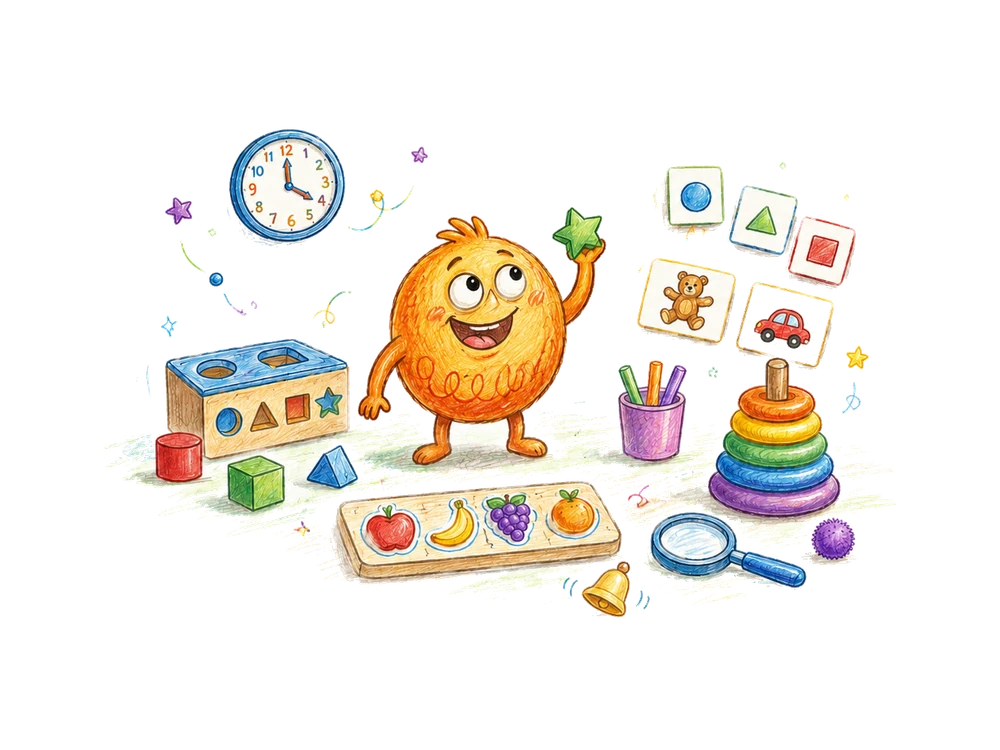
A child may enjoy noticing details without wanting to speak to a group. The five activities below are ordered by the audience involved in each example: the first can remain a private choice, while the last invites a small group to notice a clue chosen by the child. This is not a ranking of confidence or social ability. A child can choose any option, use a preferred way to communicate, or decide not to share at all.
Choose the setting before choosing a game
A quiet moment at home, a library table, or a classroom corner may offer different levels of noise and privacy. Ask the child where and with whom they would like to play. A child who speaks little in one setting may be talkative in another, or may prefer not to speak. Neither behavior reveals by itself how much they notice or understand.
The order in this article describes the audience in the particular examples: private observation, an exchange with a trusted partner, a shared record, an optional clue for another person, and an invitation to a small group. It does not measure learning value or the amount of support required. A private choice can involve substantial thought; a group game can be declined without losing access to the activity.
Offer ways to respond that the child already uses: a gesture, eye gaze, sign, communication device, drawing, spoken words, or directions to a partner. Explain any new symbol and include a way to say ‘not sure,’ ‘help,’ and ‘stop.’ A child can participate without speaking, holding a pencil, or allowing someone to move their body.
Use familiar materials appropriate to the child's age and access needs. An adult checks that pieces and surfaces are safe and comfortable. Choose a natural stopping point together, such as one observation or one clue. The examples are invitations, not a sequence the child must complete to earn a group role.
1. Make a private choice between two shapes
Place a large circle and a large triangle on a clear surface, or provide accessible representations of those shapes. Tell the child that they may look at or explore both and choose one to notice. They do not need to tell anyone which one they chose. A trusted partner can remain nearby, describe the layout, or give space according to the child's preference.
If the child wants a question, offer a specific one: ‘Which shape has three straight sides?’ In this pair, the triangle has three straight sides and three corners; the circle has a curved boundary. The child can indicate the triangle, ask a partner to point, or pass. If the shapes are drawn ambiguously or are hard to distinguish, prepare clearer examples before interpreting the response.
A private choice may never become visible to the adult. Avoid treating silence as evidence that the child did not notice or did not want to participate. The child can ask for a different shape or end the activity. If they later choose to share, they can decide what to share and with whom.
3. Make a record with the child's chosen support
Invite the child to keep one detail on paper or in another format. A triangle might be represented by three connected straight lines, with a partner writing ‘three sides’ if the child asks. The child may draw, dictate, select a prepared symbol, or direct someone else. A record is optional; observing a shape does not require producing a worksheet.
A picture can show what the author selected, but it may need explanation. If a line is open, ask whether the child intended an open path or a closed triangle before changing it. If an adult drew at the child's direction, read or describe the result back and allow corrections. Do not quietly ‘fix’ the work to match an adult's expectation.
The child decides whether the record stays private, is shown to a trusted person, or is put away. Photographing or displaying it is a separate choice. A note such as ‘The child selected the triangle while a partner held the cards’ describes the situation and support; it does not measure overall attention or predict behavior in a group.
4. Give one partner a clue
If the child wants to create a clue, place a circle and a triangle where the chosen partner can access them. The child can select the triangle and indicate or dictate, ‘This shape has three straight sides.’ The partner looks for the shape and points to it. The clue can be delivered through a card, a device, a gesture, an adult reading the child's words, or speech.
Before the partner answers, agree that the two shapes shown are the choices. A triangle has three straight sides, but so can other triangles of different sizes or orientations. Rotating the triangle does not change the number of its sides. If the child adds another triangle, the clue may match both; the partner can ask for another feature instead of assuming one must be wrong.
The child may prefer to point to a feature instead of naming it. They could direct a partner to trace each side of a large outline, provided the materials and interaction are comfortable. The partner can summarize, ‘I found three straight sides. Is this the one you meant?’ The child can confirm, correct the choice, or decide that the clue is finished.
If the partner chooses the circle, compare the agreed feature rather than judging the person. The circle's boundary is curved; the triangle's boundary in this example consists of three straight segments. A child may choose to show the difference or request an adult description. If no one wants to continue, the round can end without a correction or a final answer.
An observation clue can also concern a picture book: ‘I notice two birds on this page.’ The partner points to the birds the child meant. If there are more birds elsewhere on the spread, specify whether the clue concerns one page or the whole picture. The child can choose a different detail or tell an imaginary story; a count should describe the selected group.
One trusted partner is only an example of a smaller audience. For some children a familiar peer is more comfortable than an adult; for others, no audience is preferred. Ask who should receive the clue and how. Giving a clue privately today does not obligate the child to present it to a group later.
5. Invite a small group only if the child chooses
A child who wants others involved might place two large shapes where a few people can access them and ask a partner to read the child's clue: ‘Find the shape with three straight sides.’ The child may speak, point, use a device, or ask someone else to share the clue. The group can respond by pointing or choosing cards rather than calling out answers.
Agree in advance who will be present, how the clue will be shared, and how the child can pause or end the game. A small group can still feel crowded or noisy. If circumstances change—another person joins, the room becomes louder, or the child no longer wants to share—the invitation can be revised or withdrawn. The child's initial yes is not permanent consent.
A partner should share only what the child authorized. If the child wants a drawing shown but not their name, use that arrangement when feasible. Do not display a private choice or announce that the child is ‘practicing speaking’ without permission. A classroom may have its own agreed rules, but an adult can still offer ways to communicate and participate that respect the child's preferences.
Group members can contribute without competing for speed. One may ask to inspect the triangle, another may offer a description, and the creator can decide which response addresses the clue. If multiple triangles are present, the creator can add a feature or accept more than one answer. A timer or public ranking is unnecessary for this observation game.
If the child decides not to present after preparing a clue, they can keep it, give it to one trusted person, or discard it. The preparation was still an activity they chose. The adult should not use the invested time as a reason to pressure them to continue. A group can play a different game without revealing why the plan changed.
This final option is last only because it involves more listeners in the example. It is not a goal toward which the child must progress. A child may enjoy this group activity and prefer a private one tomorrow; another may always prefer to direct a partner. Both are valid ways to participate in observation and decision-making.
More observation prompts with clear boundaries
Compare two leaves that are already available and appropriate to handle. Ask the child to choose a detail such as edge shape or size; they may point or direct a partner to describe it. If the leaves differ in several ways, a statement about one feature does not automatically describe the others. Do not require collecting or touching unfamiliar plants, and follow local rules for the place.
Look at a picture of a neighborhood market, a playground, or an imagined street. The child can choose one visible object for a partner to find. ‘The bicycle beside the bench’ gives a location relative to another object; if there are two benches, the partner may need another clue. The image can be fictional and need not reveal the child's home or usual route.
Set out three large safe blocks: two smooth and one with a raised mark, if the child welcomes those materials. The child may privately choose one property to notice, then decide whether to tell a partner. A block can belong to several groups at once—for example, smooth and large—so agree on the feature being compared before asking which one is different.
Listen to a familiar short sound only if the child wants and can access the activity. A partner might tap twice, pause, and tap once; the child can show what they noticed with markers, a gesture, or a device. For someone who does not use sound in that way, a visible or tactile sequence can offer a different experience. Do not claim that one representation reproduces another person's sensory experience.
At a window, the child might notice that the sidewalk looks wet or that leaves are moving. Those are observations from that place and time. ‘It will rain all afternoon’ is a prediction, not something established by a brief look. If the child wants, an adult can record the observation and prediction separately; neither a weather forecast nor outdoor travel is required.
A wordless book can invite attention to a character's position. The child may point to the person near a door or ask a partner to describe the page. If they invent a reason the character is there, treat it as their story unless the image establishes the detail. Observation and interpretation can both be interesting when their roles are clear.
In a kitchen, two large paper shapes can be placed on a tray while food is prepared separately. A child might notice a curved edge on one and straight edges on the other. An adult selects a safe location and materials; the game need not delay a meal. If the kitchen is busy or noisy, another room or another time may work better.
A child can create a clue about an object they choose instead of answering adult questions. They might indicate ‘round’ for a plate or ‘has a handle’ for a cup. A partner should check that the clue fits the selected object and ask if more than one object matches. The child is free to change the clue or keep the selection private.
Support the observation without turning it into a performance
Give the child time to inspect the materials before asking for a response. A partner can say, ‘Take a look; tell me if you want a question.’ Some children may prefer a clear question immediately; others may want to explore first. Ask rather than assuming that one pace suits everyone. A pause is part of communication, not necessarily a problem to fill.
Offer a real way to pass. A card, gesture, device message, or spoken ‘not now’ can end the question without requiring an explanation. If the child does not respond, check whether the materials and communication options are accessible and allow time. Do not repeatedly ask louder or faster, and do not treat silence as agreement to share their work.
If a child uses an augmentative or alternative communication system, make sure relevant vocabulary is available in their familiar layout. Options might include ‘circle,’ ‘side,’ ‘show me,’ ‘different,’ ‘not sure,’ and ‘finished.’ The person should be able to correct a partner and refuse an activity, not merely select from the answers the adult expects. Wait for their selection and confirm the intended message.
A partner can offer choices without making them exclusive: ‘Would you like to point, have me describe the pieces, or do something else?’ If none fits, ask the child or someone familiar with their access needs what would help. Pointing, speech, writing, and device use are different methods; requiring one particular method can hide a child's observation rather than reveal it.
Position materials where the child can reach, see, hear, or otherwise explore them. A large high-contrast outline may help one person; another may need an accessible tactile representation or a spoken description. Ask before physical guidance. If a partner moves a piece, they should say what changed and let the child confirm the new position.
Some observations depend on a shared viewpoint. Two people on the same side of a table may agree that the triangle is left of the circle. From opposite sides, their left and right descriptions can reverse. Mark a common viewing position or name whose viewpoint is meant. A disagreement about direction may reflect a different reference point rather than inattention.
If a child describes a color differently from an adult, acknowledge the description and clarify which sample they mean. Lighting, labels, and individual perception can affect the exchange. Use shape, text, or another agreed cue when identifying a piece by color alone would exclude someone. A casual game cannot diagnose how the child sees; a family with a concern can consult an appropriate professional.
Separate what is visible from what is inferred. In a picture, ‘the dog is beside the gate’ describes a position if it is shown. ‘The dog wants to leave’ is an interpretation unless the story provides that information. The child can enjoy either statement, and an adult can ask which one the child intended. There is no need to police imaginative play as if every sentence were a factual report.
A child who chooses to share with one peer may want the peer to respond quietly or privately. Agree on what the peer will do: point, say the chosen name, or ask for another clue. If the peer misunderstands, check the materials and the original instruction before attributing the mismatch to either child. The creator can revise the clue or leave it as it is.
A group invitation should include an exit that does not require public explanation. The child may give a signal to a trusted adult, ask to move to a quieter place, or decide that a partner will finish the game without them. Before the activity, agree on what the adult will do if the signal is used. Do not promise that no one will notice; promise to respect the agreed response where possible.
An adult may need to balance individual choices with a classroom's practical constraints. Explain those constraints honestly: a table may need to be cleared for lunch, or a partner may have to leave. Offer available alternatives such as saving a card, finishing privately, or stopping. The child does not need to perform for an audience because an adult prepared materials.
If another adult asks what happened, a specific description preserves context: ‘The child chose the triangle by pointing while the cards were on the table.’ It does not justify claims that the child is always quiet, always attentive, or ready for a larger group. Record the support used only when the information has a legitimate purpose, and follow the family's or institution's privacy arrangements.
A child can be quiet and still make a lively, unusual, or humorous observation. Avoid presenting quietness as a problem that the game must fix. The activity offers a way to notice and communicate if the child wants to; it is not a treatment, a personality assessment, or a promise about future social behavior. Concerns about communication or access can be discussed with appropriate professionals without using the game as a diagnosis.
At the end, ask whether the child wants to keep the chosen object, share a clue, save a drawing, or move on. If the answer is no or the child has already stopped, honor it. A finished observation may remain known only to the child. The next activity can use a different audience, a different communication method, or no observation prompt at all.
Helpful answers
Does a quiet child need to speak to take part?
No. They can observe, point, sign, use a communication device, direct a partner, or choose not to share.
What does the ranking describe?
It describes the audience involved in the examples, from a private choice to an optional small-group invitation. It is not a measure of ability.
Can the child stop after one observation?
Yes. A single chosen detail can complete the activity; none of the later options is required.
Turn a little idea into an adventure.
Try a short activity together, then bring the discovery back into your day.
Shapes and object practice