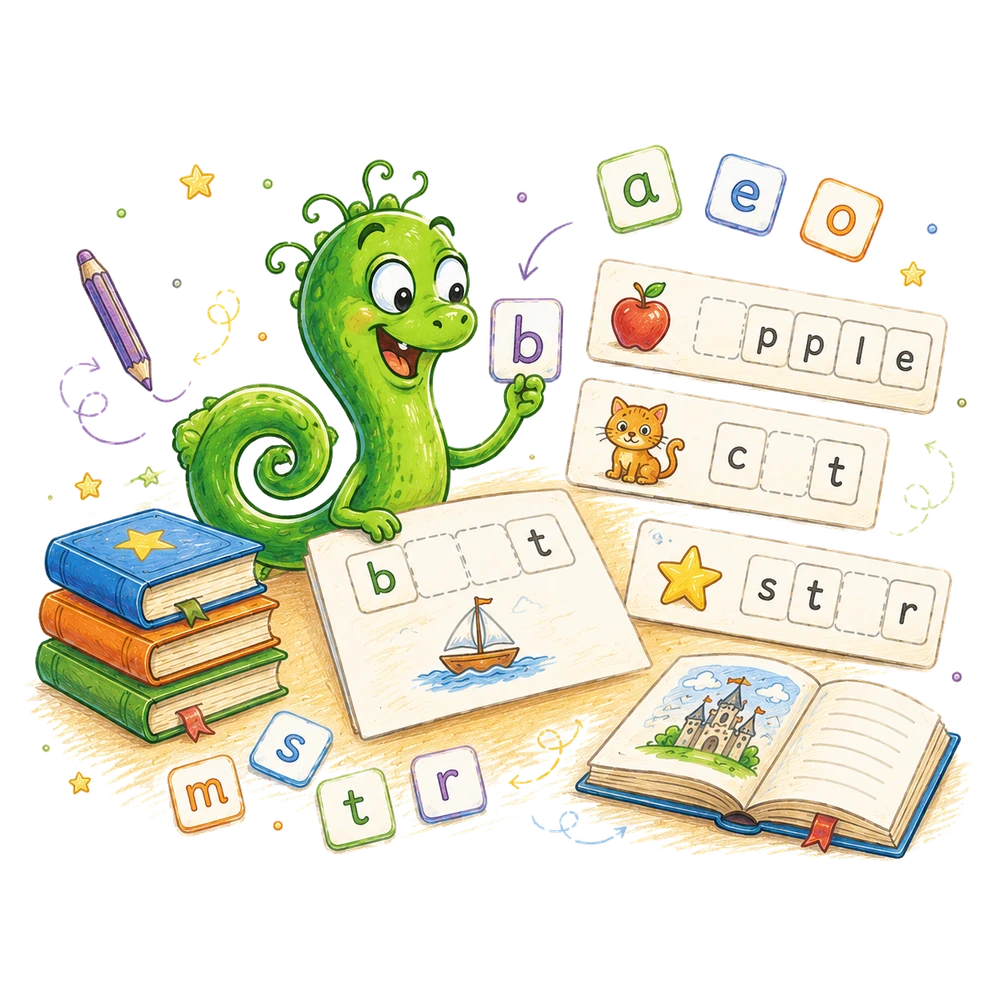
A child can build a complete idea by choosing who does something, what that person does, and what the action involves. In this activity, picture cards turn those choices into something the child can see and rearrange. A listener might hear ‘The dog carries the ball,’ then watch the child replace one card and explain how the meaning changes. The goal is communication and exploration of sentence structure, not a test of whether the child can read or write every word. The guide below includes a complete first set of cards, a sample conversation, ways to respond when a sentence is surprising or incomplete, and several extensions that use the same materials.
What the child will practice
The central task is to connect a person or animal with an action and an object in a sentence that a listener can understand. In ‘The dog carries the ball,’ the dog is doing the action, carries tells us what happens, and the ball is the thing carried. The child can point to the cards while an adult says the words, say the sentence independently, sign it, use a communication device, or combine these approaches.
Changing one card gives the child a useful way to check meaning. If the dog is replaced by the girl while the other cards stay in place, ‘The girl carries the ball’ describes a different person doing the same action. If the object is changed instead, the child can hear a different part of the message change. These are language choices that can be discussed; the activity does not measure a child's intelligence, readiness, or ability to use every kind of sentence.
This guide uses simple English examples suitable for an early reader with adult support. A child who already reads may enjoy the written words; a child who does not may use pictures alone. Families can adapt the game to another language, but they should make new examples that fit that language's own word order and grammar. A direct word-for-word substitution will not always make a natural sentence.
Gather materials and decide how the cards will be used
You need nine pieces of paper or card, a thick marker, and a clear work surface. An adult can cut the pieces into large rectangles; no printer, special kit, or paid material is necessary. If loose cards are difficult to handle, write or draw the choices on a single sheet and let the child point. A magnetic board or reusable sleeves are optional and should only be used if their pieces are safe for the child.
Make three sets. For ‘who,’ draw a dog, a girl, and a robot. For ‘does,’ draw or write carries, kicks, and paints, with a simple action picture when possible. For ‘what,’ draw a ball, a box, and a picture. Write the words under the drawings if the child finds print helpful. Use ‘the dog,’ ‘the girl,’ and ‘the robot’ on the first set so that the spoken examples have the small word ‘the’ available.
Keep the action cards separate from object cards by placing them in three labeled columns. The labels can be words, drawings, or positions on the table; do not rely only on color to identify a column. A child can choose a different character or object. Before playing, agree on the name of each picture so that a drawing of a dog is not unexpectedly called ‘puppy’ in one turn and ‘dog’ in the next. Either word is fine, but a shared label makes the first example easier to follow.
A complete first round
Start with one known choice in each column. The adult can read the cards, but the child should be able to choose whether to point, speak, use a device, or have another person move the pieces. Leave room for the child to refuse a card or suggest a different one. The following sequence uses the dog, carries, and ball cards.
Place the cards in the order they will be spoken. Point to each one as you say the phrase, then repeat the full sentence at a natural pace. This helps a listener connect the individual choices without requiring the child to memorize the adult's wording.
- Place the dog card on the left. Ask, ‘Who is doing something?’ If the child points, say, ‘The dog.’
- Place carries next. Ask, ‘What does the dog do?’ You can demonstrate carrying with a large safe object or point to the picture on the card.
- Place the ball card last. Ask, ‘What does the dog carry?’ Wait for the child's choice or point to the chosen card if that is their preferred response.
- Say the whole sentence: ‘The dog carries the ball.’ Trace the three cards with a finger from left to right while the child listens or joins in.
- Ask the child whether the sentence matches the cards. If they want to continue, invite them to change one card. If they prefer to finish, leave the completed sentence available to revisit.
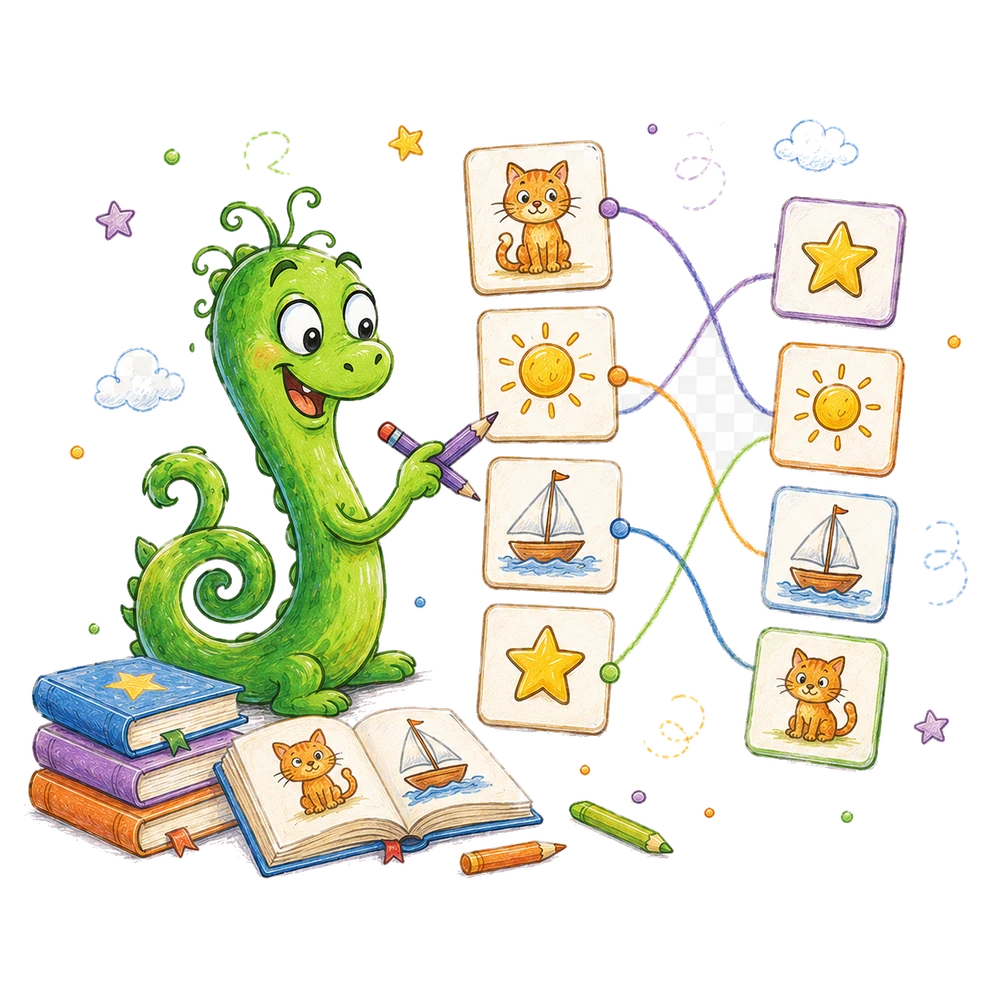
What an adult and child might say
Adult: ‘You chose the dog. What do you want the dog to do?’ Child: points to carries. Adult: ‘Carries. What should the dog carry?’ Child: points to the box. Adult: ‘The dog carries the box. Does that match your idea?’ Child: nods, or moves a card to make a change.
The adult's question checks the child's intended meaning rather than treating the adult's first interpretation as final. If the child points to the picture card but means a painting rather than a photograph, you can agree on the word ‘picture’ and continue. If they meant a different object altogether, replace the card or draw a new one. The learner is not required to accept the adult's interpretation merely because it is grammatically complete.
Another child might respond with the single word ‘box.’ The adult can expand the response without demanding repetition: ‘Yes, the dog carries the box.’ A child who says ‘dog carry box’ can be understood and offered a natural model: ‘The dog carries the box.’ Avoid interrupting every contribution to require the same sentence back. The important next question is whether the child wanted to communicate that idea and can make or revise a choice.
Change who, then compare the meaning
Keep carries and the ball in place. Replace the dog card with the robot. Read the two sentences separately: ‘The dog carries the ball’ and ‘The robot carries the ball.’ Ask, ‘What changed?’ A child might point to the first card or say ‘dog to robot.’ Then ask, ‘What stayed the same?’ The action and the ball remain the same in this example.
If a child says that the ball changed, put the two character cards next to each other and point to the unchanged ball card. The adult can ask, ‘Is this still the ball you chose?’ A child may have intended another object but been unable to reach it; invite a correction rather than assuming that the answer reveals a language difficulty.
Try the girl card next and let the child choose a new name if they wish. ‘The girl carries the ball’ is a complete example, but a personal name can also be the subject: ‘Maya carries the ball.’ Do not use a real child's name in a public record without the family's agreement. If the child prefers an invented name, write it on a new card or use the picture without a name.
Change the action without changing the people or objects
Begin again with ‘The dog carries the ball.’ Replace carries with kicks and read ‘The dog kicks the ball.’ Ask the child to show the difference with a gesture or a safe toy if they want to. One action moves the ball by holding it; the other uses a kick. The sentence still has the same dog and ball, but it tells the listener something different about what happened.
Action cards can be harder to interpret than object pictures because a still drawing may not show movement clearly. Before treating a choice as an error, demonstrate the two actions or describe them. The child can also draw arrows or pick a different action card. If a kick is not appropriate for the play area, act it out with a finger or talk about it instead; do not require a physical movement the child cannot or does not want to make.
For a clear comparison, keep the tense and subject the same in the first few turns. ‘The dog carries the ball’ and ‘The dog kicks the ball’ both describe an action in the same present-tense form. Later, you can explore ‘carried’ or ‘will carry,’ but explain that changing the time of an event is a separate choice from changing the action.
Change the object and check what the action applies to
Set out ‘The robot carries the ball.’ Replace the ball with the box. Ask, ‘What is the robot carrying now?’ The child can point to the final card and answer ‘the box.’ The listener can then compare ‘The robot carries the ball’ with ‘The robot carries the box.’ The robot and the action did not change; the thing carried did.
A common mix-up is to answer with the character when the question asks about the object. If the child says ‘robot,’ acknowledge that the robot is in the sentence and ask a more precise question: ‘Yes, the robot is carrying something. What is being carried?’ Point to the object card if the child wants that support. If the child intended the robot to carry a different object, let them replace the card and reread the sentence.
Do not make every combination into a fact about real animals or machines. A robot can be a pretend character in a child's story. If a child chooses ‘The robot paints the ball,’ discuss what they imagine: a painted ball, a picture of a ball, or another idea. These meanings are different; the cards alone may not specify which one the child intends.
Unexpected combinations can become stories
Some combinations are unusual but still possible in pretend play. ‘The dog paints the picture’ might describe a dog holding a brush in a cartoon. Instead of saying that dogs cannot paint and removing the card, ask, ‘Is this a pretend dog? How does it paint?’ The child's explanation may supply the missing context and turn a surprising sentence into a story.
Other combinations can be unclear because an action has more than one meaning. ‘The girl paints the box’ could mean painting the surface of the box or painting a picture of it. Ask which meaning the child wants. If they mean a picture of the box, model ‘The girl paints a picture of the box.’ That longer sentence uses words beyond the three original cards, and that is fine: the cards are prompts for communication, not a limit on what the child may say.
A combination may also be grammatically complete but refer to something the child finds upsetting. Let the child replace a card or stop. You do not need to invent a real-world explanation for every sentence. The useful distinction is between a sentence that is unclear to its listener and an imaginative idea that becomes understandable when the child explains it.
Handle an incomplete or confusing message
Suppose the child chooses the dog and ball but skips the action. ‘The dog, the ball’ names two things, yet the listener does not know what connects them. Instead of saying ‘That is wrong,’ ask, ‘What is the dog doing with the ball?’ Offer two action pictures, such as carries and kicks, and let the child choose, invent another action, or decide not to finish the sentence.
If the child selects an action but leaves the object blank, consider whether that action needs an object for the intended meaning. ‘The dog sleeps’ is already a complete sentence and does not need a ‘what’ card. ‘The dog carries’ can be understandable in some contexts, but the listener may reasonably ask what is being carried. The three-column activity is a useful starting structure, not a rule that all English sentences must contain exactly three parts.
When the child uses words in a different order, ask them to show what they mean. If the cards are ball, dog, carries and the child intends ‘The dog carries the ball,’ help arrange the cards while speaking the sentence. A child using another language or an augmentative communication system may use a different order; follow their established language supports rather than treating English word order as a universal standard.
Model verb forms without turning the game into correction
In the present-tense examples, a singular subject such as ‘the dog’ takes ‘carries,’ ‘kicks,’ or ‘paints’: ‘The dog carries the ball.’ If the subject is ‘the dogs,’ the usual present-tense form changes to ‘carry’: ‘The dogs carry the ball.’ You can prepare an extra card for the plural form, or an adult can supply the word while the child points to the action picture.
If the child says ‘The dog carry the ball,’ respond to the idea first: ‘The dog carries the ball. Where is it taking the ball?’ This gives a natural model in the conversation without requiring repeated correction. If the child's learning goal specifically includes verb forms, compare the two examples explicitly and show how the subject changes. Keep that extra focus separate from the initial task of building an understandable message.
Use the child's own communication method and avoid treating accent, speech production, or a different home language as a mistake. A card labeled ‘does’ is a question prompt, not the word that must be inserted before every action. ‘The dog does carries the ball’ is not the intended sentence. If you ask ‘What does the dog do?’ the answer can be ‘The dog carries the ball.’
Make the first version easier
Reduce the choices before reducing the child's role. Start with a single dog card, a single carries card, and two object pictures. The adult says ‘The dog carries…’ and the child chooses the ball or box. The child still controls the information that completes the message, even if the adult supplies the sentence frame.
If three columns are visually crowded, place only the current choice in view. Show the dog, then add carries, then offer the two objects. A large card, a high-contrast drawing, a stable surface, or a digital communication display may make the task more accessible. Do not assume that the child can see a small picture, reach a card, or use speech just because the activity is described on paper.
Give a clear way to request help: ‘Would you like me to read, move the card, or show an example?’ Do the part requested and check whether it helped. The child can also choose to watch one round without selecting a card. Watching is not proof of comprehension or lack of comprehension; it is simply another way to be present in the activity.
Add a challenge that changes the message
Once the child wants another challenge, add a fourth card for a place: in the park, in the kitchen, or by the door. Build ‘The girl carries the box in the kitchen.’ Ask how the place card changes the listener's picture of the event. Keep the original three-card sentence nearby so that the child can compare what information was added.
A second extension is to make two sentences with the same cards in a different order of events: ‘The robot carries the box. The robot paints the box.’ Ask what happens first and what happens next. This introduces a short sequence, not just a longer sentence. The child can use ‘first’ and ‘then,’ point to the two rows, or tell an adult how to arrange them.
A third option is to add a description to one object: a red ball or a large box. Describe where the extra word belongs in English and compare ‘the ball’ with ‘the red ball.’ Do not add all three extensions at once. Select one that matches the child's interest, available communication, and willingness to continue.
Make a listening game with two possible sentences
Lay out two completed rows: ‘The dog carries the ball’ and ‘The girl carries the box.’ An adult reads one sentence without pointing; the child indicates the matching row. Then switch roles if the child wants to say, sign, or select a sentence for the adult to find. Read at a comfortable pace and repeat the full sentence on request.
If the child selects the wrong row, check what they heard before giving an answer. Ask, ‘Did you hear dog or girl?’ or show the two character pictures. The child may have missed a word, chosen a preferred picture, or intended to ask for repetition. Pointing to a different row is not enough to identify why the mismatch occurred.
To make the comparison more demanding, use rows that differ in only one card: ‘The dog carries the ball’ and ‘The dog carries the box.’ Now the listener must attend to the object. To make it easier, change both the character and the object and read slowly. Avoid covering the text if the child uses print as an important access support.
Use a book or toy to connect the sentence with an event
If a picture book shows a person carrying a box, set out the girl, carries, and box cards and compare the row with the page. Ask what is visible in the illustration and whether the sentence describes it. If the pictured person is not a girl, replace that card with a more accurate one. The point is to make a claim that fits the chosen scene, not to force every illustration into the original set.
With toys, use a large figure and a safe block. The child can place the block beside the figure and decide whether the figure is carrying, pushing, or looking at it. A stationary arrangement can be ambiguous; ask the child to demonstrate or explain the action. Then build the corresponding sentence and check it with the child.
The physical scene and the card row are two representations of the same idea only if their details match. If the toy is pushing the box while the action card says carries, a listener may describe a different event. Offer the child the choice to change the card or change the scene. An imaginative story may provide additional context, so ask before declaring either representation incorrect.
Notice what helped, without making a scorecard
After a round, you might note one specific observation if it will help with a later activity: ‘The child chose the action picture after I demonstrated carrying,’ or ‘The large cards were easier to point to.’ Record the support as well as the response. A correct match after a demonstration and a match made without that demonstration happened under different conditions; neither needs to be ranked against another child's work.
Ask the child what they liked or want to change. They might prefer animal characters, fewer cards, a different surface, or no repeat. Do not record private names, photos, or sensitive details unless the family has a reason to keep them, and store any notes in a private place. A short home activity is not a standardized language assessment.
If a persistent communication or learning concern affects the child's daily life, a parent can share specific examples and questions with the child's teacher or an appropriate professional. This game can provide an observation of a particular situation; it cannot establish a diagnosis or predict a child's future progress.
Choose the next activity on BrainHunters
If the child wants another story-based activity away from the cards, try wordless picture books for storytelling practice. Ask the child to describe a visible action, then consider whether a listener needs more information about who or what is involved. For a separate activity involving written letters and sounds, explore letters and early reading.
Choose the child's available level and activity based on the options actually shown in the product. The card exercise does not require a particular paid plan or promise that an online task will contain the same sentences. A family can also put the cards away and return to play without another lesson.
Helpful answers
Does every sentence need a who, an action, and an object?
No. The three-card structure is a useful starting point for examples such as ‘The dog carries the ball.’ A sentence such as ‘The dog sleeps’ can be complete without an object. Other sentences can contain additional information or use different structures.
What if the child cannot read the words on the cards?
Use recognizable pictures and let an adult read the labels. The child can point, sign, use a communication device, or direct someone else to move a card. Reading the printed labels is not necessary to choose and communicate an idea.
Should I correct an unusual sentence?
First ask what the child intends. A pretend dog may paint a picture in a story, and that imaginative sentence can be understandable. If the listener cannot tell what happened, ask a specific question or offer a natural model rather than rejecting the idea.
How many cards should we introduce at once?
Begin with the number the child can comfortably use. One subject, one action, and two object choices can be enough for a first round; add alternatives only when the child wants them.
Is the word ‘does’ supposed to appear in every sentence?
No. ‘Does’ in the activity's label prompts the question ‘What does the character do?’ The resulting sentence might be ‘The dog carries the ball,’ without adding the word ‘does’ before carries.

Turn a little idea into an adventure.
Try a short activity together, then bring the discovery back into your day.
Letters and early reading practice