

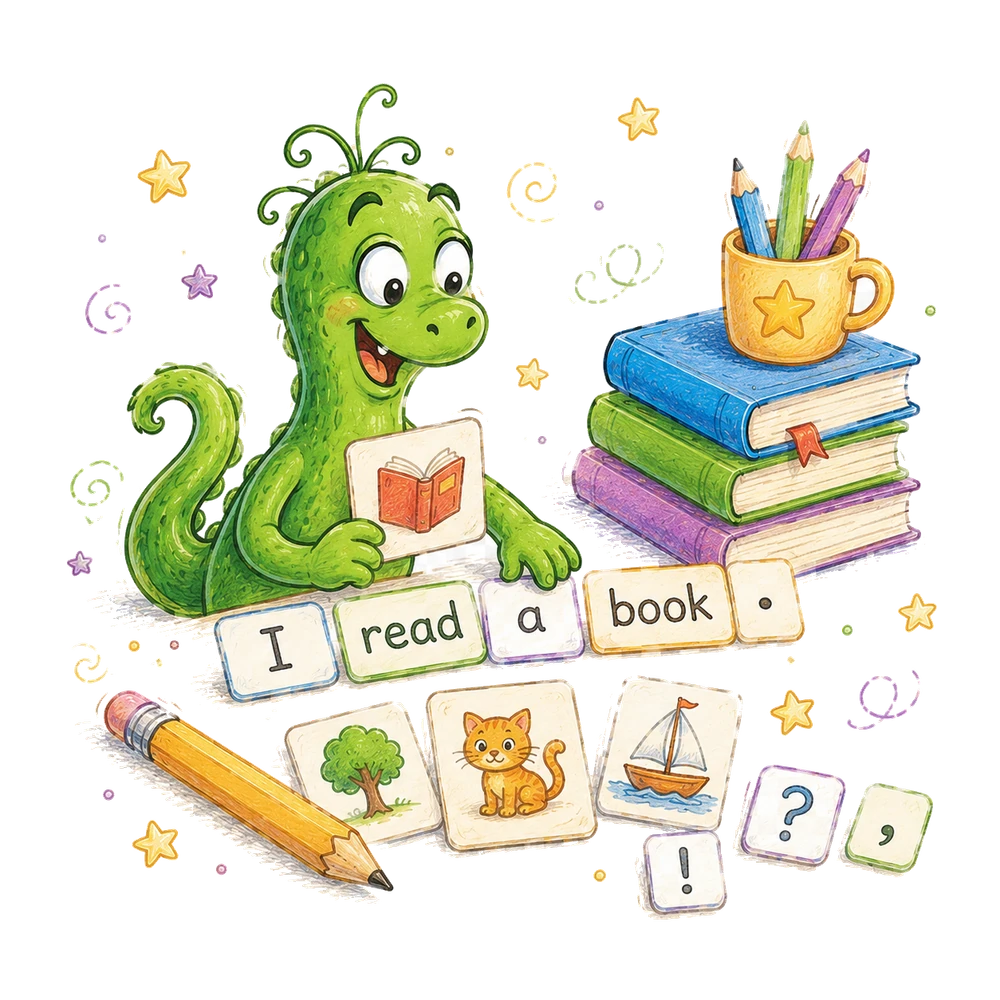
Punctuation can help a reader interpret a sentence aloud. A period often marks the end of a statement, a question mark marks a direct question, and an exclamation mark can signal strong feeling or emphasis. The mark is one clue; the words and situation also matter. This activity compares short sentences, invites different readings, and checks whether the expression fits the meaning. A child can listen, point to a mark, choose a recording, or direct an adult reader. The aim is to connect punctuation with interpretation, not to force a single voice or volume.
The skill: use punctuation with meaning
The target is noticing the end mark of a written sentence and considering how it relates to the sentence's purpose and meaning. ‘The dog is here.’ is a statement. ‘Is the dog here?’ is a direct question. ‘The dog is here!’ can express excitement, surprise, or another strong response depending on context.
Punctuation does not mechanically prescribe one exact pitch, pause, or volume. A question can be spoken with different intonation, and an exclamation can be expressed quietly. Read the words and discuss the situation before choosing an expressive reading.
The child may participate without reading aloud. They can point to the mark, select between two adult readings, use a communication device, or indicate an interpretation. The activity should not equate a particular speaking style with comprehension.
Prepare three sentence cards
Write three short cards in large, clear print: ‘The dog is here.’ ‘Is the dog here?’ and ‘The dog is here!’ Place a simple dog picture nearby if it helps establish the scene. Read each sentence aloud before asking the child to compare them.
Use a pencil and paper. Make the final punctuation large enough to distinguish, but keep the words visible. A period, question mark, and exclamation mark have different shapes and functions; a reference card can name each one.
Explain the invented situation if needed: a person is looking for a dog and then notices it. Different contexts can support different readings. The picture supplies meaning, while the printed words and mark supply evidence about the written sentence.
Compare the cards step by step
Place the three cards side by side. Read each naturally once, pointing to the words and then the final mark.
- Show the period at the end of ‘The dog is here.’ Read it as a statement.
- Show the question mark in ‘Is the dog here?’ Explain that the words ask a direct question.
- Show the exclamation mark in ‘The dog is here!’ Discuss a possible feeling, such as surprise or excitement.
- Invite the child to point to the card matching an adult reading or to choose how an adult should read one card.
- Check the words and the mark together. Discuss whether the chosen expression fits the stated scene.
- Try another plausible reading if useful, then read the complete sentence again without treating volume as the only way to express meaning.
A conversation about a question mark
Adult: ‘Is the dog here?’ Child points to the statement card. Adult: ‘Let's look at the words and the mark. This card says “Is the dog here?” and ends with a question mark. It asks whether the dog is here.’
The child compares the cards and selects the question. Adult: ‘How might someone ask this if they are worried? How might they ask if they are curious?’ Both readings can fit a question, depending on the scene.
If the child identifies the mark but cannot read every word, the adult can read the sentence and point to the punctuation. That supported response differs from independent reading, but it still shows attention to the mark's role.
What a period contributes
A period commonly marks the end of a declarative sentence such as ‘The dog is here.’ It tells the reader where that written sentence ends. The words state information rather than ask a direct question.
A reader may pause at the end, but the exact length of the pause depends on the text and reading context. A period is not a stopwatch instruction. Read the sentence naturally and allow the meaning to guide the delivery.
Compare ‘The dog is here.’ with the same words followed by an exclamation mark. The words are unchanged, but the final mark suggests a different emphasis. Discuss the scene instead of assuming that the period always requires a flat or emotionless voice.
What a question mark contributes
A question mark marks a direct question in writing. In ‘Is the dog here?’ the word order and meaning ask for information, and the final mark signals the question's end.
A reader may use rising, falling, or another intonation depending on the question, dialect, and intention. Avoid teaching that every question must end with the voice rising. The mark identifies the written question; expression is interpreted with the words and context.
Ask the child to choose between two readings and explain or indicate which sounds like a question in the invented scene. Both may be plausible. Point back to the written words so the activity does not rely on voice alone.
What an exclamation mark contributes
An exclamation mark can mark strong feeling, urgency, or emphasis. ‘The dog is here!’ might express excitement when the dog returns, surprise when someone spots it, or alarm in a different scene.
The mark does not require shouting. A quiet but emphatic reading may suit the situation. Invite the child to choose an emotion and explain what in the scene supports it.
If the child reads the sentence in a calm voice, ask what situation they imagined. The choice may be reasonable. Compare another reading and discuss how the same punctuation can support more than one interpretation.
Read the words before choosing a voice
A final mark is a clue, but the words provide essential information. In ‘Is the dog here?’ the question form asks about the dog's presence. In ‘The dog is here!’ the words state that the dog is present, with added emphasis.
If a child selects a card only by its mark, read the whole sentence and ask whether it matches the scene. This checks meaning as well as symbol recognition.
A picture of a dog cannot reveal every word or punctuation mark on a card. Use it to discuss the scene, then return to the print for the exact sentence. The picture and text provide different kinds of information.
Try a second set of sentences
Write ‘We can go.’ ‘Can we go?’ and ‘We can go!’ Read the cards and notice that the question changes the word order as well as the punctuation. The first and third share words but differ in the end mark.
Imagine a group waiting for permission. A question might ask whether they may leave; the exclamation might express excitement after permission is granted. The statement can communicate the same fact without that marked emphasis.
The child can point to the matching card after hearing a reading, or choose an invented context for one card. Verify the printed words and mark before deciding whether the choice matches the stated task.
A pause inside a sentence
A comma can help organize parts of a sentence, but it does not always correspond to a fixed spoken pause. For example, ‘After lunch, we read’ contains a comma after the introductory phrase.
Read the sentence naturally and discuss its meaning. The adult can point to the comma and explain that it separates parts of the written sentence. Avoid counting a prescribed number of seconds at the mark.
This extension is separate from the first activity's end marks. If the child is still distinguishing period, question mark, and exclamation mark, return to those three before introducing additional punctuation.
Compare an expressive reading with the text
An adult reads ‘The dog is here!’ as though surprised. Ask the child to find the card and point to the words and mark. Then try a different reading that could express relief, and discuss how the imagined context changed.
If an adult reads ‘Is the dog here?’ as a statement, the child can notice the question words and mark. Reread it as a question. The listener's evidence comes from the complete text, not only a performance cue.
A reader's accent, language background, or communication style may influence intonation. Avoid declaring one natural voice incorrect merely because it differs from the adult's. Focus feedback on whether the sentence and intended meaning were understood.
Create a short dialogue
Write two lines: ‘Is the dog here?’ and ‘The dog is here!’ Assign the lines to two fictional speakers or read both together. The first asks; the second can express a response to seeing the dog.
Ask the child to choose how each speaker feels. A worried question and a relieved response are one possibility. Another pair of emotions may fit a different scene. Point to the punctuation while discussing why the readings differ.
The child can play a role, direct an adult, point to a card, or use recorded speech. Participation does not depend on producing a particular volume or facial expression.
Make the first comparison easier
Start with two cards: a statement ending in a period and a direct question ending in a question mark. Read both and name the marks. Ask the child to point to the question card.
Use large print and a simple reference showing the two symbols. An adult can read the words while the child identifies the mark. If needed, offer the same scene and repeat the readings.
Add the exclamation mark in a later round. One clear distinction can be enough for a first activity. Keep the reference available rather than turning symbol recall into an unstated prerequisite.
Add challenge with two plausible readings
Show ‘The dog is here!’ and ask for two situations that could make the sentence exclamatory: a happy reunion and a surprised discovery, for example. Read it to fit each situation and discuss the evidence.
Then show ‘Is the dog here?’ and offer two question readings with different emotions. Both can remain questions. Ask which imagined scene supports each reading.
The challenge is to connect punctuation, wording, and context rather than identify one universally correct tone. A child may direct an adult's reading or select a description instead of performing aloud.
Check a punctuation mismatch
Write ‘Is the dog here.’ and read it as a direct question. Ask what end mark would conventionally match that written question in the activity. Replace the period with a question mark and read it again.
For a statement, write ‘The dog is here?’ and discuss what the mark suggests. In some contexts it can indicate uncertainty or an echo question, but that interpretation differs from the straightforward statement. Choose a clear intended meaning before revising.
The goal is to make the relationship between wording, punctuation, and intended meaning visible. Do not claim that a mark can never be used in a less common context; explain the convention used in the example.
Play a partner reading game
One person selects a card and reads it or asks the adult to read it. The partner finds the written sentence and points to its end mark. Then both discuss whether the reading fits the words and the chosen scene.
Swap roles so the child can choose a context or direct the adult's expression. If a listener chooses a different card, compare the full wording and punctuation before repeating the reading.
A partner can use a reference card for mark names. The game need not be timed or scored. The useful check is an explanation supported by the text and context.
Record and observe
Make a small chart with a period, question mark, and exclamation mark. Add one example sentence and a short note about its purpose or a plausible context. The child can dictate while an adult writes.
A useful observation might say: ‘Pointed to the question mark after the adult read a direct question’ or ‘Chose a surprised reading for an exclamation in the stated scene.’ Include whether the words and reference were visible.
One expressive reading does not establish understanding of every punctuation use. One different intonation does not by itself indicate a difficulty. If questions continue, specific examples can be discussed with a teacher or appropriate professional.
Compare punctuation without changing the words
Write ‘We won.’ and ‘We won!’ on separate cards. The words are identical, while the end marks differ. In a fictional game, the first might be read as a straightforward report and the second with added excitement or emphasis.
Ask the child what stayed the same and what changed. Point to the same two words and then to the different marks. Invite an adult to read each version in a way that fits the proposed scene.
The period does not forbid emotion, and the exclamation mark does not demand a particular loudness. The comparison shows how punctuation can guide interpretation while leaving room for the reader's voice and the surrounding story.
Compare word order as well as the end mark
Place ‘The dog is here.’ beside ‘Is the dog here?’ The question is not created solely by replacing the period with a question mark: the words are also arranged differently in this example.
Read both and ask which one states the dog's presence and which asks about it. The child can point to the first word on each card and then to the end mark. Both pieces of evidence help distinguish the sentences.
A statement with a question mark can sometimes serve as an echo question or express uncertainty in context. For the initial activity, use the clear direct-question form and explain any later variation separately.
Listen for meaning without requiring imitation
An adult reads ‘Can we go?’ in a curious voice and then in a worried voice. Ask the child what may be different about the speakers' feelings. Both readings remain questions, even though their expression differs.
The child can choose an emotion card, point to the sentence, or suggest a scene. They do not need to imitate the adult's pitch or accent. The written question and the listener's interpretation are the focus.
If a child prefers a different reading, ask what situation they imagined. Compare that situation with the words. The aim is to understand how context affects expression, not to enforce a single performance.
Use punctuation in a real message
Invite the child to dictate a short message, such as asking whether a family member has seen a book. An adult can write ‘Have you seen my book?’ and read it back. The question mark fits the direct question.
If the child instead wants to report that the book has been found, write a statement such as ‘I found my book.’ Ask whether a period or an exclamation mark better fits the intended emphasis. Either choice may be reasonable in a suitable context.
The child can change the wording after hearing it. The punctuation should support the intended message, and the recipient's understanding can be checked by reading the complete sentence. The activity does not require sending the message outside the family.
Separate a mark's name from its function
Show a question mark and name it. Then present a direct-question sentence and discuss what the sentence asks. A child may recognize the symbol before understanding its function, or understand the spoken question before recalling the symbol's name.
Use a reference card with the mark and a short example. Ask the child to match the symbol on the card to the end of the sentence. The adult can supply the name while the child indicates the match.
Avoid assuming that a correct symbol name proves the whole sentence was understood. Ask what information the speaker wants, or offer two possible meanings. These are related but separate checks.
Check where the sentence ends
Write two short statements: ‘The dog is here. The cat is asleep.’ Point to the period after the first sentence and then to the second sentence. Each period marks a sentence boundary in this example.
Read both naturally. A child can indicate where one written sentence ends and the next begins. The length of a spoken pause may vary; the written boundary remains visible in the text.
If the child counts the period as a word, compare the words with the punctuation mark. The period is a written symbol marking the end, not an additional word in the sentence. This distinction can be shown without requiring a formal word-count exercise.
Consider an exclamation without a command
An exclamation mark can follow a statement such as ‘We won!’ It is not limited to instructions or warnings. The sentence may express excitement about an event.
Compare ‘Look out!’ as an urgent instruction with ‘What a surprise!’ as an exclamation about a reaction. Both use an exclamation mark, but the words and situations differ.
Ask the child which scene might fit each sentence. They may propose alternatives. The punctuation suggests emphasis, while the words help determine what the speaker is doing.
Let a listener ask about the reading
After an adult reads ‘The dog is here!’ with a surprised tone, a partner can ask why that expression was chosen. The reader might explain that the imagined character did not expect to see the dog.
The listener can suggest a relieved reading under another scene. Both interpretations can be checked against the words and the exclamation mark without claiming that one tone is mandated by punctuation alone.
A child can direct the adult to try a different emotion or point to the relevant card. The conversation makes the reader's assumptions visible and gives the listener a chance to offer another plausible interpretation.
Return to the three original cards
Lay out the statement, direct question, and exclamation again. Read one and invite the child to select its card using both the wording and the final mark. Keep the reference visible if useful.
After the selection, ask what the sentence does in the chosen scene: states information, asks a question, or expresses emphasis. The child can point or select a description while the adult supplies words. Finish after a checked example if the child prefers.
Check the intended message before revising
If a sentence ends with a mark that seems unexpected, first ask what the writer intended. ‘The dog is here?’ may be an echo question in a conversation, while ‘The dog is here.’ can be a straightforward statement. Context determines which revision is appropriate.
After agreeing on the intended meaning, read the sentence with the chosen mark and ask whether it communicates that meaning to a listener. The child can point to the punctuation while an adult reads. This check connects the written choice to an actual message.
Continue with reading and sentences
For arranging sentence parts, see Sentence Building with Who, Does, and What Cards. For discussion during a shared book, try Asking Better Questions during Read-Aloud Time. The same punctuation can be considered in a larger context.
Letters and reading offers an optional digital continuation. Paper sentence cards and a shared conversation are enough for this activity.
Helpful answers
Does an exclamation mark always mean shouting?
No. It can signal strong feeling or emphasis, which may be expressed in different ways depending on context.
Must every question end with a rising voice?
No. Intonation varies with the question, speaker, dialect, and context.
What does a period commonly mark?
It commonly marks the end of a declarative sentence. The words and context also guide the reading.
Can a child participate without reading aloud?
Yes. They can point to a mark, select a reading, use a device, or direct an adult.
Is punctuation the only clue to meaning?
No. The words and situation also matter when interpreting a sentence.

Turn a little idea into an adventure.
Try a short activity together, then bring the discovery back into your day.
Letters and early reading practice