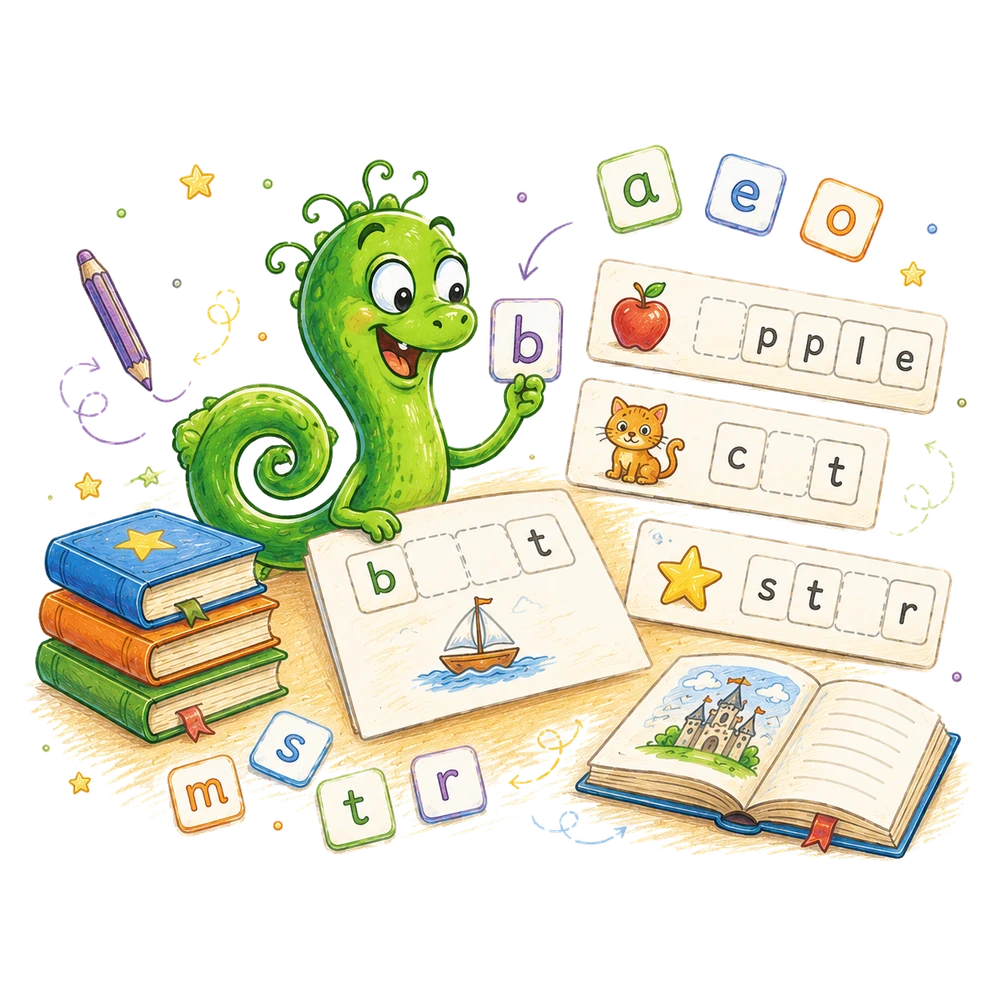
A few letter tiles can show how a written word changes when one letter changes. Build “map” and “mop,” compare the middle letters, and let the child choose how to participate.
Build and change short words
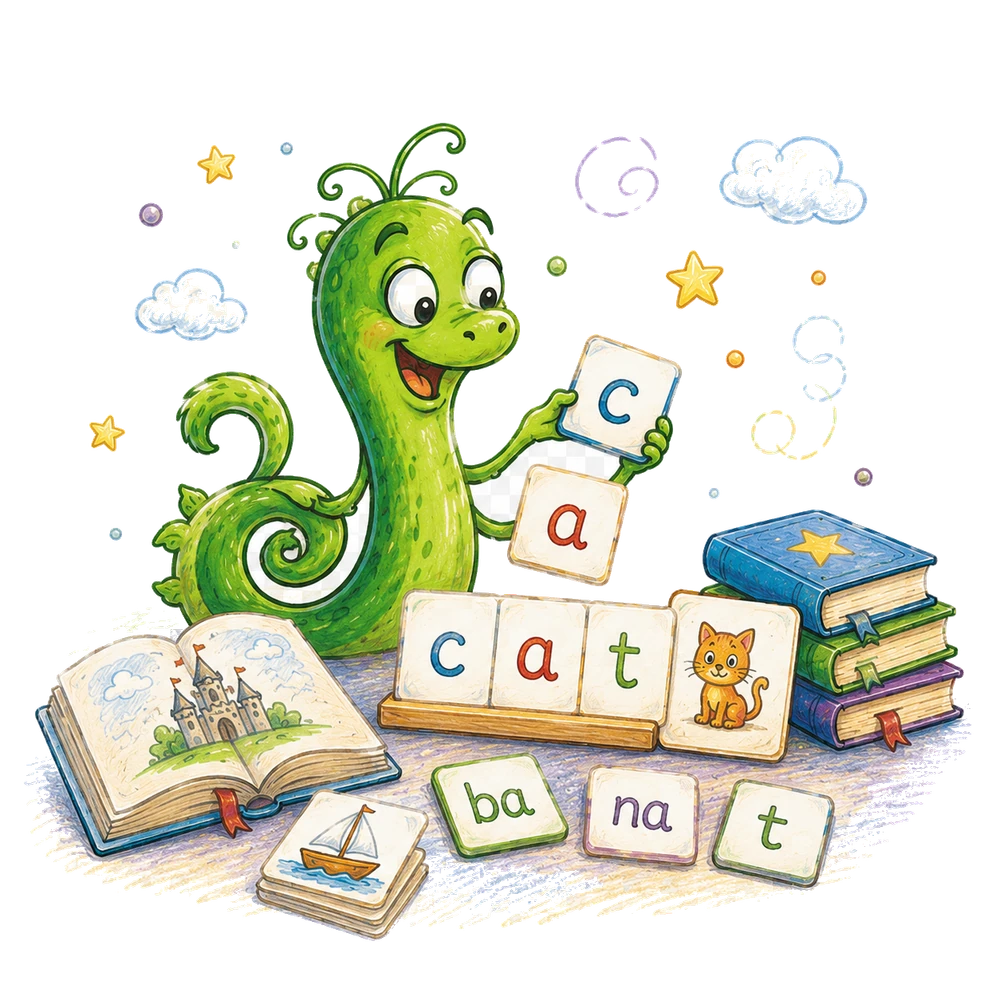
A small set of letter tiles can make the relationship between a written word and its sounds visible. In this activity a child builds “map,” reads the word with an adult, and changes one tile to make “mop.” The changing letter represents a change in the middle sound; the first and last letters stay in place.
The goal is to notice and discuss a specific change, not to race through a list or spell every word independently. A child can place a tile, point to a letter, say a sound, or direct an adult. Spoken examples below use common American English pronunciations; pronunciation can vary across families and regions.
Prepare a small set of tiles
Write lowercase m, a, p, o, s, and t on separate large paper squares. A second copy of a or p is not needed for the words used in the first sequence. Make the letters dark and clear, and give the child room to move the pieces from left to right.
An adult can prepare the squares; cutting is optional if the letters are drawn in separate boxes on one sheet. Use materials appropriate for the children present and avoid small loose pieces when they are unsafe. A plain strip of paper can mark the space where the word will be built.
Name letters and hear sounds
Show m and say its letter name, “em.” In “map,” this letter represents the first sound, /m/. Show a and p as well. Letter names and speech sounds are related but are not the same thing: the name of a letter is not necessarily the sound heard in this particular word.
A child does not need to produce each sound perfectly to participate. If an adult models the sounds, keep them natural and brief. For example, avoid adding an extra vowel after /m/ when trying to demonstrate the beginning of “map.” The word itself can be said normally.
Build the first word
Say “map” and explain that a map can show where places are. Lay out m, a, and p in that order. Point to the letters from left to right and say the word naturally. The child can arrange the tiles, select from a small set, or tell the adult where to place each one.
Ask the child whether they want to show where the word starts and where it ends. If the child uses a gesture or communication device, accept that response. The first arrangement can be a model; independent spelling is not a prerequisite for the rest of the activity.
Listen to the beginning and end
Say “map” slowly enough to hear its parts without changing the word into a different pronunciation. Point to m as you notice /m/ at the beginning and p as you notice /p/ at the end. The middle vowel in a typical American pronunciation of “map” is /æ/.
If separating the sounds is difficult, keep the whole word available and compare it with another word later. Do not require the child to repeat an isolated sound before continuing. A child may notice that both “map” and “mop” begin with m by looking at the tiles.
Change the middle tile
Place an o tile nearby. Say “mop” and explain that a mop is used to clean a floor. Ask: “What would we need to change in map to make mop?” Offer a and o as visible choices. If useful, point to the middle position rather than expecting the child to infer it.
Replace a with o and read m-o-p as “mop.” In a common American pronunciation, the vowel sound differs from the vowel in “map”; the exact pronunciation of “mop” varies among speakers. The written change is clear even when the adult describes the sounds in familiar rather than technical terms.
A sample conversation
Adult: “Here is map: m, a, p. Let’s make mop. Which tile could we change?” Child points to a. Adult: “Yes, that is the middle tile. We can put o there.” Child or adult replaces it. Adult: “Now the letters are m, o, p: mop.”
Child: “The m stayed.” Adult: “It did. The p stayed too. The middle letter changed.” If the child points to p instead, compare the beginning and end of both spoken words and offer to show the middle tile. The child can accept help or choose to stop.
Change the first letter
Return to “map.” Place s nearby and show how changing m to s creates “sap.” Explain the word in a simple context: sap is liquid found in plants, such as the sap collected from some maple trees. The adult can provide this meaning; the child need not already know the word.
Point to the unchanged a and p and compare the first letters. If “sap” is unfamiliar, use a different sequence from the available letters, such as “map” to “tap,” and explain the action of tapping lightly. Do not assume that an unfamiliar word is a reading error.
Change the last letter
Build “mat” with m, a, and t. Explain that a mat can be a small floor covering. Replace t with p to make “map.” The first two letters remain in place while the final letter changes. Say both words and invite the child to point to the changed position.
If the child wants to move all the tiles, allow them to rebuild the word, then compare the two arrangements. The purpose of changing one tile is to make the difference easy to see; it is not a rule against using another method to construct the word.
Use a word in a sentence
After building “map,” say a short sentence: “The map shows the park.” Ask whether the child wants to make another sentence or point to a picture of a map. After building “mop,” an example is “The mop is by the door.” Use examples that make sense in the child’s surroundings.
A word can have more than one meaning, and an unfamiliar object can be explained without testing the child’s background knowledge. The sentence gives the printed word a purpose. It should not become a requirement to write or repeat a long sentence.
If the child chooses the wrong tile
Suppose the child replaces p with o when changing “map” to “mop.” Look at the resulting letters together. Ask which letter was supposed to stay at the end, and point to the original word if a written model is available. Rebuild “map” and try the middle position with help.
Do not invent a pronunciation or treat the child’s choice as careless. The child may have been listening for a different part of the word or may not have understood the direction. The adult can move the tile while the child indicates the desired change.
Keep a model visible
Write “map” on a separate strip and leave it above the tiles. The child can compare the model with m-a-p, then change the middle tile to make m-o-p. After the change, point to the parts that still match the model and the part that differs.
A visible model reduces the need to remember every letter while moving a tile. It is a support, not a shortcut to be removed immediately. The child can ask to see the model again or decide to build a familiar word without it on another turn.
Say the whole word after each change
Once a tile changes, read the complete word from left to right. For “map” to “mop,” do not stop after naming the new letter; connect the written arrangement with the spoken word and its meaning. The adult can read if the child prefers to listen.
If the child says a different word, ask what they intended. Compare the visible tiles and the intended spoken word. The child can correct the arrangement, ask for help, or choose a different word to make. A single response does not reveal why a choice occurred.
A simpler starting point
Present only m, a, and p, with a written “map” model. Invite the child to match each tile to the corresponding letter. The adult can name each letter and read the completed word. One matched word may be enough for the day.
If moving pieces is uncomfortable, the child can point to the next tile or direct the adult. Use large print and a clear background. The child does not have to explain letter sounds or complete a timed sequence to participate.
A longer sequence with a clear purpose
If the child wants another turn, build “mat,” change t to p to make “map,” then change a to o to make “mop.” Read each word and ask which position changed. Keep the previous word on a model strip if that helps the comparison.
Each step changes one tile, but the changed position is not always the same. Invite the child to show the tile before moving it. If the sequence becomes confusing, return to one pair of words. More changes do not automatically make the discussion more useful.
When the child knows a different word
The available tiles can also make “top.” If the child suggests it, arrange t-o-p and use it in a sentence, such as “The top of the box is open.” Check that the intended word can be made from the tiles present; add another tile only if both players want to.
A child may invent a sequence of letters and ask what it says. Explain that some sequences do not form a familiar English word, but they can be explored as invented names in play. Do not present a made-up word as a commonly used word.
Make turn-taking explicit
One player selects the starting word and the other changes one tile. Then switch roles if both want to. A turn ends after the player chooses a change and the pair reads or inspects the new arrangement. The child can tell the adult what to move instead of handling a tile.
If both want the same tile, place the needed letter where it is visible and agree on who will use it first. The adult should follow the child’s direction during the child’s turn. Stop or change the game when a participant no longer wants to continue.
Support different forms of communication
The child can indicate letters by pointing, looking, naming them, or selecting them on an accessible communication tool. Place the tiles and the tool so the child can use both comfortably. Ask for confirmation when a selection is unclear and wait for the response.
A child may understand the written change without producing an isolated speech sound. The adult can model the whole words and accept the child’s selection. This home activity does not assess speech, hearing, reading development, or the need for specialist support.
Letter names and sounds can differ
The letter a has the name “ay,” but in the word “map” it represents the vowel in “cat” in common American English. The letter o has the name “oh,” while the vowel in “mop” may sound different depending on the speaker’s accent. Model the actual familiar words rather than promising that a letter always has one sound.
If the child calls a tile by its name, acknowledge it: “That is the letter a.” Then connect it to the word: “In map, this letter helps write the middle sound.” Avoid asking the child to replace an accurate letter name with a sound in every context.
Notice what the child uses
After the activity, think about whether the child recognized the first letter, noticed the middle change, used the visible model, or asked for a word’s meaning. These observations can guide the next invitation. A child might need fewer choices or a clearer starting word.
Do not compare the number of words built with another child’s total. One thoughtful comparison can be a complete activity. The game is not a diagnosis or a substitute for advice from a teacher or specialist when a family has a specific concern.
Put the tiles away
Ask the child whether they want to save the paper tiles or recycle them. If saving, place them in a suitable container out of reach of younger children who could put small pieces in their mouths. Keep the model strips with the tiles if they will be useful later.
On another day, choose a familiar word and one clear change. The child may prefer to make a name, draw a map, or do something else entirely. The next activity need not be longer or harder to be worthwhile.
Compare map and tap
Build “map” with m, a, and p. Put a t tile beside the row and say “tap.” Ask the child whether the beginning or ending of the spoken word sounds different. Show the written change by replacing m with t. The tiles now read t-a-p.
Use “tap” in a familiar sentence: “Tap the table gently.” The child can make a gentle tap if that is comfortable, or simply listen. Then read both written words and point to the unchanged a and p. The physical action is optional and should not damage the surface.
If the child points to a different tile, rebuild the original word and compare the written forms side by side. A written model can show where the letters differ even if isolating the beginning sound is difficult.
Compare tap and top
Arrange t-a-p and place o nearby. Say the two familiar words in short sentences: “Tap the table” and “The top of the box is open.” Ask whether the child would like to find the written change. The middle a changes to o; t and p stay.
Place o in the middle and read t-o-p as “top.” The adult can point to the first and last letters to show what remained. Depending on accent, descriptions of the vowel sound may differ; use the speakers’ natural words rather than requiring an unfamiliar pronunciation.
Return a to the middle if the child wants to compare the pair again. A single move back and forth can show the relationship clearly. There is no need to add a timer or require a fixed number of repetitions.
Compare top and mop
Build “top” and show the child the m tile. Explain that changing the first tile can make “mop.” Move t away and put m in its place. The o and p remain in the same positions. Read the completed word and connect it with a familiar cleaning tool.
If the child does not know a mop, describe or show an appropriate example rather than assuming every family uses the same object. A child might know the verb “mop” or might need an explanation of both forms. Knowledge of the object is separate from recognizing the tile change.
Ask what changed in the written row. The child can point to the first position, name m, or indicate the removed t. Accept the contribution that communicates the comparison.
Compare mat and map
Build “mat” and place p nearby. Say “mat” and “map” in ordinary speech. Both begin the same way in common American English, while the last sound changes. Replace t with p and read the new arrangement: m-a-p.
The child may hear or see the final difference more easily than the middle vowel difference. Point to the last position and compare t with p. If the child prefers, write the two words one above the other and align their letters.
Explain “mat” with a familiar example, such as a mat near a door, without assuming that every home has one. The written comparison remains useful even if the child has not encountered that object.
Compare mat and sat
Place m-a-t on the strip and show s. Replace m with s to make “sat.” Use a sentence such as “The cat sat on the mat,” and explain that “sat” tells about sitting in the past. The child can notice that the final a and t tiles stay in the same places.
If discussing past tense is too much for this activity, simply say the sentence and focus on the first letter. “Sat” should not be presented as an object or as the present-tense form “sit.” A child may already know the word from conversation or may ask what it means.
When the child chooses another tile, compare the resulting arrangement with the intended word. Offer the written model “sat” rather than repeating the same question until the child guesses.
Try a word change with a listener
The child builds “map” while the adult looks at the row. Then the child chooses a different word from a small list shown on paper: “mat” or “mop.” The adult asks which tile to change and follows the child’s direction. The listener can point before moving to confirm the choice.
After the change, read the word together. If the child intended “mop” but indicated t, clarify by showing both possibilities: changing the last tile produces “mat,” while changing the middle tile produces “mop.” The child decides whether to revise the instruction.
This role reversal gives the child a reason to communicate position and choice. It is not necessary to use terms such as “medial vowel” or to speak aloud if another communication method is more comfortable.
Keep spelling examples precise
The examples here use short written words that can be built with the listed tiles. English spelling has many patterns, and not every word can be analyzed by assigning one letter to one sound. This activity does not claim that the relationship is always that simple.
If the child asks about a familiar name or a longer word, write it separately and discuss the letters you know. It is acceptable to say that a spelling needs checking. Do not force the name into the small tile set or change its spelling to fit the exercise.
For bilingual families, the same written letter may represent different sounds in another language. Follow the language of the chosen word and the child’s familiar pronunciation rather than assuming one sound applies across languages.
Choose words the child can understand
Before a session, say the intended words in short sentences and listen for questions. If “sap” is unfamiliar, use “tap” instead for the first-letter change. If “mop” is unfamiliar, explain it or choose another supported word pair.
The letters still matter, but comprehension gives the completed word meaning. A child who recognizes the pattern but does not know a word may need a description rather than a correction. A drawing or an available object can help when the child wants one.
Do not ask the child to memorize a definition before continuing. A brief explanation and a choice about the next word are enough. Words and examples can be adapted to the language used in the home.
Check the direction of the row
Put the model word above the building strip, aligned so the first letters are on the same side. Point to the first position and move across to the last while saying the whole word. The child can follow with a finger, a gaze, or an instruction to the adult.
If the child places the tiles in a different order, ask what word they intended and compare with the model. Rearrange together if requested. A tile’s location is easier to discuss when the starting position is visible and there is enough space between letters.
The adult should not cover the letters while pointing. For a child who needs a larger display, draw the same word in large boxes on paper and use pointing rather than loose tiles.
Continue on BrainHunters
If the child wants a screen activity, explore letters on BrainHunters together. Read the actual instruction and support the child’s preferred response. A letter activity on the site may have a different goal from this home word-building game.
The tiles used at home do not automatically create a recorded response on the site. Screen use is optional; a single comparison between two written words can stand on its own.
Helpful answers
Does my child need to know every letter before starting?
No. Begin with a visible model and a few letters; the adult can name and place tiles with the child’s direction.
Are a letter’s name and sound always the same?
No. For example, the letter a is named “ay,” while it represents the vowel heard in “map” in common American English.
What if a word is unfamiliar?
Explain it in a simple sentence or choose a familiar alternative. The child does not need to know every example in advance.
Turn a little idea into an adventure.
Try a short activity together, then bring the discovery back into your day.
Letters and early reading practice