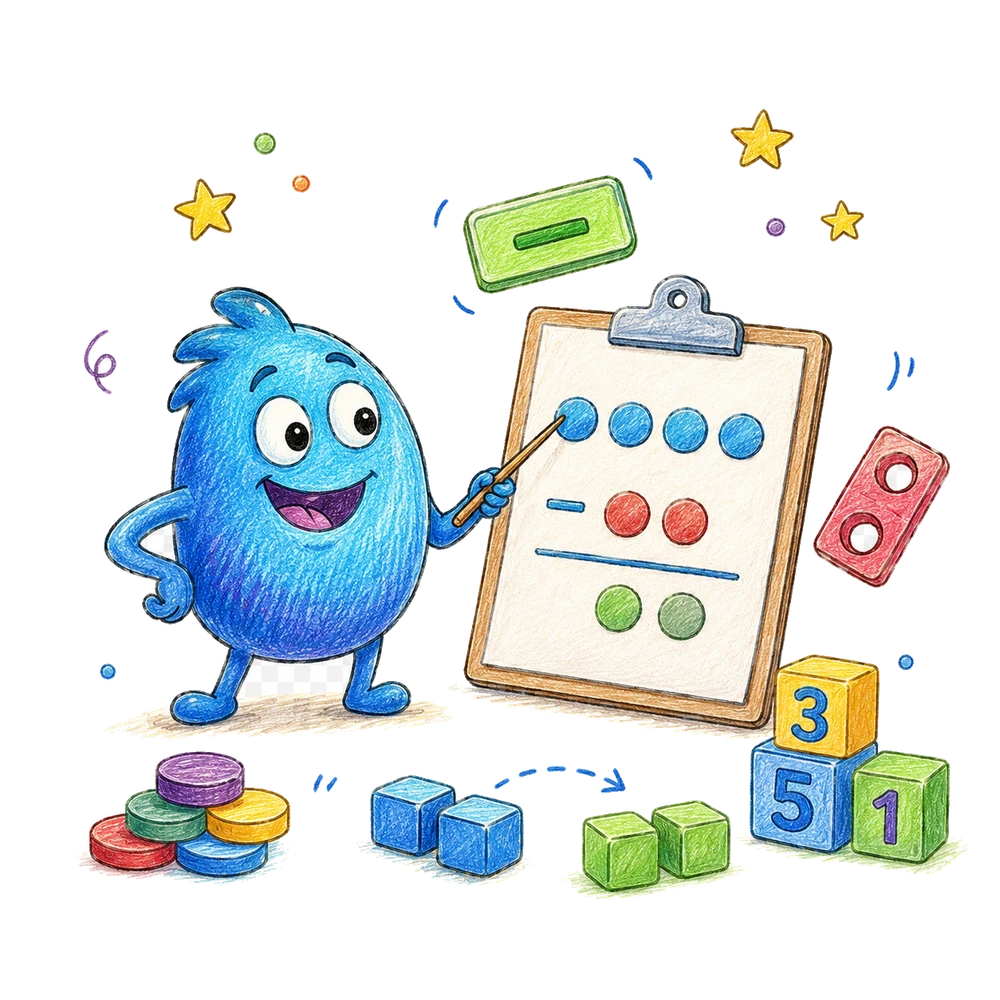
A subtraction story is easier to discuss when the objects remain visible. Start with six paper circles, move two to a second area, and count the four that remain.
Tell a take-away story with objects
A subtraction story can show what happens when part of a group is moved away. Put six large paper circles on a table, move two to a separate space, and ask how many remain in the original group. The child can see the starting group, the removed part, and the part left behind.
The focus is connecting the story to a visible change: six at the start, two moved, four remaining. A child can count, point, move the circles, or direct an adult. Memorizing subtraction facts is not required. The objects that were moved still exist; they are simply no longer in the group being counted.
Prepare the materials
Draw or cut six large paper circles. An adult can prepare the pieces, and children need not use scissors. Use large, safe materials appropriate for everyone present. A sheet of paper can mark the starting area and another sheet can hold the circles that are moved away.
Place the two areas side by side with enough space to distinguish them. The child should be able to see or indicate each circle. If loose pieces are inconvenient, draw six circles on a sheet and cover two with removable paper while keeping the remaining circles visible.
Count the starting group
Put all six circles in the starting area. Point to each one once while counting aloud: “One, two, three, four, five, six.” The child can point, move a finger above the pieces, or ask the adult to do so. The last number tells how many circles are in the group.
If the child counts one circle twice, rearrange the pieces in a line or move each counted circle to a nearby row. Count the whole starting group before moving any away. A different arrangement can make each object easier to track without changing the quantity.
Move two circles away
Tell a simple story: “Six paper circles are on the mat. Two move to the other sheet.” Move one circle and then another to the second area, counting “one, two” as they move. Ask the child whether they want to move the pieces or direct the adult.
The moved circles remain visible. They are no longer on the starting mat, but they have not vanished. This distinction helps when the child later checks that the two parts still make the original six.
Count what remains
Point to the circles still on the starting mat. Ask, “How many are left here?” Count them together if the child wants support: one, two, three, four. The answer refers to the original area, not all the circles on both sheets.
If the child counts all six, acknowledge what they counted: “There are six altogether on the two sheets. I am asking how many remain on this sheet.” Indicate the starting area and invite another count without hiding the removed pieces.
A sample conversation
Adult: “We started with six circles. Two moved to this sheet. How many are left on the mat?” Child points to the four circles and counts them. Adult: “Four are still on the mat. Can you show where the two went?” The child points to the other sheet.
Child: “There are still six if you put them together.” Adult: “Yes. Four here and two there make the six we started with.” This is a useful check, not a contradiction of the answer four: the question determines which group is being counted.
Write the matching equation
If the child is ready to connect the story to symbols, write “6 − 2 = 4” beside the materials. Point to 6 for the starting group, 2 for the circles moved away, and 4 for the circles remaining on the mat. Read it as “six minus two equals four.”
The child may trace or point to the numbers without writing them. Keep the objects in place so the symbols have a visible reference. If the equation is distracting, leave it out and stay with the story and the pieces.
Check by putting the parts together
Ask whether the child wants to return the two removed circles to the starting group. Count or inspect the group again: there are six circles altogether. Explain that four remaining plus two returned make the original six.
This check connects subtraction with combining parts, but it need not be presented as a separate written addition problem. If the child moves a different number back, describe the action and count the new group. The purpose is to see where the pieces went.
Try a familiar story
Six toy cars are parked on a paper mat; two drive to a separate garage drawn on another sheet. Ask how many cars remain parked on the mat. Use safe toy cars if they are already available, or let paper circles stand for cars.
Children may picture a different garage or route. Keep the counting question clear: the four cars left on the mat are the answer, even though the other two are still in the garage. The story does not require real vehicles or a specific household experience.
Let the child choose the story
The child might imagine six birds on a branch, two flying to a tree. Use the paper pieces to represent the birds and mark the branch and tree with separate sheets. Before counting, ask which pieces represent the birds that flew.
If the child changes the number of birds or adds another event, update the objects to match the new story. Ask what question the child wants to answer. A meaningful story is not required to follow the adult’s original script.
Distinguish the starting number from the removed number
In “six circles are on the mat; two move away,” six describes the whole starting group and two describes the part moved. Show each quantity at the moment it matters. The child can count the whole before the move and count the moved pieces during it.
If the child begins with two circles and tries to remove six, pause and reread the story. Build six first, then choose two to move. A visual reset is more helpful than repeating the equation without showing what its numbers represent.
What if the child moves three?
Suppose the child moves three circles instead of two. Count the moved group together and compare it with the story: “We moved three; the story said two.” Ask whether the child wants to return one circle or invent a story about moving three.
Both choices can lead to meaningful work, but they answer different questions. If three move from six, three remain. If one is returned so that two have moved, four remain. Keep the objects visible and follow the chosen story.
What if the answer is five?
Ask the child to show the circles being counted. They may have included one moved circle, counted a piece twice, or represented a different story. Do not assume the reason. Separate the two areas clearly and count the pieces on the starting mat one at a time.
If the child wants, move each counted circle into a short row while keeping it within the starting area. Stop when every remaining piece has been counted once. Then compare the count with the child’s earlier answer without treating the correction as a punishment.
Use a smaller starting group
Begin with three circles. Move one to the second sheet and count the two that remain. Say the whole story while pointing: “Three here, one moves, two remain.” The child can watch or direct the adult and can choose whether to repeat the action.
When that comparison is comfortable, try a different starting number. A child does not need to master a certain number of examples before playing. Reduce the number or simplify the layout whenever the objects are hard to track.
Offer a further challenge
Start with eight circles and move three. Ask the child to show the remaining five and explain the choice with the objects. Another option is to keep six as the starting group but change how many move, comparing the result with the earlier story.
Change one part of the story at a time. If you change both the starting number and the removed number, count carefully before drawing a comparison. The child can keep all objects visible instead of doing the calculation from memory.
An unknown removed part
Place six circles on the mat. Move some to the other sheet while the child watches; leave four on the mat. Ask how many moved. The child can count the two circles on the second sheet or compare the original six with the four remaining.
This is a different question from “How many remain?” The answer is the moved part, two. Keep that part visible for a first example. Hiding it introduces a memory demand and is not necessary to explore the relationship.
An unknown starting group
Show four circles on the mat and two on the other sheet. Explain that the two were moved away from the mat. Ask how many circles were on the mat before the move. The child can put both groups together and count six.
Here the unknown is the whole starting group. The story is still connected to a removal, but finding the start can be done by combining the visible parts. Make sure the child knows both groups belonged to the original collection.
Compare two groups as a separate story
Place six circles in one row and four in another. Ask how many more are in the first row. Pair one circle from each row; two circles remain unpaired in the row of six. This compares quantities rather than showing objects physically leaving a group.
The same difference can be written 6 − 4 = 2, but the meanings of the numbers differ from the earlier take-away story. Keep the rows separate and name the question. A child may need time to see why both stories can involve subtraction.
Make the layout accessible
Use large, high-contrast pieces against a plain background. Arrange them in a line or two clearly separated groups. If moving a piece is hard, the child can point, look toward it, use a communication device, or ask the adult to move it.
Leave enough time for the child to indicate which pieces should move. Confirm an unclear selection before acting. Do not require spoken counting if the child can show a quantity in another way. Use supports familiar to the child and appropriate to the setting.
Play with another person
One person tells a removal story and the other moves the pieces, then they can switch roles. For example, the child says that two circles go to the garage and the adult moves two. The child can check the moved group and decide what question to ask.
If the adult moves three by mistake, the child may point out the mismatch. Return one or change the story with agreement. Avoid comparing players’ speed or turning the number of correct answers into a score.
A common mistake: asking about the wrong group
After moving two pieces, an adult might point between both sheets and ask “How many are there?” That could mean four on the starting sheet, two on the second sheet, or six altogether. A precise question identifies the group: “How many are left on the mat?”
If the child answers a different valid question, say which group they counted and clarify your own question. The child’s response can reveal ambiguity in the instruction rather than a failure to subtract.
A common mistake: removing the evidence
Taking the two pieces out of sight can make it harder to check what happened. It also adds a memory demand to the subtraction story. Keep the moved pieces on a separate sheet for the initial activity, and show that they remain part of the original collection.
A child who wants to try remembering may later cover the removed group temporarily and reveal it to check. That is an optional new challenge. Restore the visible objects if the task becomes frustrating or the child wants support.
Notice the child’s strategy
The child might count every remaining piece, recognize four without counting, or use the relationship between six and two. They might prefer to move the pieces back and forth. Ask them to show their method if they want to share it.
A method is useful if it answers the stated question and the child can follow it. Do not require mental arithmetic before the child is ready or compare the child’s speed with someone else’s. This activity alone is not an assessment of development.
Move one, then another
Begin with six circles in the starting area. Move one to the second sheet and count the five that remain. Then move one more and count four. The child can see that two separate moves of one have removed two circles in total.
Ask where the first and second moved circles are now. Point to both on the other sheet, then to the four on the mat. If the child wants an equation, 6 − 1 − 1 = 4 describes the two moves, and 6 − 2 = 4 describes the combined removal.
Keep the two moves distinct from a new story that starts with five. The starting group in this sequence was six. A visible layout helps both players agree on what each number describes.
Try removing none
Place six circles on the mat and tell a story in which none move away. Ask how many remain on the mat. The child can look at the unchanged group and count six. The second sheet stays empty.
If using symbols, write 6 − 0 = 6 and explain that zero describes the number moved. No piece should be removed to represent zero. The child can point to the empty second sheet and the complete group on the mat.
This example can help distinguish “nothing moved” from “nothing remains.” They are different situations. If the child prefers not to discuss zero yet, keep the story with objects and return to another comparison.
Try moving the whole group
Put four circles on the mat and move all four to the other sheet. Ask how many remain on the mat. The starting area is empty, so zero remain there. The four circles can still be seen on the second sheet.
An equation for the action is 4 − 4 = 0. Point to the empty starting area when discussing zero and to the four moved circles when describing what left. This avoids suggesting that the objects themselves disappeared.
If the child counts four, ask which sheet they counted. Four moved is a correct description of the other group; zero answers the question about the starting mat.
Show a starting group without counting twice
Arrange six circles in two rows of three. Count them once, pointing across the first row and then the second. After moving two pieces, ask how the child wants to count what remains. They might count each circle or recognize a familiar arrangement.
The rows are an organizational aid, not a rule that changes the amount. If the child rearranges the remaining pieces, count again to confirm that moving them within the same area does not add or remove any.
For a child who loses track of touched pieces, move each counted circle to a separate part of the mat. Keep both parts within the remaining group so the movement does not accidentally become another subtraction.
Keep a record of one story
If the child wants a record, draw six circles on paper. Cross out two with the child’s agreement, or cover two with removable pieces so the original drawing remains visible. Ask which circles represent the ones that moved.
Write “6 − 2 = 4” only if it helps connect the drawing with the action. The child may dictate a caption such as “Two went to the garage.” Read the caption back and let the child change it.
A crossed-out drawing is a representation: the paper marks did not literally travel to another location. The two-sheet activity makes that movement visible. Use whichever representation helps the child discuss the question.
Compare two removal choices
Start with six circles and move one away. Count five remaining, then return the circle to restore the starting group. Next move two away and count four remaining. Ask what changed between the two stories.
The starting number stayed six; the number moved changed from one to two. With one more piece removed, one fewer remained in this comparison. Show the pieces rather than requiring the child to state a general rule.
Restore all six before the second story. If the first removed piece stays away and two additional pieces are moved, the second action removes three in total from the original group and answers a different question.
Use a container without hiding the pieces
A shallow open box can serve as the starting area, with a tray beside it. Place six large pieces in the box and move two to the tray. Make sure the child can see inside the box and reach or direct the movement of the pieces.
If the sides of the box hide the remaining pieces, use flat paper mats instead. The container is a story setting, not an essential material. Avoid putting small pieces in a container that a younger child might access unsupervised.
Ask “How many are still in the box?” and point to its interior. Count only those pieces for that question. The tray remains visible for checking how many moved.
Let the child make a matching question
After arranging a starting group and moving some pieces, invite the child to choose a question: “How many are left here?” or “How many did we move?” The adult answers by counting the group the child indicates.
If the adult counts both areas when the child asked about the mat, the child can correct the selection. The adult can say, “I counted all of them. You asked about the mat; let me look there.” This models how the words in the question identify the relevant group.
The child can communicate the question with a point and a number, or ask an adult to supply the words. There is no need to phrase it in a prescribed sentence.
A two-step story needs two clear actions
Start with six circles. Move two to the second sheet, leaving four. Then return one to the starting mat, leaving five there. Tell the child which action happens at each step and ask which group the final question concerns.
The second action adds a piece back, so it should not be described as another removal. The starting area has five at the end, while one circle remains on the other sheet. Check that all six pieces are still present across both areas.
This longer story is optional. If it is difficult to follow, return to a single removal and keep the groups visible. A child can direct the adult through each move rather than keeping the sequence in memory.
Continue on BrainHunters
If the child wants a separate screen activity, explore numbers on BrainHunters together. Read the instruction actually shown and help the child indicate an answer in an accessible way.
The paper-circle story is not automatically recorded on the site. A screen is optional; the child can invent another story with visible pieces or stop after one comparison.
Helpful answers
Why keep the removed pieces visible?
They show where the removed part went and make it possible to check that the two parts still form the starting group.
Does the child need to write an equation?
No. The story can be explored with objects and conversation; add 6 − 2 = 4 when the child is ready to connect symbols with the action.
What if the child counts all six pieces?
That is the total across both areas. Clarify that the question asks how many remain on the starting mat.

Turn a little idea into an adventure.
Try a short activity together, then bring the discovery back into your day.
Numbers and counting practice