English print normally runs from left to right across a line. At the end of a line, the reader returns to the beginning of the next line below. A finger or movable marker can make that path visible while an adult reads a short, meaningful text. This activity helps a child connect spoken words with their printed positions; it does not require the child to decode every word or move a finger independently. The direction described here applies to ordinary English print. Other languages and writing systems may use different directions.
The skill: follow the path of English print
The target is locating where an English line begins, following the printed words from left to right, and returning to the beginning of the next line when the text continues below. A child can point, move a marker, or direct an adult while listening to the text.
Tracking print is related to, but distinct from, recognizing individual words and decoding letters. A child may follow the adult's finger while the adult reads, or may independently point to each word. Describe the support used when interpreting the response.
The activity should use meaningful text, not a row of isolated marks. A short sentence with clear spacing lets the child see where words begin and end while hearing the same sentence read aloud.
Prepare two short lines
Write two lines in large, clear print: ‘I see a cat.’ on the first line and ‘The cat can nap.’ on the second. Leave visible spaces between words and enough room below each line for a finger or marker.
Read the two sentences aloud before beginning. A simple cat picture can support the meaning, but keep it separate from the print so the starting point of the text is clear. A pencil and paper are sufficient.
If a child needs a larger format or higher contrast, adjust the print. An adult can move a marker according to the child's indication. The task does not require the child to hold a pencil or produce speech.
Follow the first line step by step
Place the page where the child can see the whole first line. Explain that you will point under each written word as it is read.
- Find the first word, ‘I,’ at the left of the line.
- Move a finger or marker beneath ‘I,’ then ‘see,’ then ‘a,’ then ‘cat’ while the adult reads.
- Notice the spaces between the words and the period at the end of the sentence.
- Return to the left side of the next line and find ‘The.’
- Follow ‘The cat can nap’ from left to right as the adult reads it.
- Invite the child to point, direct a partner, or choose the next word position during another reading.
A conversation about returning to the next line
Adult: ‘We finished the first line at cat. Where does the next line begin?’ Child points to the right side below the period. Adult: ‘In this English text, the next line begins back at the left. Let's find its first word together.’
Point to ‘The’ and follow the second line from left to right. The child can trace the return path with a finger or indicate where an adult should place the marker.
If the child points to the picture instead of the second line, distinguish the illustration from the printed text. The picture helps explain the scene, while the words are read in the stated order.
Match one spoken word to one printed word
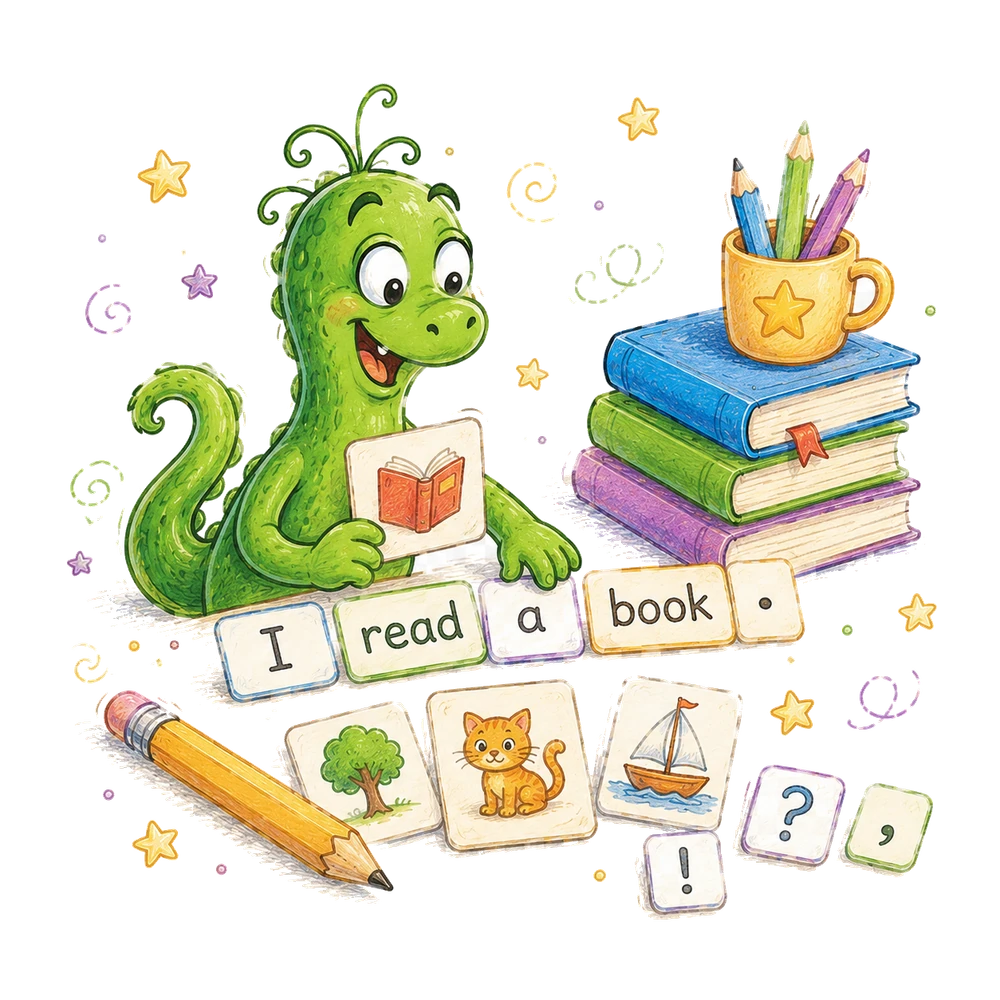
Read ‘I see a cat’ and point beneath one printed word at a time. Move the marker as the spoken word changes. The spaces help show four written words in this sentence.
If the adult's finger moves too quickly, pause and align it with the spoken word. A mismatch between speech and pointing can confuse the child even when the written direction is clear.
The child may not recognize each word independently. The adult's reading supplies the words while the child practices following their positions. A later task can check individual word recognition separately.
Find the beginning and end of a line
Point to the leftmost word on the first line and say that this is where this English line begins. Follow to the period after ‘cat.’ The period marks the end of the sentence, not an extra spoken word.
Ask the child to indicate the beginning and end with a finger, marker, or verbal direction. If the page includes a picture or title, clarify which line is being read before asking for its start.
A line break and a sentence ending are not always the same. A sentence may continue onto the next line. For the first example each sentence occupies one line; a later example can show a sentence that wraps.
Follow a sentence that wraps to the next line
Write ‘The cat can’ on one line and ‘nap on the mat.’ on the line below. Explain that the sentence continues after the line break. Read it as one sentence while returning to the left of the second line after ‘can.’
The line break changes the visual path but does not add a period after ‘can.’ The sentence ends at the period after ‘mat.’ Point to the continuation and read it naturally.
If the child pauses as though the sentence ended at the line break, show that the punctuation appears later. A brief pause to move the finger is natural; the written sentence continues across the two lines.
Distinguish a word from a letter
Point to the word ‘cat’ and then to its three letters c, a, and t. The word is one unit separated from neighboring words by spaces; it contains three written letters.
If the child moves the finger for each letter while the adult says one whole word, slow down and clarify whether the task is tracking words or examining letters. Both are valid activities, but they use different units.
For word tracking, move under ‘cat’ once as the word is spoken. A later phonics task may examine its individual letters and sounds. Keeping the questions separate helps interpret the child's action.
Use a marker without covering the text
A finger, paper strip, or small pointer can indicate the current word. Place it below or beside the print so the letters remain visible. Move it smoothly in the direction of reading.
If a marker covers the word or causes the child to lose the line, reposition it or use a wider guide. An adult can control the marker while the child points to the next position.
The marker is a support for the path, not an additional word. Remove it only if the child wants to try without it. A visible guide may remain useful for longer or denser text.
Notice punctuation without counting it as a word
In ‘I see a cat.’ the period shows the sentence ending. Point to it after reading ‘cat,’ but do not say it as an extra word unless the task is naming punctuation.
A question mark can mark the end of a direct question, and an exclamation mark can signal emphasis. Their roles can be discussed separately from the left-to-right path.
If the child points to the period as a fifth word, compare the four groups of letters separated by spaces with the mark at the end. Clarify that punctuation is part of the written sentence but is not an additional spoken word in this reading.
Keep the direction tied to the writing system
This guide describes ordinary English print, which is read from left to right across a line. Other writing systems can have different directions, including right-to-left lines. A multilingual child may be familiar with more than one convention.
If the child uses a different direction for a text in another language, do not label that convention wrong. Identify the language and writing system of the current text and show its path.
The English example provides a specific rule for this page. A family can compare it with another familiar script using accurate examples, but should not assume that one direction applies to all writing.
Make the first task easier
Use a single short line such as ‘I see a cat.’ Read it aloud and point beneath each word. The child can show the first word or indicate when the adult should move to the next.
Use large print, clear spaces, and a contrasting background. A child can respond by pointing, eye gaze, gesture, or a communication device. The adult may move the marker under the child's direction.
Add a second line only when the return sweep is useful to explore. One line can establish the left-to-right path without adding a line-change decision.
Add challenge with a page layout
Write three short English lines with clear left margins. Ask the child to identify the start of each line and direct an adult through the reading path. Use a sentence that continues across one line break if the child is ready.
Add a separate title above the text and a picture beside it. Explain which part will be read first. The child can locate the title and then the first line of the main text without treating the picture as a word.
If the page has columns or unusual layout, explain the intended order before treating a different path as an error. Published pages may require additional navigation rules beyond a simple single-column example.
Play a partner tracking game
One person reads the two-line text and the other moves a marker under the words. Both check that the marker begins at the left of each line and follows the spoken words. Swap roles if the child wants.
A partner can deliberately point to the wrong line start and ask the child to correct it. Return to the left margin and follow the next line. The adult should keep the reading pace aligned with the marker.
The child may direct an adult rather than move the marker. A reference arrow can remain visible. The purpose is to make the reading path understandable, not to race across the page.
Record and observe
Draw a short arrow beneath each line, pointing left to right, and a return arrow from the end of the first line to the beginning of the next. Label the path if useful. The arrows are guides, not part of the sentence.
A useful note might say: ‘With an adult reading, pointed to each word from left to right and returned to the next line after a prompt.’ Include the text and support used.
One tracked line does not establish independent reading of every word. One misplaced finger does not establish a persistent difficulty. If questions continue, share specific examples with a teacher or appropriate professional.
Compare the path with the spoken sentence
Write ‘I see a cat.’ Read it once without pointing, then read it again while moving under the four words. Ask the child what the marker follows. It follows the written words in the same order as the adult says them.
If the marker stops under ‘see’ while the adult says ‘cat,’ pause and return to the beginning. Move one word at a time at a pace both participants can follow. The adult should adjust the reading speed rather than assuming the child caused the mismatch.
A child who recognizes the words may read them independently; another may follow while the adult reads. The direction task can be practiced in either way. Describe the actual support when recording the result.
Find a word after a pause
Read ‘I see a cat’ and pause with the marker under ‘see.’ Ask which printed word comes next in the line. The next word is ‘a.’ The child can point to its position while the adult supplies its name if needed.
Continue to ‘cat’ and the period. If the child points back to ‘I,’ compare the direction of the path with the arrow beneath the line. The instruction asks for the next word in this English sentence, not an arbitrary word on the page.
For an easier version, highlight the current word and leave the next one unobstructed. For a harder version, pause at a line break and ask where the continuation begins. Both versions can keep the text visible.
Track a line with a repeated word
Write ‘The cat sees the cat.’ Read slowly and point to each occurrence of ‘the.’ The same written word appears twice, once at the start with a capital letter and once later in lowercase.
Ask the child to show which occurrence is being read at each moment. The first ‘The’ and the later ‘the’ are separate positions in the sentence, even though they represent the same word. The marker's movement follows the text order.
If the child jumps back to the first occurrence when hearing the second, return to the preceding word ‘sees’ and move to the next printed position. The context and location help keep the two occurrences distinct.
Follow a line break inside one sentence
Write ‘The cat can nap’ on the first line and ‘on the mat.’ on the second. Read the words across the first line, then return to ‘on’ at the left of the second. The period after ‘mat’ marks the sentence ending.
Ask whether the sentence ended after ‘nap.’ The line ended there, but the written sentence continues on the next line. Point to the words that complete it and read the whole sentence naturally.
A child can use an arrow from the first line's end to the second line's beginning. If the arrow is distracting, an adult can model the return with a finger. The support should make the path clear without covering the words.
Compare a picture and its caption
Place a cat picture above a caption reading ‘A cat can nap.’ Ask the child to point to the picture and then to the first printed word. The picture represents the subject; the caption supplies a sequence of written words.
Read the caption from left to right and point beneath each word. The picture does not determine the exact wording: the same image could have a different caption. Check the print when deciding what the page says.
If the caption is positioned below the picture, explain that the layout places it there. The direction within the English line remains left to right. A different page may position its caption elsewhere, so inspect the actual layout.
Use a two-column page only after stating its order
A simple single-column page normally continues from one line to the next below. A page with two columns may require reading the first column from top to bottom before returning to the top of the second, depending on its design.
Create a small example with clearly labeled columns and explain the intended order before asking the child to track it. Follow the words within each English line from left to right, then discuss the transition between columns.
Do not assume every page uses the same column order. Headings, captions, and design conventions can affect navigation. If the layout is ambiguous, consult the surrounding text or choose a simpler page for the first exercise.
Check a partner's pointing
A partner reads ‘I see a cat’ while pointing under ‘I,’ then ‘see,’ then skips to ‘cat.’ Ask the child whether each spoken word had a matching printed position. The short word ‘a’ was skipped by the pointer.
Return to the beginning and point beneath each of the four words once. The partner can slow the reading to match the marker. The correction concerns coordination between speech and print, not the meaning of the sentence alone.
On another turn, the partner can point in reverse order. Show the first word at the left and trace toward the period. A child may direct the repair without needing to read all words independently.
Compare tracking words with tracking letters
Write ‘cat’ by itself. Say the whole word while pointing beneath the complete written word once. Then, in a separate task, point to c, a, and t as individual letters and name them.
The two tasks have different units. Moving once per word while a sentence is read is not the same as moving once per letter. Neither action should be judged by the rule of the other task.
Return ‘cat’ to the sentence ‘I see a cat.’ Follow the four words in order. If the child wants a letter-level activity, use a separate turn and explain the changed goal.
Locate the next line with a visual guide
Place a paper strip just below the first line without covering the words. After reading to the line's end, move the strip down and back to the left beneath the next line. The movement shows both the downward transition and the return to the line start.
If the strip covers the second line during the transition, adjust its width or use a finger instead. The child should be able to see the word that begins the new line before being asked to point to it.
An adult can move the guide while the child indicates the destination. The guide may remain throughout the activity. Removing it is a separate change in support, not a necessary condition for a valid response.
Explain the path to a listener
Ask the child to show a partner where to begin reading the first English line. The partner reads while following the child's directions. At the end, the child can indicate the beginning of the next line.
If the partner starts at the right edge, the child can point to the first word at the left. Both then follow the printed words in the intended order. A page with clear margins makes the check easier.
The explanation can consist of gestures, eye gaze, a device, or words supplied with support. The listener should be able to follow the indicated path; a memorized verbal rule is not required.
Return to the original two-line text
Read ‘I see a cat.’ and ‘The cat can nap.’ again. Invite the child to choose whether to point, direct an adult, or watch the marker. Check the return to the left of the second line.
If the child wants to stop after one line, the first line still offers a clear example of English print direction. The second-line transition can be revisited later with the same visible text.
Check the page before asking for a path
Look for the first line, its left margin, and the next line before beginning. If a picture overlaps the text or a line is crowded, choose a clearer example or enlarge the print. The child should be able to see the positions they are asked to follow.
Read the words at a pace that allows the marker to stay aligned. If the adult and marker become separated, pause and locate the current word together. This preparation makes the tracking task easier to interpret and gives both participants a shared reference.
Continue with meaningful reading
For a short sentence containing a target word, see High-Frequency Word Practice in a Tiny Sentence. For discussing a picture book, try Reading a Picture Book by Predicting and Checking.
Letters and reading offers an optional digital continuation. A clearly spaced sentence and a shared reading are enough for the activity.
Helpful answers
Which way does ordinary English print run across a line?
From left to right. When the text continues on a lower line, the reader returns to that line's beginning.
Does a line break always end a sentence?
No. A sentence can continue onto the next line; punctuation and wording indicate its structure.
Is a period an extra word?
No. It is punctuation marking the sentence ending in the example.
Must the child move a finger independently?
No. They can point, direct an adult, or use another accessible way to indicate the path.
Do all writing systems use the same direction?
No. The direction described here applies to ordinary English print; other writing systems may differ.
Turn a little idea into an adventure.
Try a short activity together, then bring the discovery back into your day.
Letters and early reading practice