A stone, a wooden block, and a paper cup can lead to a useful conversation about how objects are classified. Begin by defining the rule: is the question about the object’s current form, its material, or a visible feature? Some examples have mixed or unknown histories, so a “need more information” area belongs in the activity. This guide provides safe sample materials, dialogue, and ways to compare without pretending every case has one obvious answer.
First decide what the labels mean
For this activity, “natural object” means an object presented substantially as it occurs in nature, such as a fallen stone. “Human-made object” means an object people shaped or assembled for a purpose, such as a paper cup. Both can be made from materials that ultimately come from natural resources.
This is a practical sorting rule, not a claim that every object has a simple, uncontested category. A wooden block is made by people from wood; a fallen branch has a different history. A cut branch, polished stone, or object with both natural and manufactured parts may require a discussion or a separate “not sure” area.
The central skill is stating a criterion and using evidence to explain a choice. The child may point, speak, use a communication device, or direct a helper. If the object’s history is unknown, the honest answer can be “we need more information.”
Prepare a small, safe set
An adult selects a few clean, age-appropriate objects or large photographs: for example, a stone, an unaltered fallen leaf shown in a picture, a paper cup, and a manufactured spoon. Check that all items are suitable for the child and that no sharp, dirty, or small pieces are offered when inappropriate.
Use two labeled areas and a third area labeled “need more information.” Labels can include words, symbols, and spoken descriptions. Explain the labels before sorting. A child can select by pointing while an adult moves an object or image.
Do not collect living things, handle unfamiliar plants, or enter an unsafe area to obtain examples. Pictures can support the same classification when real objects are unavailable or unsuitable.
Sort one object at a time
Keep the rule and the chosen objects visible. The goal is a checkable explanation, not guessing an answer hidden by the adult.
- Explain the two categories and the option for uncertain cases.
- Show a clearly described object or picture and name it together.
- Ask whether the object was shaped or assembled by people in the stated example.
- Let the child indicate a category or request more information.
- Discuss the known history and check whether it supports the choice.
- Repeat with another item or change the rule explicitly for a new round.
A sample conversation
Adult: “This is a stone we found on the ground. For our rule, we are asking whether people shaped or assembled the object. What do you think?” Child: “Natural.” Adult: “We know where we found it, but can we tell whether it was polished or changed by a person?”
If the stone’s history is uncertain, place it in “need more information” or use a clearly described example: “Imagine an unworked stone from a riverbank.” For that defined example, the group can place it in the natural-object area. The distinction between a real observation and an invented history matters.
Next show a paper cup. “People make and shape this cup from paper, so it fits our human-made object rule.” The child can ask where paper comes from, opening a separate conversation about materials and resources.
Object and material are different questions
A wooden block is an object cut and shaped by people. Wood is the material from which it was made. Under the stated rule, the block belongs with human-made objects even though its material comes from a tree.
A sheet of paper is also manufactured from material derived from plants, among other possible inputs. Asking “what is it made from?” is different from asking “did people make this object in its current form?” Both questions are useful, but they produce different groupings.
If a child says “wood is natural,” acknowledge the material claim and restate the object question. The child can then decide where the wooden block belongs under the agreed rule.
A fallen leaf and a paper leaf
Show a photograph of a leaf that fell from a plant and a paper shape cut to resemble a leaf. In the defined examples, the fallen leaf is a natural object and the paper leaf is a human-made object. Both may have similar outlines.
Ask, “What do we know about how each one came to be in this form?” The picture alone may not prove the full history. Tell the child the relevant information about the examples rather than expecting them to infer everything from appearance.
Do not pick a leaf from a living plant or handle an unfamiliar plant just for the comparison. Clear photographs or adult-prepared drawings are enough to discuss the two histories.
A stone and a stone bead
Compare an unworked stone with a bead described as a piece of stone shaped and drilled by a person. The material in both examples can be stone, while their histories differ. Under the activity rule, the bead is a human-made object.
If a real stone has an unknown history, do not assert that it has never been polished or shaped. Place it in the uncertain area or describe a hypothetical unworked stone. A child can still compare the visible surfaces without deciding the history.
Small beads and stones can be choking hazards. Use large images or other age-appropriate representations when real pieces are not suitable. The adult chooses and supervises the materials.
A branch and a wooden block
Use a photograph of an unaltered fallen branch and a large wooden block made in a workshop. The branch in this defined example fits the natural-object rule; the block fits the human-made rule. Both can be described as wood.
A branch cut into a carefully shaped tool is less straightforward if the group has not agreed on how much alteration matters. Ask whether the object should be considered a made tool, a modified natural object, or an example needing more information. Record the rule used.
This discussion is not a contest over a single hidden answer. It helps children notice that classification depends on the question and on knowledge of the object’s history.
A shell with an unknown history
A shell in a photograph may be a natural structure, but the picture may not reveal whether it has been cut, polished, or assembled into another object. Describe what is visible and use “need more information” if the stated rule requires a history you do not know.
A shell attached to a necklace is part of an object assembled by people. The necklace as a whole can be classified as human-made while the shell component has its own origin. Clarify whether the question concerns the whole item or one component.
Use photographs when a real shell is sharp, small, or unsuitable. Do not remove live animals or collect shells where local rules or conditions prohibit it.
What “need more information” means
A third sorting area is not a pile of wrong answers. It holds cases where the available evidence is insufficient or the agreed rule does not settle the question. A child can move an item there and explain what they would want to know.
For a smooth stone, the question might be “Was it polished by a person or shaped by water?” The appearance alone may not answer it. An adult can provide a reliable history if known, or leave the case unresolved.
If the group later changes the rule, revisit the same object. For example, sorting by visible texture can be completed without knowing who shaped the stone. State the new criterion before moving the item.
Do not infer history from appearance alone
A rough object is not necessarily natural and a smooth object is not necessarily manufactured. People can make rough pottery, and natural processes can produce smooth stones. Invite the child to describe the surface first, then ask what is actually known about the object’s history.
If the adult supplied a story about how a sample was made, label it as information provided for the activity. If the group does not know, say so. This prevents a guess from becoming a fact in the record.
A photograph can show useful details but may not show the production process. The activity becomes more reliable when the object description includes its known origin or admits that it is unknown.
A simpler two-example start
Begin with a clearly described unworked stone in a picture and a paper cup made in a factory. Explain the rule and the examples’ histories. Ask the child to point to the item people made in its present form.
Keep both images visible and offer spoken labels or symbols. The child can choose by pointing, eye gaze, speech, or a device. A helper confirms the chosen image before placing it in a labeled area.
Add the uncertain category only when it is useful for a less clear example. The first round does not need a long list of objects or a demand to remember their names.
A more demanding mixed object
Consider a pencil described as a manufactured object containing wood, graphite, paint, and possibly an eraser. As a whole, it was assembled or shaped by people. Its components have different sources and processing histories.
Ask first whether the question concerns the whole pencil or a named component. Then place the whole pencil under the human-made object rule. A separate diagram can show materials and their sources without trying to put the entire pencil into a single material category.
If a particular component’s source is unknown, mark it as unknown. The child does not need to memorize a manufacturing process to understand that an object and its materials are different subjects.
A sorting mistake can reveal a different rule
A child puts a wooden block in the natural-object area and says, “It is wood.” This is a valid observation about material. The adult can respond: “Yes, it is made of wood. Our current question is whether people shaped the block.”
Show or describe the cut and shaped block and let the child reconsider. If the block’s history is not actually known, use a clearly described example instead. Do not assume a polished or cut surface proves every detail of its origin.
In a later round, sort by material: wooden objects together, paper objects together, and so on. The block can legitimately move because the rule changed.
Sort by what can be seen
If object histories are unavailable, choose an observable rule instead: smooth-looking versus rough-looking surfaces, or round versus angular outlines. Present the rule clearly and point to the feature being compared.
A child may place a smooth cup and a smooth stone together. That grouping can be correct under a surface rule even though one object is manufactured and the stone’s history may be unknown. One collection supports several useful classifications.
Keep the categories separate in the record. A surface description should not be used to infer whether an object was made by a person.
A picture may need a caption
A photograph of a leaf-shaped ornament may look like a real leaf. Add a factual caption when known: “paper leaf cut by an adult” or “fallen leaf photographed on the ground.” Read or otherwise provide the caption before asking for a history-based classification.
If the image lacks a reliable caption, place it in the uncertain area. The child can describe what the picture shows, but the picture alone may not establish the process that produced the object.
Accessible captions can be spoken, printed in large text, or represented with agreed symbols. Make sure the child can access the relevant information before asking them to use it.
Ask the child to invent a rule
After trying the example rule, invite the child to choose another property, such as color, material, or intended use. Ask them to name or show the rule before sorting. A helper can write the rule in the child’s words.
When the child places two objects together, ask what feature they share. If a paper cup and a wooden block are grouped because people made both, that is one valid rule. If grouped because both are brown, inspect whether that description fits the actual objects.
A rule may need revision when an object does not fit either group. The child can add a category, change the rule, or set the object aside with an explanation.
Two children sort together
One child chooses an image and another asks the agreed question about its history. A third person, if present, may place it in a labeled area after the selector confirms the choice. Roles can be shared or changed.
If one child focuses on material and another on the finished object, record both observations. Then return to the rule chosen for this round. A disagreement can reveal two reasonable questions rather than a need to choose a winner.
No child has to handle a real object. A picture, spoken description, device selection, or direction to a helper can make the same reasoning visible.
A plant pot as a whole and as parts
Consider a manufactured pot containing soil and a living plant. Ask whether you are classifying the pot, the plant, the soil, or the whole arrangement. The answer changes with the object named in the question.
The pot is human-made in the defined example. The plant is a living organism; the soil is a mixture whose contents and treatment may vary. The whole arrangement was assembled by a person even though it contains natural components.
The adult should choose a safe plant and handle the pot. Children can point to a photograph and identify the part being discussed without touching soil or leaves.
Food examples need a clear description
A whole apple from a tree and applesauce prepared by a person differ in processing, but the growing and production histories can also involve human work. Tell the child what aspect the rule asks about instead of assuming “food” means one category.
If the task concerns the current object, a manufactured container of applesauce is an assembled product, while an apple is a fruit produced by a plant. A cultivated apple still grows in an orchard managed by people. These facts answer different questions.
Food is optional. Consider allergies, choking risks, and the setting’s rules before using real items. Pictures avoid making tasting or handling a requirement.
When the child asks about plastic
A plastic spoon is a manufactured object; people shape the material into the spoon. A question about where the plastic’s ingredients came from is a separate question about materials and production.
If the adult does not know the composition of a specific spoon, say so and consult its reliable product information if needed. Do not claim that the spoon appeared without natural resources or that its exact ingredients can be identified from appearance.
For the first sorting round, it is enough to know that the spoon was made and shaped by people. The child can point to its handle and bowl to describe its intended form.
Change the question and keep the evidence
Sort a wooden block and a paper cup by “people made the object.” Both fit the human-made group under the stated rule. Next sort them by material: one is wood and one is paper. Explain the new categories before moving either object.
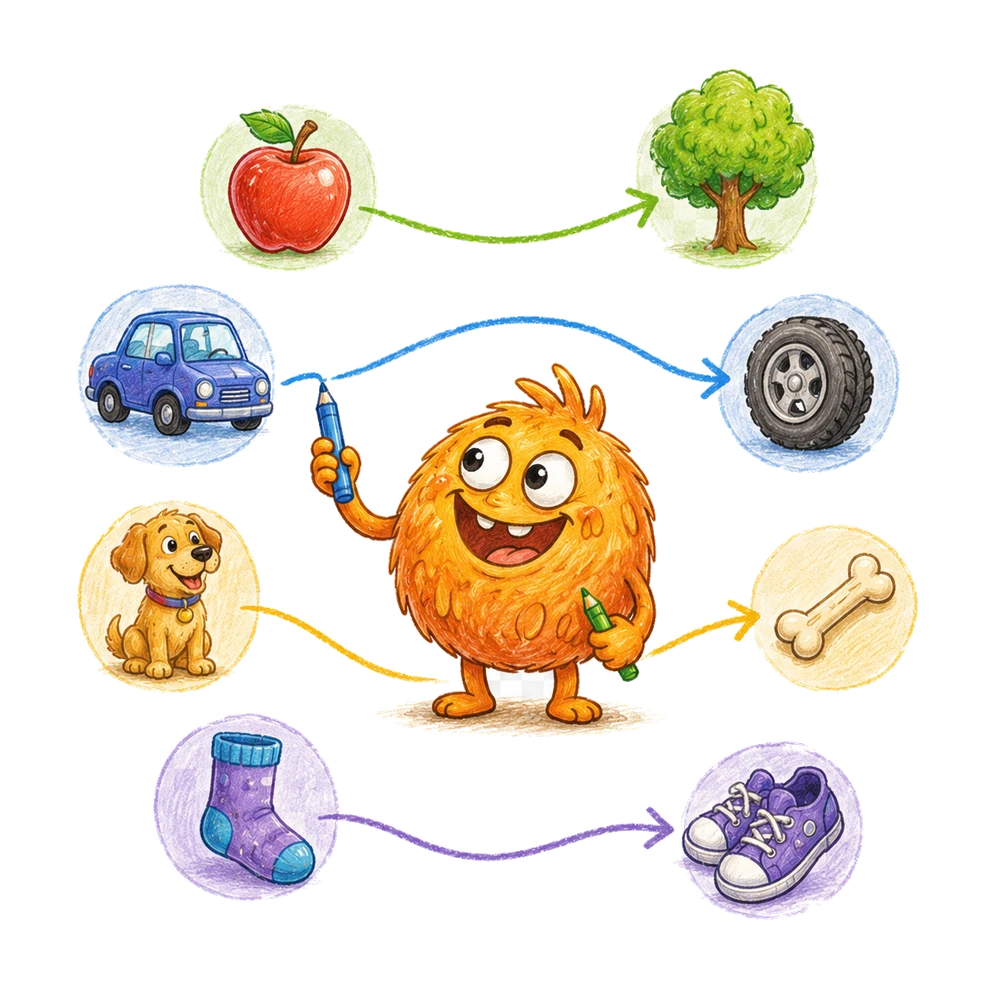
The objects did not change. The question changed from production of the finished item to material composition. A child may use a diagram with arrows to show the same item in two different classifications.
If an item contains several materials, a single material group may not be enough. Add a mixed-material category or focus on one specified component. The method should match the question.
A record with room for uncertainty
Draw or write three labeled areas and record a few examples with their descriptions: “unworked stone in the story,” “paper cup made by people,” and “smooth stone with unknown history.” The description is part of the evidence supporting each choice.
If the group revises a rule, add a dated note rather than silently replacing the earlier category. The same object may move because the definition changed, not because the child suddenly discovered a new visible feature.
A record is optional. One well-explained choice and one honest “not sure” can complete the activity without a photograph, score, or long worksheet.
Accessible participation
Use large images, clear spoken descriptions, contrasting labels, or a communication board according to the child’s needs. Explain each symbol and make the “need more information” option accessible as well as the two main categories.
A child can indicate an object and category by pointing, eye gaze, speech, or a device. A helper repeats the selection for confirmation before moving the image. If the child prefers not to touch real objects, no contact is required.
Provide the history information in an accessible format. A child cannot reasonably classify an object by a production history that has not been shown, read, described, or otherwise made available.
A photograph of a woven basket
A basket made by weaving plant fibers is a useful example of a made object with plant-derived material. Show a large photograph and explain that a person wove the fibers into the basket. Ask whether the question concerns the basket as a whole or the material used.
Under the object rule, the basket belongs in the human-made group. If the child says the fibers came from a plant, acknowledge that as information about material. The two statements can both be true.
If the particular basket’s material is unknown, do not assign it a plant source from the photograph alone. Use a reliable caption or treat the material as uncertain. The weaving can be discussed only to the extent that the example’s history is known.
Explain a choice to another person
After sorting, invite the child to choose one example and show another participant where it was placed. The explanation might be “People made the cup” or “We do not know whether this stone was polished.” The child can communicate through a device or gesture while a helper supplies agreed words.
The listener can ask which rule was used and what information supported the choice. If the group discovers that an important fact was missing, move the image to the uncertain area and note the reason. A revised placement is part of the investigation.
Continue with an observation activity
For a related activity focused on visible features, leaf shape comparisons on a walk compares outlines without requiring collection or plant identification. It asks a different question from the history-based sort here.
Observing a seed before it grows offers another way to separate what can be seen from what is predicted or unknown. A photograph can replace a real seed when handling is unsuitable.
Return materials to safe storage after the activity. The child can choose one example to explain again or leave an uncertain item unresolved until reliable information is available.
Helpful answers
Is a wooden block natural or human-made?
Under the stated object rule, a block shaped by people is human-made; wood is its material and comes from a tree.
What if we do not know an object’s history?
Place it in a “need more information” area or choose a different, clearly described example.
Can a child sort by color instead?
Yes. State the color rule and check the visible samples; the resulting groups answer a different question.
Do we need to collect objects outdoors?
No. Clear photographs or adult-prepared drawings can support the same discussion.
Can a mixed object have natural materials?
Yes. A human-made object can include materials from natural sources; discuss the whole object and its components separately.
Turn a little idea into an adventure.
Try a short activity together, then bring the discovery back into your day.
Shapes and object practice